
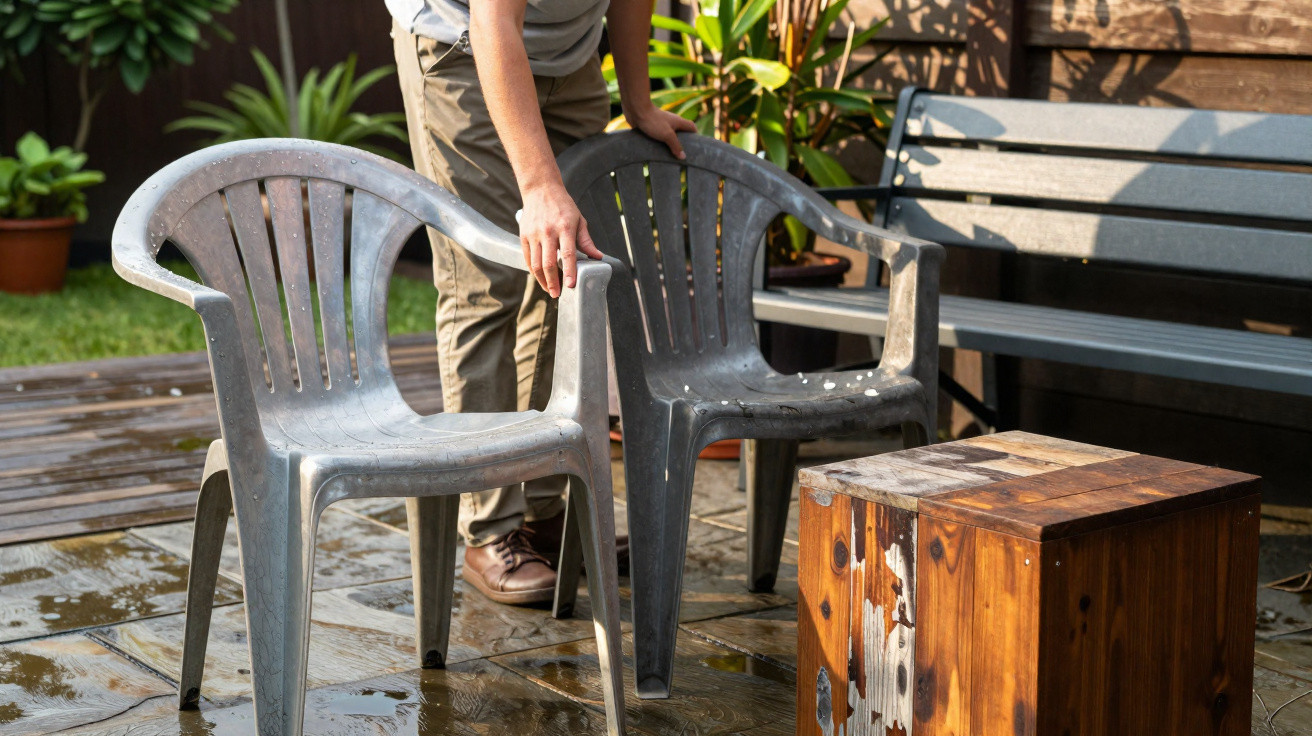
Frost, rain and sunshine can quickly weaken certain garden equipment. Before buying, it is worth checking how well it will genuinely withstand the seasons.
When warmer weather returns, many homeowners notice the same problems: a chair that has become brittle, a wobbly bench, a stained table or warped decking boards. The amount paid only a few months earlier is no guarantee against disappointment. In a garden, longevity above all depends on a material’s ability to cope with moisture, temperature fluctuations and ultraviolet rays.
Frost causes more damage than you might expect
Dry cold alone is not usually the greatest threat. The main issue is the repeated sequence of rain, frost and thawing. Water seeps into tiny cracks, joints and poorly protected areas. When it freezes, it expands, and the resulting pressure gradually worsens existing flaws.
Furniture can appear undamaged in November yet deteriorate rapidly before spring arrives. Varnish starts to peel, fittings rust and legs become unsteady. On a terrace, moisture trapped beneath a rug or plant pots can also speed up the development of mould and black marks.
A small crack that stays damp through winter can become a genuine breaking point as soon as the first frosts arrive.
Untreated wood looks appealing at first but needs considerable care
Unprotected pine or fir furniture is attractive for its natural appearance and often affordable price. Its weakness is well established: these woods absorb water readily. Without deep treatment, they swell, warp and may split.
Moisture also creates favourable conditions for fungi that break down the timber. Joints and fixings become less secure. A bench placed directly on soil or in an area that remains wet will suffer even more, as rainwater cannot drain properly from beneath its feet.
Warning signs to look out for
- Black or greenish stains that return after cleaning;
- Boards lifting or screws working their way out of place;
- A rough, grey and crumbly surface to the touch;
- Cracks around knots in the wood;
- Furniture that feels unstable when someone sits on it.
A suitable wood stain or oil can slow this deterioration, but it must be applied regularly. The wood needs cleaning and drying, damaged areas must be sanded, and the protective finish then reapplied. For a large garden furniture set, this quickly becomes a demanding task.
Cheap plastic chairs do not always cope with cold weather
Standard plastic does not rot in the way wood does, but that does not mean it will remain undamaged for years. Exposure to sunlight causes some plastics to lose their flexibility. They fade to a whitish colour, become dull and eventually break around the armrests or backrest.
Cold weather makes this brittleness worse. A chair left in direct sunshine all summer may fail after even a minor impact in winter. Thin resins, commonly used for entry-level models, struggle to support an adult’s weight once they have already been weakened.
Woven resin furniture also needs close inspection. A steel frame that is not adequately protected can rust beneath the synthetic fibres. As rust expands, it distorts the frame and can make repair impossible.
Aluminium: a durable option for exposed areas
For furniture that remains outdoors for much of the year, aluminium is often a reassuring choice. It is lightweight, does not rust like ordinary steel and requires little maintenance. Powder-coated models have a baked-on paint finish that creates a durable barrier against damp and sunlight.
Basic care is normally enough: lukewarm water, mild soap and a non-abrasive sponge. Highly acidic products and metal scouring pads should be avoided, as they can dull the finish.
A well-designed aluminium frame can stay outdoors over winter, provided water does not collect inside its tubes or beneath its cushions.
Cushions require separate attention. Even with a strong frame, foam that stays damp will eventually develop an unpleasant smell and may become mouldy. Storing them in a ventilated storage box, dry shed or indoors remains preferable between November and March.
Composite provides an appealing compromise
Boards and equipment made from plant fibres combined with synthetic resins appeal to homeowners seeking a wood-like finish without the same maintenance demands. This material absorbs very little water, does not feed fungi and does not need annual staining.
It is particularly suitable for terraces, fixed benches and pool surrounds. The initial cost can be high, but it should be weighed against how often a fragile product needs replacing. Not all composite products are equal: versions that are too thin or insufficiently dense can become very hot in sunshine and expand.
Before selecting a composite board or piece of furniture
- Check the product’s thickness and the quality of its internal structure.
- Ask whether the colour has ultraviolet protection.
- Allow for expansion gaps when installing a terrace.
- Avoid places where water can remain trapped for several days.
- Clean greasy stains promptly to prevent them becoming embedded.
Deep-treated wood retains its charm
Wood enthusiasts can choose pieces treated in an autoclave. This process involves placing timber in a chamber, removing the air and then forcing a protective product into it under pressure. Protection is therefore not confined to the surface.
For a bench, pergola, edging or structure positioned close to the ground, wood designed for damp conditions offers better durability. It may turn grey over time, but this weathered patina does not necessarily indicate damage: it often simply reflects the natural effect of sun and rain on the surface.
The key issue to monitor is direct contact with waterlogged ground. Pads, supports or a well-drained slab will reduce moisture beneath the feet. This measure significantly extends the life of joints and fixings.
A considered purchase reduces garden waste
Replacing a table, armchairs or decking boards every two or three years is expensive and adds to the volume of waste requiring disposal. A durable product is not necessarily the one with the highest price tag. Above all, it must suit the site’s real conditions: a very sunny balcony, damp lawn, uncovered terrace or garden exposed to frost.
For exposed spaces, aluminium and thick resins offer a practical solution. To retain the look of wood, composite or deep-treated wood can prevent many disappointments. Installation matters just as much as the chosen material: a slight slope for drainage, a breathable cover and feet kept off the ground often make all the difference over successive seasons.



Comments
No comments yet. Be the first to comment!
Leave a Comment