
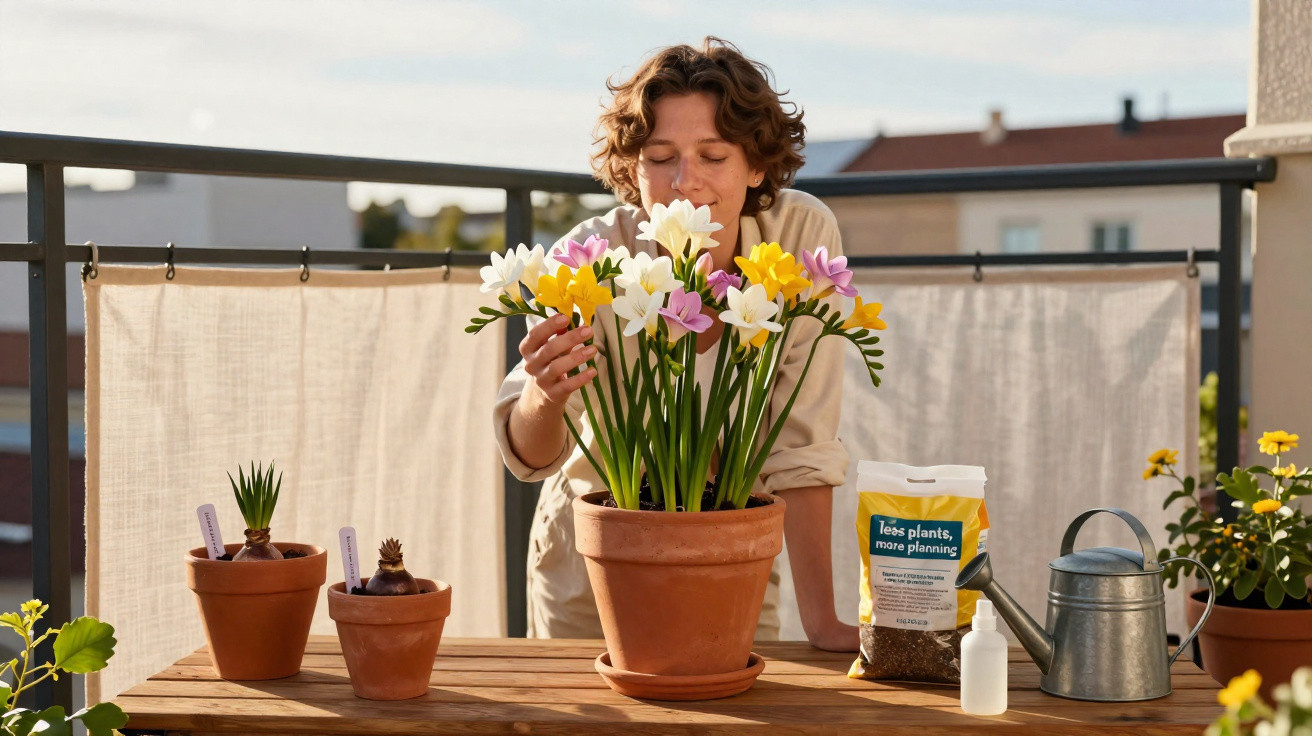
Does that sound like wishful thinking? It does not have to remain that way.
Many city dwellers cram their balconies with pots in the hope of creating a fragrant summer haven. Yet it often ends in stress: watering, repotting, pest alerts – while the scent fails to live up to expectations. The good news is that creating an intensely scented summer setting does not require five different plant species; in many cases, one carefully chosen flower planted in several pots is enough.
The secret to a fragrant balcony: fewer plants, better planning
When space is limited, it is tempting to fill every corner: a little lavender, some jasmine, and another pot of scented pelargoniums. This can soon look cluttered and becomes difficult to maintain. A more sensible approach is to choose one main fragrant plant, with no more than one or two subtle companions.
This is where an often-overlooked option comes in: a bulb plant whose fragrance is familiar to many people from perfumery, but which few deliberately grow in containers.
With just a few pots of this flower, an entire balcony or small terrace can become a fragrant summer lounge.
The hidden fragrance queen: freesias as balcony stars
The freesia (Freesia) originally comes from southern Africa and is one of the classic fragrance notes used in many perfumes. Its scent suggests a blend of honey and citrus: fresh, warm and clear, without the heavy, overpowering quality associated with some strongly scented plants.
In pots, freesias produce long, gently curved stems with trumpet-shaped flowers that all face attractively in one direction. Their colours range from pure white through yellow and pink to rich red or violet. You can grow single-colour pots or opt for colourful mixes.
- Powerful fragrance even in a small space
- Plenty of colour despite limited room
- Perfect for pots on balconies and terraces
Gardening guides rightly rank freesias among the most intensely scented container plants. On a small urban balcony, two or three well-positioned containers are often enough to perfume the entire area while they are in bloom.
How to plant freesias in pots for maximum fragrance
If you want minimal effort and maximum scent, do not cut corners on pot size or compost. The plants will reward you with sturdy stems and abundant flowers.
Choosing the right pot
A deep container measuring at least 20 to 30 centimetres in diameter is ideal. Freesias develop a fairly strong root system, which quickly becomes restricted in shallow bowls.
- A drainage hole in the base is essential.
- Use a saucer only if excess water is emptied away.
- With smaller pots, choose several containers rather than overcrowding one completely.
The best compost mix
Freesias do not tolerate waterlogged roots. A free-draining growing medium helps prevent rot and encourages flower production. A reliable mixture consists of:
| Component | Proportion | Purpose |
|---|---|---|
| Good-quality potting compost | approx. 50% | Nutrients and water retention |
| Sand | approx. 25% | Improves drainage |
| Light organic material (e.g. compost, coconut coir) | approx. 25% | Loosens the mix and adds extra nutrients |
A pot roughly 15 centimetres in diameter will hold five to seven corms, depending on the variety. Plant them around three to five centimetres deep. Importantly, the pointed end should face upwards, with approximately five to six centimetres between corms. This will later create a dense, flower-filled “bouquet” in the pot.
Location, care and flowering: what freesias need on a balcony or terrace
The best position for plenty of scent
Freesias thrive in light. A spot in full sun or light partial shade, receiving at least six hours of sunshine daily, will encourage plentiful flowering. A corner with some protection from the wind is ideal, such as in front of a warm house wall or beside a balustrade.
For extra convenience, place the pots close to the balcony door or where you sit with your morning coffee. That way, you can enjoy the scent every time you open the door or step outside.
Watering and feeding correctly
After planting, the corms need consistent moisture without sitting in water. Allow the top layer of compost to dry slightly before watering again. Permanently soggy compost quickly causes rot.
As buds form and flowers open, freesias respond well to regular feeding. Adding a potassium-rich liquid fertiliser to the watering can every two weeks supports strong flower stems and an intense fragrance.
Those who water regularly but moderately and feed every 14 days are often rewarded with a true tunnel of flowers in just a few square metres.
Supporting and cutting
Long, elegant stems can become unsteady in wind or heavy rain. A slim cane or small circular plant support is enough to keep them upright. This gives a neat appearance and prevents snapped flower stems.
Once freesias are flowering, you can cut individual stems for a vase, perhaps for the balcony table. This does not diminish the overall display, brings freshness indoors and often even encourages further blooms.
Overwintering freesias: bringing the fragrance back every year
In very mild areas, freesias may remain in the ground. In places where frost occurs, however, the situation is different: their corms tolerate only light frosts of around three to four degrees below zero. Winter is therefore a risk in many areas.
For the safest approach, treat corms in pots like a small treasure:
- Do not cut them back immediately after flowering; allow the foliage to yellow naturally.
- Reduce watering gradually until the compost is almost dry.
- Lift the corms from the pot after the first light frosts.
- Store them somewhere dry and cool, ideally between four and ten degrees, such as a cellar.
The following spring, plant the corms again in fresh compost. Over time, this creates a personal “fragrance vintage” that feels a little more familiar each year.
How many pots are actually enough for a small balcony?
For a typical urban balcony of three to five square metres, surprisingly little is needed to achieve a clearly noticeable scent. As a broad guide, the following is often sufficient:
- one larger container (30 cm) beside the door
- one medium-sized pot (20 cm) close to the seating area
- optionally, one small pot by the railing
Even this combination can produce an aroma that makes many other scented container plants seem faint by comparison. If you wish, add one quietly scented companion plant, such as a single lavender variety. The important thing is not to fall back into filling the space with too many pots – the freesia should take centre stage.
Common mistakes and how to avoid them
To prevent your fragrant summer from going wrong, it helps to watch for the most common care mistakes:
- Compost that is too wet: causes corms to rot and plants to fail.
- A position that is too shady: produces lots of foliage, few flowers and hardly any scent.
- Weak fertiliser or none at all: results in spindly stems and few buds.
- A draughty location: long stems snap before they can properly get going.
Keeping these points in mind greatly reduces the care required and lets you focus on what matters: sitting back, taking a deep breath and enjoying it.
Why freesias are ideal for balcony beginners
Many people new to growing plants feel daunted by bulb and corm plants. In practice, freesias are quite forgiving, provided they are not left standing in water and receive enough light. This makes them an excellent choice for beginners: visible results, strong fragrance and a clear routine throughout the year.
When planting freesias for the first time, start with a mixture of different colours. You will quickly discover which shades and forms best suit your own balcony style. In the second year, you can then buy more of the varieties that brought you the most pleasure.
The result is a fragrant balcony created not by dozens of pots, but by a few thoughtfully planned containers. In the end, that feels not only more relaxed but often considerably more refined too – like a small private perfumery in the open air.



Comments
No comments yet. Be the first to comment!
Leave a Comment