
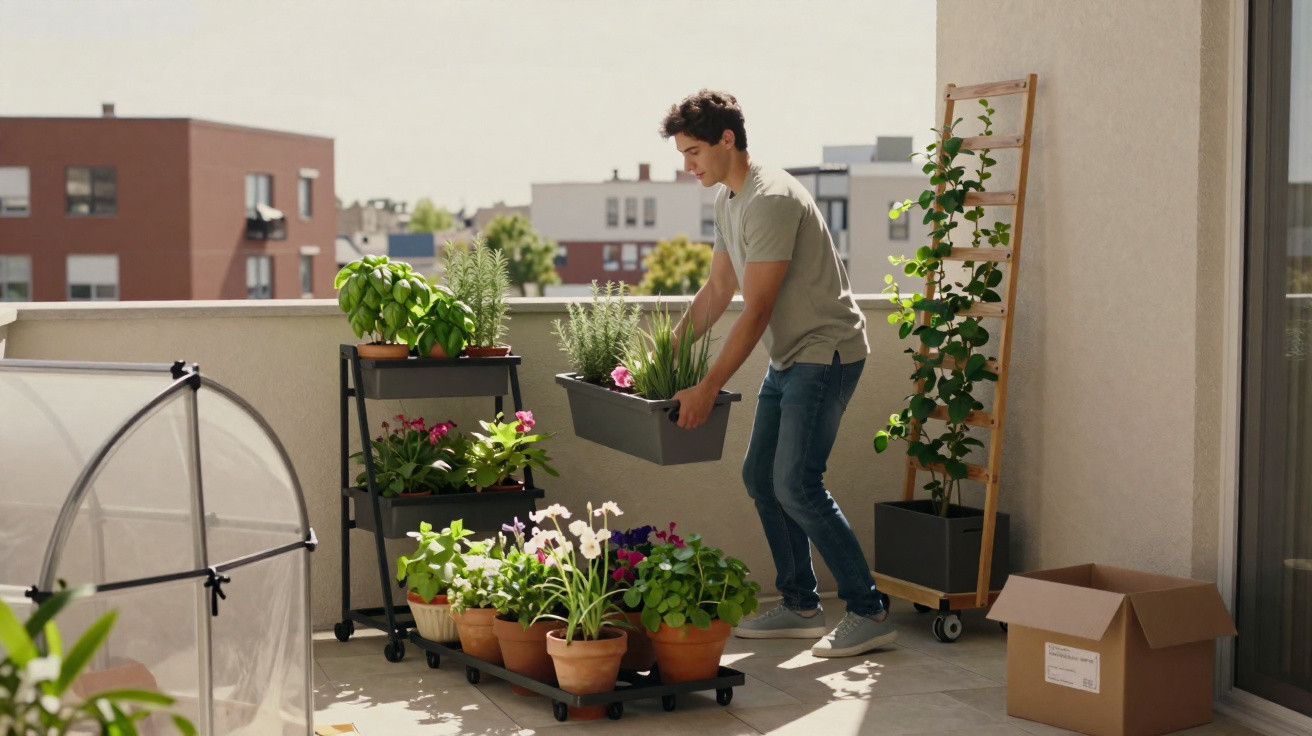
A move does not have to mean leaving your garden behind if you design it to be mobile from the outset.
Anyone renting a home will know the feeling: no sooner have perennials, herbs and tomatoes settled into the courtyard or on the balcony than another move is on the horizon. Many people reluctantly leave their plants behind because the tenancy agreement prohibits digging into the ground or fixing anything to the walls. A thoughtfully planned “portable garden” can prevent this frustration surprisingly easily.
What makes a portable garden suitable for renters
A portable garden is made up almost entirely of pots, planters, tubs, raised beds and free-standing frames. Nothing is planted permanently in the ground and nothing is fixed in place. Every component can be positioned, moved around and taken away again. This means the rented garden can be returned almost to its original condition when you leave, while your collection of plants simply moves with you.
Before getting started, it is worth carrying out a quick check:
- Review the tenancy agreement: what is permitted on the balcony, terrace or lawn?
- Check the balcony’s load-bearing capacity, particularly for large tubs and raised beds.
- Take photographic records of the outdoor area before making any changes.
Free-standing trellises, plant ladders, small polythene greenhouses and lightweight containers, ideally fitted with castors, make a good foundation. Much of this can be made from existing crates, old shelving or pallets. This keeps costs manageable while ensuring the garden remains adaptable.
The basic idea: everything you plant sits in movable containers – your garden becomes a piece of furniture that does not get left behind when you move.
Five planting ideas that can easily move home with you
1. A mobile row of tubs as a flexible border
One of the simplest options is a “nomadic border” created from closely arranged pots. It can run alongside a fence, sit on a gravel strip or mark the edge of a terrace.
A practical arrangement:
- Place taller plants at the back, such as grasses, lavender or a small olive tree.
- Position perennials in the middle, including sage, hardy geraniums or compact roses.
- Set trailing plants at the front, such as verbena, ivy or dichondra, so they spill softly over the edges.
Put heavier tubs on wheeled plant stands. This lets you shift them according to sun or wind conditions – or simply roll them to the removal van when you move out.
2. Green privacy screening with a free-standing trellis
If you are not allowed to put nails into the wall, a self-supporting trellis is an effective solution. It stands in front of the wall and is weighted down by two long planters.
The planters can hold annual climbers such as nasturtiums, sweet peas or morning glories. Over the course of a season, they will cover the trellis and create a living privacy screen. Strawberries or low-growing herbs can be planted in the lower sections.
When it is time to move, dismantle the trellis while leaving the planters planted up, then take them to the car as complete units. In this way, the green wall remains largely intact.
3. A mobile herb ladder for small balconies
Where space is limited, make use of height: a sturdy garden ladder or purpose-built plant shelf is ideal for herbs in small pots.
Arranging them according to their light requirements helps keep the plants healthy:
- At the top: sun-loving herbs such as basil, thyme and rosemary.
- In the middle: chives and parsley, which tolerate a little partial shade.
- At the bottom: mint, preferably in its own pot as it spreads readily, and fast-growing cut-and-come-again salads.
Simply place the ladder against the wall on a protective mat. When moving, it can be carried like a piece of furniture: briefly remove the pots, relocate the ladder, replace the pots and you are done.
4. A small polythene greenhouse to take with you
A compact, flexible mini greenhouse made from polythene creates a mild environment for delicate plants. It can stand on a terrace or lawn, be secured to the ground with pegs and provide several shelves.
It can accommodate:
- young tomato and pepper plants being raised,
- summer-flower seedlings,
- heat-loving herbs.
Many models can be dismantled in just a few minutes. Put the shelves and plants into boxes, then roll up the cover. At the new home, simply assemble everything again – ideally, the plants will notice only a brief change of location.
5. A lightweight raised bed for a garden on the go
A rectangular raised bed that is not overly heavy, positioned on a lawn or pallet, combines vegetable growing with mobility. Wooden or plastic models that can be carried by two people if necessary are ideal.
For added organisation, divide the bed into four sections in your mind:
- Culinary herbs such as oregano, marjoram and parsley.
- Leaf salads and radishes for quick harvests.
- Low-growing tomato varieties paired with basil.
- Bee-friendly flowers such as calendula or borage.
The growing medium should be loose rather than excessively heavy, for example a mixture of compost and potting soil. When moving, remove some of the soil if needed to reduce the weight, or use a sack trolley to relocate the entire bed.
How to care for your portable garden without stress
A portable garden requires much the same care as a fixed garden: regular watering, occasional fertiliser and a watchful eye for pests. The difference lies in considering weight and ease of transport.
A few useful tips:
- Use lightweight growing-media mixes rather than dense, heavy soil.
- Fill larger tubs with soil only to around four fifths, using mulch or expanded clay for the remainder.
- Choose light plastic saucers instead of solid stone ones.
Plan your garden as though every plant might need to be moved within two minutes in an emergency – that makes the eventual move straightforward.
Before major rearranging, it is worth watering moderately the day before. This keeps the root balls stable without water running from the pots. Lightly tie together delicate shoots with soft string so they do not snap during transport.
Preparing a portable garden when moving day approaches
Around four to six weeks before your planned move, stop undertaking major repotting jobs. Plants need time to settle after being placed in a new container. Shortly before moving day, there is a high risk that they will struggle with the combined stress of repotting and transport.
A clear sorting system is helpful:
- Arrange small pots by size in crates or folding boxes.
- Group medium-sized tubs so that one person can still carry them.
- Plan to use a sack trolley or transport trolley for larger items such as raised beds and trellises.
Free-standing trellises, polythene greenhouses and plant ladders can usually be broken down into individual parts with only a few actions, or carried whole. At the new home, set these up first and then put the plants back in place, allowing them to quickly return to a familiar structure.
Appearance, material choices and useful extras
A portable garden does not need to look temporary. Focusing on one or two main materials, such as terracotta and pale wood, creates a calm overall appearance. A recurring colour scheme, for instance plenty of green with white and purple flowers, also looks harmonious.
Helpful details can greatly improve convenience:
- Castors beneath the heaviest tubs.
- Screw-on handles on wooden crates to make them easier to carry.
- Lightweight saucers in place of heavy ceramic dishes.
- Labels written with a waterproof pen, so you can quickly identify what goes where in the new garden.
Why a portable garden is worthwhile for city dwellers
Frequent moves are particularly common in cities. Those who still want to garden over the long term gain considerable freedom from a mobile approach. Instead of starting again from scratch each time, the plant collection develops through several moves. Perennials, special roses and established herbs remain part of your life, even when your address changes.
This type of garden also provides flexibility in everyday life: you can move tubs according to the season, roll heat-sensitive plants into shade at short notice or shift delicate pots against a sheltered wall during storms. The mobility intended for moving home therefore improves daily life at your current address as well.
If you wish, you can take the principle further: temporary vegetable beds in crates, seasonal flowering shelves with cuttings to give away, or a wheeled shade bed for hostas and ferns. The more consistently you treat your plants as movable furniture, the less heartache the next farewell to your former rented garden will bring.

Comments
No comments yet. Be the first to comment!
Leave a Comment