
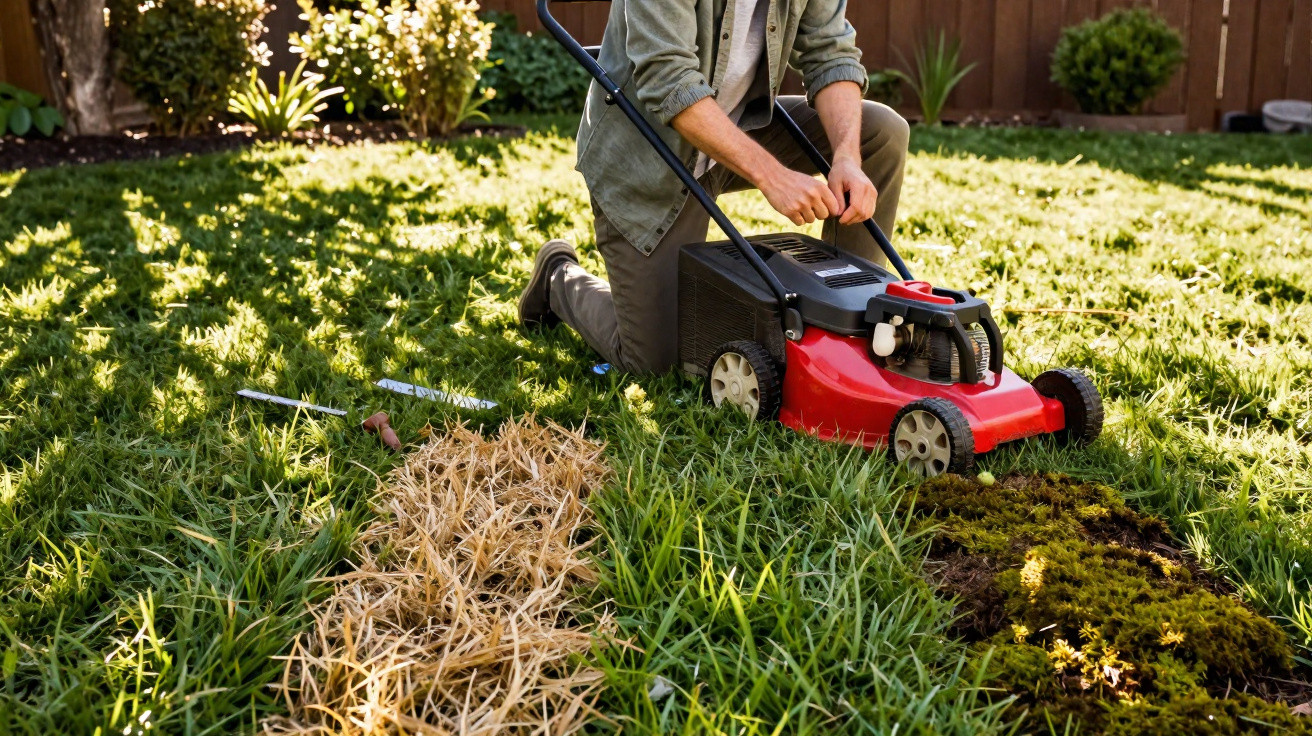
The good news is that, in most gardens, a thick, rich green lawn depends less on the most expensive fertiliser than on a few millimetres in the mower’s height setting. Set it incorrectly and the grass becomes stressed and patchy, giving moss every opportunity to spread. Set it correctly and each mow strengthens the grass while depriving moss of the conditions it needs.
Why cutting height determines whether moss or a dream lawn wins
Grass blades act like tiny solar power stations. The more leaf area remains, the more energy the plant can generate through photosynthesis and direct into strong roots. Cutting too low removes this vital leaf area, forcing the lawn to draw on its reserves.
The result is as follows:
- Roots remain shallow, so the lawn dries out more quickly.
- The soil warms up more and loses moisture.
- Blades turn yellow and may partly die back.
- Bare patches develop, creating ideal space for moss and weeds.
However, letting grass grow too long causes problems as well. When it stays permanently tall, moisture becomes trapped within the sward. A felt-like layer of dead plant material can form. This layer remains wet and poorly ventilated for longer - precisely the conditions moss enjoys.
Lawn height controls the competition: well-maintained grass crowds out moss, while stressed lawn makes room for moss.
This is especially apparent in autumn. If the lawn is consistently left too long at this time of year, blades flop over, stick together and retain dampness. A medium cutting height leaves sufficient leaf growth to build energy reserves without creating a wet carpet for moss.
The ideal cutting height for different lawn types
Not every lawn has the same requirements. A hard-wearing family lawn behind the house needs different settings from a carefully maintained ornamental lawn. A garden in full sun can cope with a lower height than a damp, shaded corner.
Lawn in full sun: everyday and family lawn
For most well-used family lawns, the following applies:
- Ideal height: 4–5 cm for most of the year
- Below 3 cm, even robust grass varieties begin to struggle
At 4–5 cm, the blades create a dense cover that shades the soil. This reduces evaporation and also weakens moss because less light reaches ground level. The lawn remains resilient underfoot, recovers quickly and can cope with children playing or garden chairs.
Fine ornamental lawn: a bowling-green look with risks
Those maintaining an especially even, fine lawn made up of narrow-leaved varieties can cut lower, but need to be highly consistent with maintenance:
- Recommended height: 2–2.5 cm
- Suitable only for very dense, well-maintained ornamental lawns
Even minor maintenance mistakes can cause this type of lawn to decline: drought damage, scorching and moss may spread faster because the grass is already operating at its limit. Anyone mowing this short must mow, water and maintain the lawn more often than they would a standard household lawn.
Shade lawns and damp areas: mow higher instead
Under trees, on north-facing sides or in low-lying areas, light is limited while dampness often lasts longer. Grass needs more leaf surface there to produce enough energy:
- Ideal height: 6–8 cm in shaded and damp areas
Longer blades make up for the lack of light. At the same time, the taller growth acts as a buffer: the soil does not become quite as wet, while vigorous grass keeps moss under better control. Shaded areas cut too low quickly become green with moss because the grass is already weakened there.
The most important rule: never remove more than one third
Garden experts repeatedly point to the same basic principle: no more than one third of the current growth height should be removed in a single mow. Following this rule protects the plants and keeps the lawn dense.
Just “trim the tips”, rather than cutting drastically: if more than one third is removed, the lawn responds with stress, weak roots and bare patches - ideal entry points for moss.
In practical terms, this means:
- If the desired height is 5 cm, the grass should be no taller than 7.5 cm when you mow.
- If it has already reached 12 cm, you need two or three mowing sessions to return it to 5 cm - not one drastic cut.
Many amateur gardeners wait until the lawn looks knee-high, then cut it down all at once. Over time, this exact pattern weakens the lawn. It is better to mow more frequently while taking off less each time.
How often to mow - from March to October
Mowing frequency depends greatly on the season. Lawn growth takes off in spring, summer heat slows it down, and autumn often brings another growth spurt.
| Season | Recommended cutting height | Typical mowing frequency |
|---|---|---|
| Spring | 4–5 cm (sun), 6–8 cm (shade) | 1–2 times a week, depending on growth |
| Summer | 6–8 cm in hot weather for greater protection | every 7–10 days; less often in dry conditions |
| Autumn | 5–7 cm; do not leave dense “clumps” standing | every 7–10 days, while the lawn is still growing |
Immediately after winter, begin with the mower on its highest setting. This removes old tips without putting the weakened lawn under stress. Only lower the cutting height gradually to the desired level as growth increases.
How to stop moss from taking over the lawn
Correct cutting height alone is often not enough. In many gardens, moss is already established, particularly where soils are compacted or acidic. In that case, several factors need attention.
Typical causes of moss in lawns
- cutting too low or too infrequently
- compacted soil with little air around the roots
- persistent waterlogging or permanent shade
- very acidic soil (low pH)
- nutrient deficiency, especially in heavily used areas
Correcting the cutting height is already a major step. It becomes even more effective if you also:
- mow in dry weather to avoid crushing the grass,
- aerate or scarify the lawn in spring,
- test the pH and apply lime where necessary,
- fertilise appropriately rather than scattering products indiscriminately.
Practical examples for common garden situations
People who work and can only mow at weekends often face the question: “Can I deal with everything in one cut?” The answer is to mow a little less, but more often. If the lawn seems to shoot up during the week, do not select the lowest mower setting at the weekend. Instead, make one pass at a higher setting and go slightly lower next time - always keeping the one-third rule in mind.
Gardens with lots of trees benefit from treating different sections separately. The sunny centre can be kept at 4–5 cm, while the area beneath the canopy should consistently remain at 6–8 cm. In gardens like these, one setting for the entire lawn simply does not work.
Why millimetres affect water use and maintenance effort
Blade height influences more than moss; it also determines how much upkeep the lawn requires. Closely cut grass needs watering more often and is more sensitive to heat. A slightly higher cut reduces evaporation and saves watering sessions in summer. This also lowers the likelihood of dry, weakened patches that moss can later colonise.
At the same time, a dense lawn maintained at the right height is better able to absorb wear from foot traffic. Children, pets and garden parties - all of these are handled far better by a lawn with strong, deep roots than by one given a shallow-rooted “short back and sides”. The correct cutting height therefore means not only less moss, but greater overall resilience for your lawn.




Comments
No comments yet. Be the first to comment!
Leave a Comment