
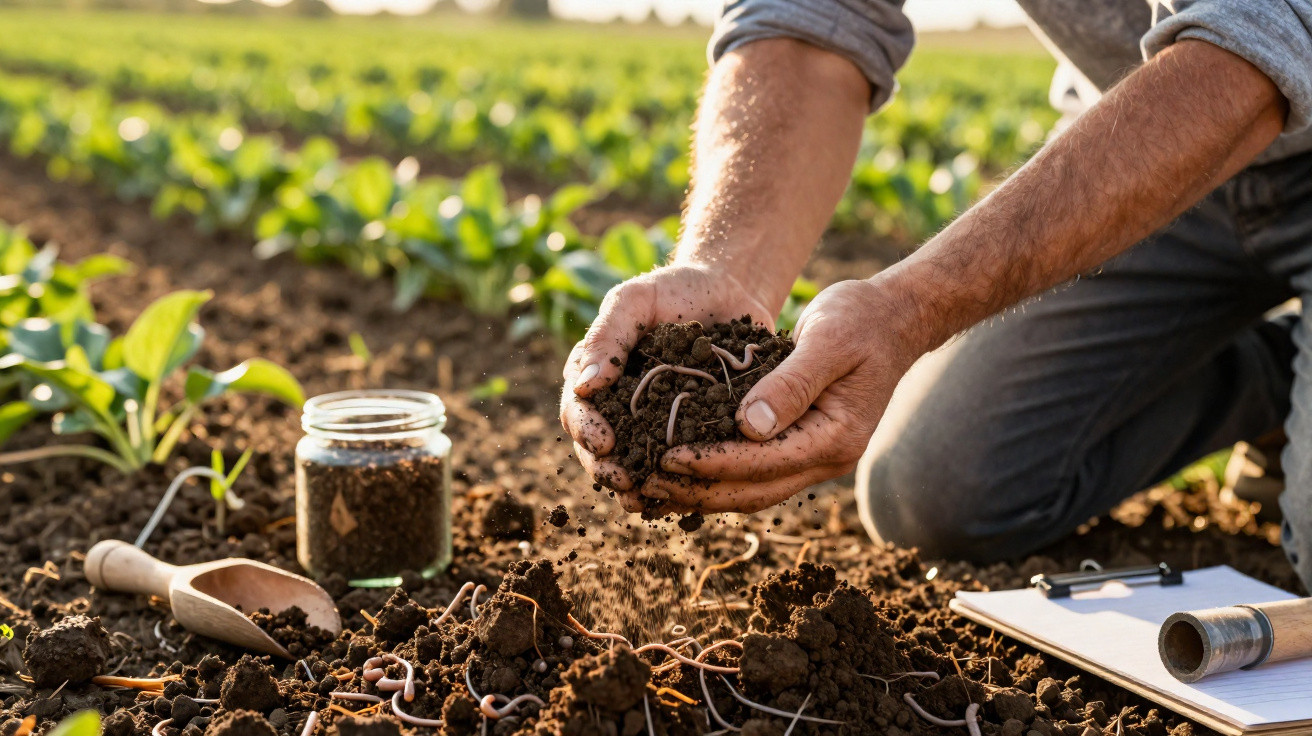
The soil broke apart like grey powder, slipping through his fingers. It had no scent, no bounce and no life. A decade earlier, this field had produced respectable wheat; now it could scarcely pay for itself. The machinery was larger, the inputs costlier and yields had levelled off. Something had gone wrong, yet the invoices gave no clue.
Five years later, the same farmer stood in the same field and picked up soil that resembled chocolate cake. It was dark, friable and cool. Earthworms wriggled away from the daylight. When he pressed the clump in his hand, it held its shape before slowly crumbling apart. Rain that had fallen overnight had soaked down into the ground instead of sitting in pools on the surface.
“I don’t know exactly when it happened,” he said, “but one day I realised the soil was working for me again.”
Beneath his boots, a quiet, unseen process had started to gather pace.
When soil starts breathing again
Cross a degraded field on a hot afternoon and the difference is physical. The surface is hard, heat rises towards your legs and every footstep sends up a faint cloud of dust. It is scarcely soil any longer; it feels more like worn-out building material.
Then walk over a field where soil organic matter has been brought back to life. The ground has a slight springiness, and your boot sinks in a little. After a light shower, pause and listen: there is no sound of water splashing and running away. There is silence, because the rain is being drawn into the soil.
That silent intake is carbon moving below ground.
Farmers rebuilding soil organic matter often recount the same unusual turning point. The early years can be slow, uncomfortable and full of uncertainty. They reduce ploughing, establish cover crops and retain crop residues at the surface. Neighbours may look sceptical. Initially, little appears to change in any dramatic way.
Then, usually in the third or fourth year, a series of signs can emerge together. Yields become more reliable in dry seasons. Puddles drain away sooner. Fields are workable earlier after rain. Earthworms become so numerous that they can clog machinery. Some weed species change. On paper, soil organic matter may have risen by only one or two percentage points.
In reality, though, the entire soil system can seem as though its volume has been turned up.
Scientists studying these changes in detail have begun to identify a pattern. After a basic level of soil organic matter has been rebuilt, carbon sequestration may not simply continue at a linear rate. It can accelerate. Microbial communities become more diverse, roots reach further down and the network of soil pores grows increasingly intricate.
Carbon draws in more carbon. Organic matter creates more organic matter.
What starts as a careful trial of cover crops can quietly become a self-reinforcing cycle. The soil begins to act less like a passive storage container and more like a lively, humming ecosystem.
How farmers trigger the carbon “snowball effect”
In the field, the practices that set this acceleration in motion can look almost deceptively straightforward. There is no miracle product, hidden additive or silver bullet delivered from a sprayer. The crucial change lies in how frequently and intensely the soil is disturbed, as well as how long it remains covered in green growth.
The first major lever is reducing, or ending, deep cultivation. Whenever metal tears through the soil, stored carbon is exposed to oxygen and microbes consume it like kindling. Limiting cultivation to shallow or targeted passes, or moving towards strip-till or no-till systems, allows soil aggregates to rebuild and remain undisturbed. Carbon is protected within these small clumps.
The second lever is cover - in the most literal sense. Cover crops, crop residues and living roots for as many months as possible each year all matter. A bare field represents a lost chance to capture carbon.
Farmers who appear to reach this tipping point most quickly often use a similar approach, whether or not they know one another. Rather than sowing monocultures, they combine plant species: legumes to fix nitrogen, grasses to develop root systems and brassicas to break through compacted layers.
They begin on a modest scale: one field or even one corner of a field. Errors happen. Seed rates may be wrong, timing can feel off, and a cover crop may set seed and turn into a problem. Let us be honest: nobody really does this every day, perfectly, according to the technical manuals.
Still, every attempt leaves a little more residue at the surface, a few more roots in the soil profile and slightly more food for soil organisms. Farmers also adapt grazing or residue management so plants are grazed, allowed to rest and then regrow, rather than being stripped down to the ground.
Behind these practical decisions sits a subtle change in thinking. The aim is no longer simply to “feed the crop”, but to “feed the soil that feeds the crop”. That shift in outlook is where the snowball begins to roll.
“Once we hit about 3–4% organic matter, it was like someone lit a fuse,” a Brazilian agronomist told me. “Water infiltration doubled, and the carbon numbers started climbing faster each year. We weren’t working harder. The soil biology was.”
To achieve this sort of turning point, certain patterns repeatedly appear in successful examples:
- They allow at least 5–7 years before evaluating the system.
- They monitor a small set of straightforward indicators: organic matter, infiltration rate and bulk density.
- They treat yield reductions in small trial plots as “tuition fees”.
- They speak to fellow farmers rather than relying only on sales representatives.
- They retain one untreated field as a living control.
The quiet power of living soil
What precisely takes place when soil organic matter passes this unseen threshold and carbon sequestration begins accelerating under its own momentum? Part of the explanation is structure - not only how the soil feels in your hand, but also the microscopic arrangement of pores and aggregates.
As roots grow and then die, they leave channels behind. Fungi extend fine threads that bind soil particles together. Root exudates work like glues. Together, these processes form a three-dimensional maze through which air and water move more gently. Carbon compounds can enter protected spaces that are less accessible to microbes.
More structure means more secure places for carbon to remain.
The other part of the explanation is biological. When organic matter reaches a particular level, the variety of organisms beneath the surface expands dramatically. Bacteria, fungi, protozoa, nematodes and arthropods begin to form complex food webs. Some are adapted to breaking down fresh residues, while others process older, more resistant forms of carbon.
It is chaotic, changing and alive. Yet, oddly, this intense activity is what allows some carbon to remain in place for longer. Fast cycling at the surface produces by-products that resist decomposition. These may attach to clay minerals or become enclosed within micro-aggregates.
The apparent contradiction is that active, “breathing” soil may lock away more carbon over the long term than cold, lifeless ground.
There is also a human change for those who work this land. On a summer evening, as you walk a field that no longer bakes and fractures, rain can bring out a faintly sweet, earthy smell. In winter, boots may sink an extra centimetre into ground that was once frozen solid.
During a difficult year - drought, a heatwave or input prices soaring - that additional resilience can feel like insurance that no policy can provide. In a favourable year, the gap between costs and income quietly grows. At a personal level, there is another, less measurable reward: the feeling that the land is finally responding once more.
We have all experienced a moment when a system thought to be fixed finally gives way, like an old door suddenly opening after years of sticking. Restoring soil organic matter is rather like that. For a long period, nothing seems to shift. Then, all at once, everything begins to work in your favour.
So where does this leave us?
Restoring soil organic matter is not a rapid climate fix or a marketing exercise for environmentally friendly packaging. It is a long, sometimes stubborn exchange with a living system that has no interest in project timelines or political schedules. It follows seasons, not press releases.
However, once soil organic matter begins to rise, the rules on the ground genuinely change. Fields move from being dependent on “inputs-only” to benefiting from “inputs plus biological horsepower”. Carbon sequestration changes from a modest yearly increase into a compounding process. Eventually, the farm, the catchment and the local climate can all feel the effects.
The compelling point is that this acceleration is not limited to a small number of showcase farms or technology-funded pilots. It is already occurring quietly on sheep farms in New Zealand, in maize–soya rotations across the Midwest, in Spanish vineyards and on urban-edge vegetable plots where compost deliveries arrive at daybreak.
The greatest challenge may no longer be the techniques themselves, since they are widely shared. It may be having the patience to see a slow system enter its faster phase, and the courage to accept that, for several years, soil-test figures could be the only encouragement available.
Some readers will regard this as a route to climate mitigation. Others will see more stable yields. Some may simply see an opportunity to leave their land a little less depleted than it was when they found it. Every one of those reasons can exist within the same handful of soil.
The next time rain falls on a field near you, observe where it travels: towards the ditch or down into the ground. That simple direction already reveals something about how much carbon the land is capturing - and how quickly it might begin capturing more.
| Key point | Detail | Why it matters to the reader |
|---|---|---|
| Soil organic matter as a threshold | Once a basic level has been restored, both biological activity and carbon storage accelerate | Explains why initial efforts can feel slow, and why persistence is worthwhile |
| Practices that trigger acceleration | Reduced tillage, permanent cover, diverse roots and time | Provides practical levers for influencing carbon sequestration in real fields |
| Benefits beyond carbon | Improved water infiltration, resilience and yield stability in challenging years | Demonstrates why this matters even when climate is not the primary concern |
FAQ:
- How long does it take to see soil organic matter increase? Most farmers and studies report noticeable changes after 3–5 years of consistent practice, with small gains visible earlier in infiltration and structure before lab numbers move.
- Is carbon sequestration really permanent in soils? Not fully. Carbon can be released again if soils are heavily tilled or left bare. The goal is to build stable pools and maintain practices that keep the system in “storage mode”.
- Can small farms or gardens have a real impact? Yes. On a global scale each plot is tiny, but locally they influence water, fertility and biodiversity. Multiplied by millions of sites, the effect adds up.
- Do you need special products or additives? Not necessarily. Most of the acceleration comes from management: less disturbance, more living roots, more diversity and time. Inputs can help, but they don’t replace those basics.
- How do I know if my soil is starting to sequester more carbon? Look for quicker water infiltration, more earthworms, better crumb structure, and cooler, moister soil under cover. Lab tests for organic matter over several years will confirm the trend.





Comments
No comments yet. Be the first to comment!
Leave a Comment