
Many amateur gardeners wonder why their Japanese maple begins to struggle, develops scorched leaves or looks limp after a few years, even when its position seems suitable. The answer often lies not in the canopy but at the base of the trunk: one simple, natural soil treatment can turn a problem tree into a showpiece.
Why Japanese maples react so sensitively
Japanese maples (Acer palmatum) are regarded as delicate beauties. Their root systems are shallow, with fine roots sitting close beneath the soil surface. This makes them particularly vulnerable to major changes in temperature and moisture.
“Protecting the roots automatically protects the leaf colour, growth and health of the entire tree.”
In bare soil, the following usually happens:
- Late frosts in March penetrate deeply and can damage the upper roots.
- Spring sunshine dries the soil faster than the tree can draw up water.
- During summer, the ground heats up and the roots experience heat and drought stress.
- The tree becomes weaker overall, its foliage looks dull and leaf edges scorch more easily.
This is exactly where a natural “protective carpet”, applied at the right time each year by experienced gardeners, becomes important.
The understated March tip: organic protection around the trunk
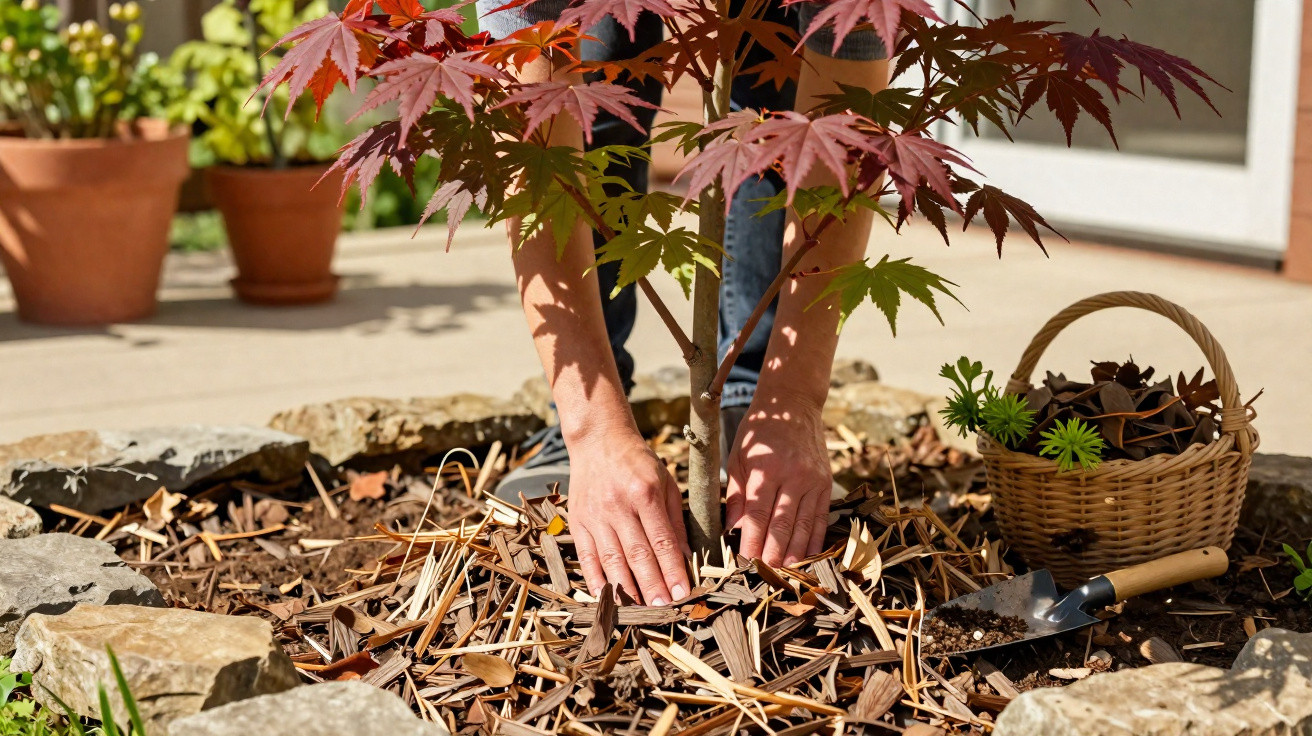
In early spring, professionals spread a layer of organic material around the tree trunk. This natural covering offers several benefits at once: it protects, nourishes and creates a more stable microclimate around the roots.
“A 5–8 centimetre layer of organic material around a Japanese maple can significantly reduce watering needs, stress and scorching.”
In March, the plant starts pushing sap upwards again while the soil is often still cold. At this stage, the natural carpet acts like a blanket:
- It limits sudden temperature changes in the soil.
- It retains moisture for longer around the roots.
- It moderates late frosts and extreme summer warming.
- It suppresses much of the weed growth.
It is important that the material does not touch the trunk itself. The root flare, where the trunk joins the thicker roots, must remain visible so that this area can dry properly and rot does not develop.
Natural materials that Japanese maples genuinely like
Japanese maples thrive in humus-rich, slightly acidic soil. Selecting the right material can help create exactly these conditions.
Proven materials for healthy Japanese maples
- Fine pine bark: slightly acidic, slow to break down and effective at retaining moisture.
- Well-rotted leaf compost: nutrient-rich and beneficial for soil structure and soil life.
- Woodchips from thin branches: known as ramial wood compost, these help build humus.
- Coarsely shredded, dry garden waste: for example, finely chopped dry hedge trimmings.
Many gardeners report that these materials create loose, cool soil resembling the maples’ natural habitat. They also reduce the need for watering: depending on the soil, water use may fall by around one third, and by even more in very sunny positions.
Recycling material from your own garden
Anyone who does not want to buy everything can make some of the materials themselves:
- Collect autumn leaves, shred them and compost them over winter.
- Put hedge trimmings through a shredder, allow them to dry, then apply them in a thin layer.
- Mix in dried grass clippings only very sparingly so that they do not rot.
These homemade options offer one clear advantage: they keep nutrients cycling within your own garden while saving money.
What can harm a Japanese maple
Not every material is suitable. Some options are more likely to cause problems for sensitive maples:
| Material | Why it is problematic |
|---|---|
| Dark stones or gravel | They become very hot and increase heat stress in summer. |
| Lava, pumice or coloured stone coverings | They retain heat, dry out the soil and provide little nutritional benefit. |
| Thick layers of fresh grass clippings | They clump together, start to rot and encourage fungi. |
| Material placed directly against the trunk | Keeps the bark constantly damp, raising the risk of rot and disease. |
Leaving a small bare ring of around ten centimetres immediately around the trunk provides a useful safety zone against excess moisture on the bark.
Step by step: Japanese maples in beds and containers
Whether the maple is planted in the garden or growing in a large pot on the patio, the process is broadly the same.
Preparing a Japanese maple in a garden bed
- Carefully remove weeds around the tree, including their roots where possible.
- Lightly loosen the surface with a hand rake, taking care not to damage any roots.
- Spread the chosen material in a layer five to eight centimetres deep.
- Cover an area extending slightly beyond the outermost branch tips.
- Keep a small ring around the trunk free of material.
Finish by watering thoroughly once. Over the following weeks, one or two substantial waterings per week are sensible. During prolonged dry spells, this may rise to three or four watering sessions, particularly in sunny locations.
Japanese maple in a pot: protecting roots on balconies and patios
In containers, root balls heat up much faster and are exposed to greater winter cold. Here, the protective carpet serves two purposes: it softens temperature extremes and slows moisture loss.
- Apply the same five to eight centimetre layer to large pots.
- Rotted leaves or fine pine bark are especially suitable in this setting.
- Use the pot rim to make the layer slightly deeper without material spilling out.
On windy balconies, the root ball will still dry out, but watering intervals become noticeably longer. This provides valuable extra time for anyone who is away from home during the day.
How natural protection affects health and appearance
Gardeners who repeat this measure every spring will gradually notice clear changes. Many trees develop:
- richer leaf colours
- fewer scorched leaf edges in high summer
- calmer, more even growth
- fewer stress reactions during heat and drought
The reason is straightforward: soil life beneath the layer becomes more active. Earthworms, fungi and micro-organisms gradually break down the material and build humus. In the long term, this humus stores water, supplies nutrients and improves soil structure.
“With every year, a more stable and lively root environment develops beneath the protective carpet – the tree repays it with greater resilience and colour.”
Useful additions and common Japanese maple care mistakes
When foliage turns pale or shows scorching, many owners tend to fertilise their Japanese maple too often. However, the cause is frequently not a nutrient shortage but stress around the roots.
A few further practical pointers:
- Fertilise only moderately, preferably with organic products and in small quantities.
- Do not use lime-rich lawn lime in the root area, as maples prefer slightly acidic soil.
- Choose a position where intense midsummer midday sun does not beat directly onto the canopy.
- In very hot weather, it is better to water briefly in the morning and evening than to water rarely but excessively all at once.
Applying natural protection in spring gives you more flexibility with all of these points. The tree can cope better with minor care mistakes because its roots are working in a more stable environment.
For anyone wanting to make their garden resemble a natural woodland setting more closely, this approach has another benefit: small ferns, woodland grasses or shade-tolerant perennials can later be planted easily beneath a loose protective layer. This creates a small, low-maintenance woodland scene around the Japanese maple that not only looks attractive but also provides extra shade and protection for the tree.
Comments
No comments yet. Be the first to comment!
Leave a Comment