
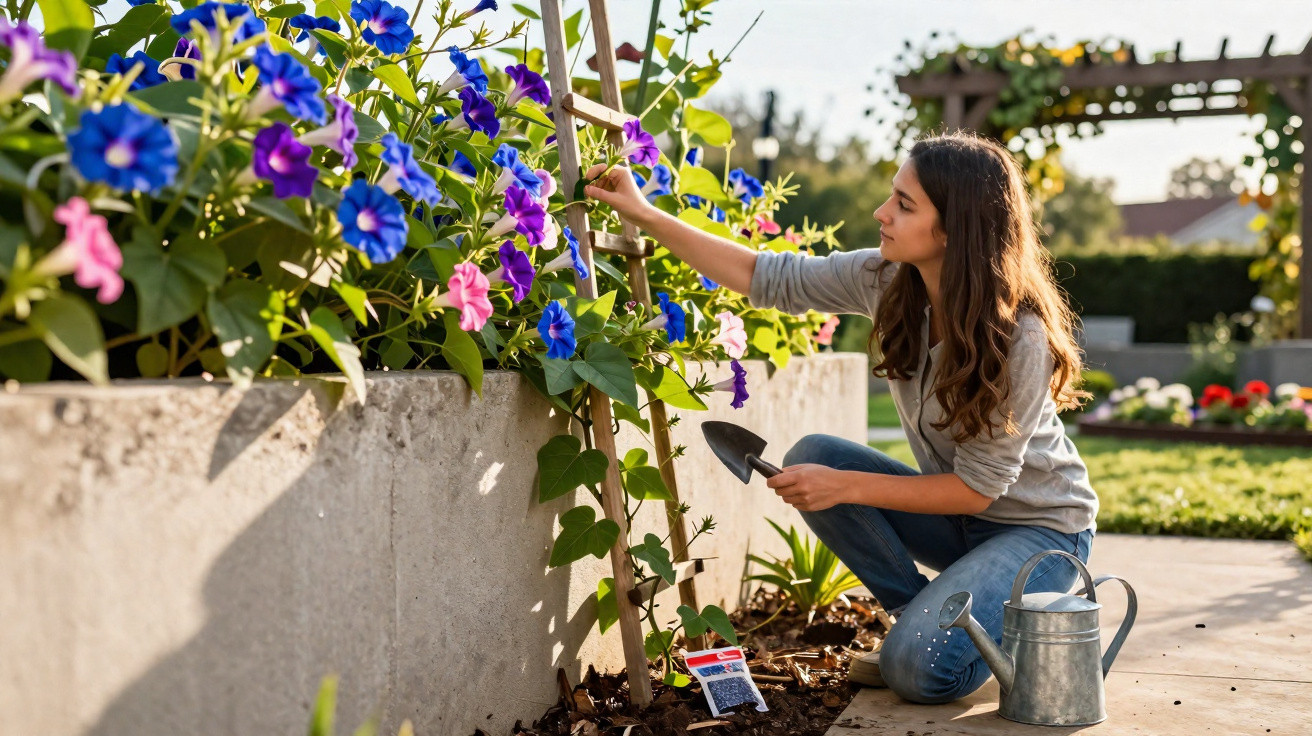
A dreary garden wall, a grey fence or a concrete block in front of the patio – yet within just a few weeks, it can all look like a green painting.
Many amateur gardeners know the issue: the garden has been carefully designed, but a bare wall or metal fence ruins the whole atmosphere. Rather than waiting years for a hedge to grow, there is a quick, affordable and surprisingly attractive answer: a climbing plant that can gain several metres in only a few weeks and completely conceal uninspiring surfaces.
The wall transformer: Ipomoea, also known as morning glory
Ipomoea, commonly called morning glory, belongs to the bindweed family. It is an annual that grows at remarkable speed, making it ideal for anyone who is impatient – or simply tired of looking at an unattractive boundary.
Its heart-shaped leaves create a thick screen, while its flowers open in the morning and close again later in the day. Available in rich shades of blue, violet, pink and white, a fully established morning glory becomes a living, constantly changing backdrop, especially at the height of summer.
With the right position and a little care, morning glory can climb up to four metres in just a few weeks, turning any troublesome wall into a colourful curtain of plants.
Why this climbing plant is so popular
Morning glory offers several advantages at once:
- Dense, decorative foliage: Its heart-shaped leaves form an enclosed green wall, making them perfect for hiding unsightly areas.
- Striking flowers: Funnel-shaped blooms in numerous shades give the garden an almost tropical feel.
- Rapid growth: In favourable conditions, the plant can climb several metres in record time.
- Easy care: It copes with relatively poor soil and does not require complicated gardening knowledge.
- Good for insects: The flowers attract bees, bumblebees and butterflies, bringing more life into the garden.
The best time: when to sow morning glory
The ideal sowing period is in spring, once temperatures become consistently milder. Those who begin in March or April have a good chance of enjoying abundant flowers early in summer. The soil should no longer be icy cold, otherwise the seeds will germinate slowly.
If you wait until late spring or even summer, the plant will often not reach its full height before the season ends. Anyone hoping to hide a concrete wall as quickly as possible should therefore sow early – and the dreary view will usually be gone by June.
How to plant it against a wall, fence or pergola
1. Position: plenty of light, with some shelter
Morning glory thrives in sunshine. A south- or south-east-facing spot with long hours of light is particularly suitable. It will also tolerate light partial shade, although flowering is usually less impressive there. Exposed, draughty corners are unsuitable, as strong winds can damage young shoots.
2. Prepare the soil
The plant does not need luxurious conditions, but it does prefer loose, free-draining soil. Compact ground should be loosened with a spade and enriched with some well-rotted compost. Good drainage is important, as waterlogging is harmful.
3. Sowing in simple steps
- Sow directly into the bed only after the last late frosts, usually from April or May.
- Soak the seeds in lukewarm water for around 12 hours beforehand to help them germinate more quickly.
- Sow them about one centimetre deep, leaving around 30 centimetres between plants.
Those wishing to make an earlier start can raise plants in pots indoors or in a greenhouse, then move the young plants to their final position later. Try to disturb the delicate roots as little as possible.
4. Watering during the establishment stage
Morning glory needs regular water during the first few weeks after sowing so that it can establish its roots quickly. Once it is well established, it can cope with occasional dry spells. Too much moisture, however, soon leads to weaker, limp-looking plants.
5. A support is essential
Ipomoea will naturally twine around anything it can grip, including wire fencing, wooden trellis, pergolas, tensioned wires and bamboo canes. The key is to provide a sturdy support when planting. Loose wire or canes that are too thin can quickly give way in the wind.
Anyone who gives their morning glory a reliable climbing frame from day one will usually be rewarded with an unbroken green wall after only a few weeks.
Summer care: keeping the green wall dense and free-flowering
Morning glory is among the easier garden plants to look after, but a few regular practices are worthwhile.
- Water regularly, but do not overdo it: It needs water during prolonged dry periods, but the soil should be allowed to dry slightly afterwards.
- Guide growth instead of letting it sprawl: Particularly long shoots can be carefully redirected or shortened so the plant appears denser.
- Provide occasional nutrients: A little compost or diluted nettle feed encourages flowers and leaf growth without making the plant overly lush and soft.
- Remove faded flowers: Taking off spent blooms regularly encourages new buds to form.
Alternatives: other fast-growing climbing plants
Anyone who does not want to grow only one species, or who would like to treat different areas differently, can combine morning glory with other quick-growing climbers.
Virginia creeper for large façades
Virginia creeper is highly suitable for large areas such as house walls, garages or long boundary walls. It clings using small adhesive pads and generally needs no additional climbing support. In autumn, its leaves turn vivid red and orange, creating a dramatic display of colour on otherwise plain surfaces.
Evergreen clematis for shadier areas
An evergreen clematis, such as the so-called Armand clematis, retains its foliage through winter and produces numerous fragrant white star-shaped flowers. It is well suited to partially shaded positions where many other flowering plants struggle, giving dark walls an elegant, almost romantic look.
Golden hops as a bright focal point
Golden hops also grows quickly, reaching up to five metres in a single season. Its yellow-green foliage creates bold highlights, particularly against dark backgrounds or on old wooden sheds. It has a wilder appearance than delicate morning glory and is ideal for naturalistic gardens.
| Climbing plant | Height grown per season | Distinctive effect |
|---|---|---|
| Morning glory (Ipomoea) | up to approx. 4 m | Intensely coloured flowers, rapid covering of walls |
| Virginia creeper | 3–5 m | Autumn colour, large façades |
| Evergreen clematis | 2–4 m | Fragrant flowers, foliage also in winter |
| Golden hops | up to approx. 5 m | Bright yellow foliage, natural, wild look |
What to consider before planting
Anyone renting a flat with a balcony or using a small terraced-house garden should consult their landlord or residents' management company before covering entire façades with greenery. Climbing plants can hide joints or grow into gutters if left entirely to their own devices. Checking their growth regularly helps to prevent these problems.
There is another consideration: morning glories produce plenty of seeds. If everything is left in place, plants may reappear in other spots the following year. Some gardeners welcome this, while those who prefer a tidier garden can collect the seeds deliberately and sow them only where the green wall is actually wanted.
Practical combinations and design ideas
Combining different climbing plants can create particularly interesting results. One option is to plant boldly coloured morning glory at the base, add occasional golden hops for bright touches, and place a clematis with pale flowers in a shadier corner. This produces lively, layered wall displays rather than one uniform green surface.
For a more understated effect, choose just one variety in a calm colour, such as blue morning glory against a white-painted garage. In small gardens, even a narrow trellis with Ipomoea is often enough to screen the patio from prying eyes and create the feeling of a sheltered space.
The fact is that a wall does not have to be demolished or replastered before it stops being an eyesore. A few handfuls of seeds, a sunny position and a simple climbing frame are enough to turn a grey problem area into a vibrant focal point in a remarkably short time.



Comments
No comments yet. Be the first to comment!
Leave a Comment