
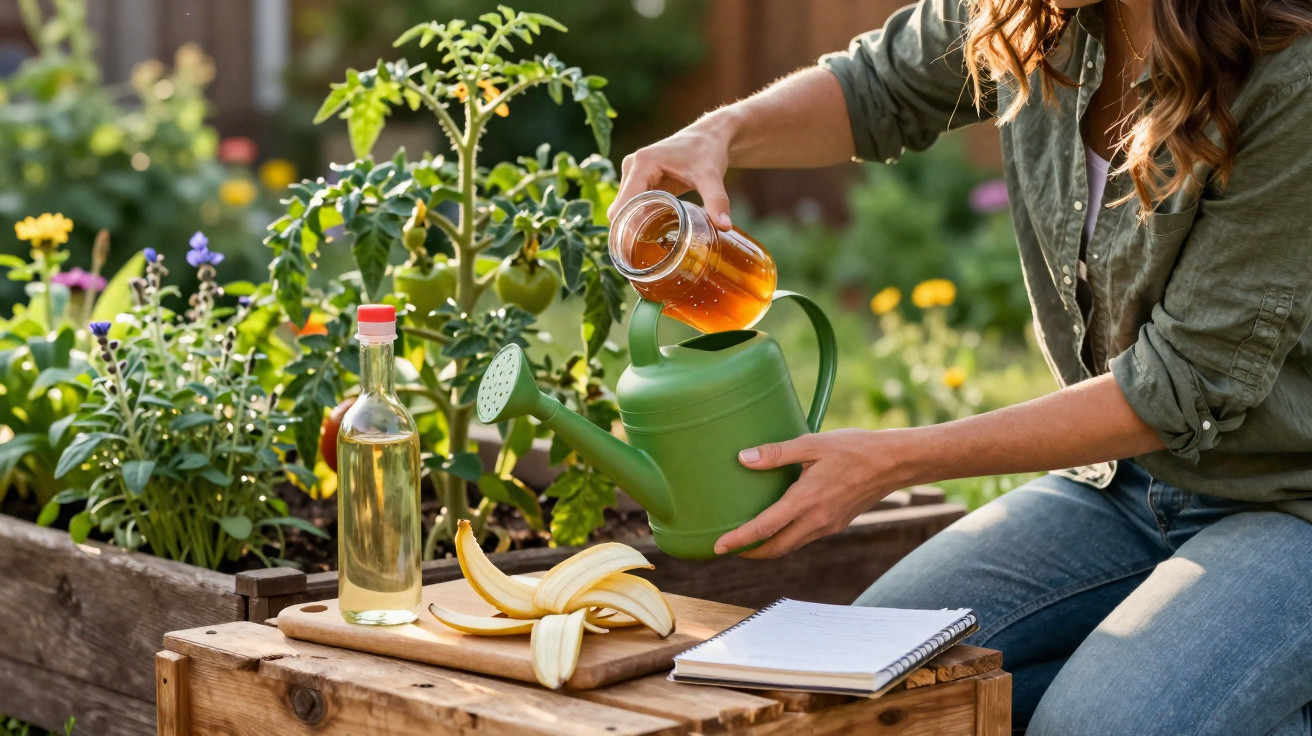
If you want to care for beds, containers and window boxes more affordably, more and more people are turning to solutions from their own kitchens. One of the more unusual methods combines banana peels and vinegar to make a liquid fertiliser that can strengthen plants, improve the soil and even deter pests – provided it is prepared and dosed correctly.
Why banana peel and vinegar can be a good idea
Banana peels have long been considered an insider tip among home gardeners. They contain plenty of potassium, as well as phosphorus and magnesium – nutrients plants need for sturdy shoots, rich green foliage and flower production. The peels usually end up in food-waste bins or on the compost heap, even though some of their nutrients can be made available much more quickly.
At first, vinegar may sound more like a cleaning product than a gardening aid. Used neat, it can actually harm plants because its acidity attacks roots and soil life. When properly diluted and combined with banana peels, however, it creates a liquid fertiliser that releases nutrients and lowers the soil pH slightly – making it suitable for species that prefer slightly acidic conditions.
The combination of banana peel and vinegar works like a quick nutrient boost, but it must only be applied to the soil in diluted form, never to the leaves.
How DIY fertiliser works in the garden
As the mixture steeps, minerals from the peel pass into the liquid. Once it has been diluted with water, it becomes a relatively gentle yet nutrient-rich feed for watering. This brings several benefits.
A nutrient boost for weakened and hungry plants
This liquid fertiliser supplies three key minerals in particular:
- Potassium: reinforces cell walls, improves resistance to drought and cold, and supports flowering and fruit formation.
- Phosphorus: encourages root development and flower buds, and is important for the plant's energy processes.
- Magnesium: a vital component of chlorophyll, helping to produce deep green leaves and improve photosynthesis.
Heavy-feeding plants in vegetable beds or containers can particularly benefit from this extra boost when their growing medium has become depleted after a few weeks.
Soil improvement and gentle acidification
Vinegar lowers the pH of the water slightly. At the correct dilution, this can be useful, as many popular garden plants prefer mildly acidic soil. These include hydrangeas, azaleas, rhododendrons and numerous fruit trees and shrubs.
The liquid fertiliser can also help make nutrients in the soil available to plants more quickly. Soil organisms can absorb and process dissolved minerals more easily, which may improve the soil's structure over the long term.
Help with pests and cleaner leaves
Another advantage is that the vinegar-and-banana mixture may keep pests such as aphids and ants away from the immediate area around a plant. The acidity and smell are unappealing to many small garden pests.
The finished fertiliser solution is not suitable for cleaning leaves, as it is too acidic. Some gardeners do use a highly diluted version, or wipe leaves with the moist inside of a peel to remove dust and restore shine. Care is needed here: sensitive species can react quickly.
Step by step: making fertiliser from banana peel and vinegar
The basic ingredients are found in almost every household. The key factors are the resting time and the dilution afterwards.
Preparation at a glance
- Collect banana peels: Place fresh, clean peels in a clean container. Use untreated bananas where possible.
- Cover with vinegar: Completely submerge the peels in white household vinegar or apple cider vinegar. No part of the peels should be exposed.
- Leave to steep for at least 48 hours: Cover the container and leave it for two days. During this time, minerals will dissolve into the liquid.
- Dilute with water: Before use, strain the liquid through a sieve and mix it with water at a 1:1 ratio.
The finished blend is especially suited to plants that need an additional supply of nutrients: heavy feeders in vegetable beds, fruit trees in containers, flowering ornamental shrubs, or potted plants on balconies and patios.
How often can the fertiliser be used?
Many home gardeners find that using the fertiliser around once a week works well. Applying it too frequently can make the soil overly acidic or provide too much of individual nutrients. This is usually not a problem in the short term, but over time it can upset the nutrient balance.
If you are unsure, begin by applying it every two weeks and watch how the plants respond. If they look more vigorous and the leaves remain healthy, there is no reason not to increase use slightly.
Important rules for safe use in the garden
This mixture is not a miracle cure, but a tool that should be used deliberately. A few straightforward rules will protect both plants and soil.
- Never pour it over leaves: The vinegar can damage leaf tissue and cause scorching.
- Always test first: Try it on a single plant or a small area before wider use.
- Use only on plants that tolerate acidity: It is ideal for hydrangeas, azaleas, blueberries, many fruit trees and roses.
- Not a replacement for good compost: If you have compost, banana peels can also be worked straight into it – with no vinegar needed.
The rule of thumb is: use a weaker dose less often rather than applying it too concentrated and too frequently.
Where banana-vinegar fertiliser works particularly well
It is most worthwhile where plants are demanding and growing in limited amounts of soil. In pots and window boxes, nutrients are used up quickly because regular watering washes much of them away.
Typical candidates for this fertiliser include:
- Tomatoes, peppers and cucumbers in containers or raised beds
- Hydrangeas in large pots on the patio
- Roses in beds with fairly sandy soil
- Small fruit trees in containers, such as lemon trees
- Flowering balcony plants such as petunias or geraniums
In large, well-supplied garden soils containing plenty of compost, the effect may sometimes be less dramatic. There, the fertiliser is more of a small additional boost during periods of growth.
What to know about risks, limits and alternatives
As appealing as using leftovers may be, this fertiliser has its limits. Highly calcareous soil will not become permanently acidic from a little diluted vinegar. Nor can it fully correct serious nutrient deficiencies; these may require targeted soil testing and an adapted fertilising strategy.
Anyone caring for very sensitive plants should be particularly cautious. Orchids, carnivorous plants and very rare species often react sensitively to any change in their watering water. In these cases, a conventional specialist fertiliser is usually the better option.
A practical rule of thumb is that anyone with a well-established compost heap can simply chop banana peels into small pieces and add them directly. The nutrients will later reach the beds through the compost. Liquid fertiliser is more useful in urban gardens and on balconies, where there is no space for composting.
Other kitchen leftovers worth using in the garden
Banana peels are not the only “waste” with gardening potential. Many home gardeners use:
- Eggshells – dried and crushed, they provide a slow-release source of lime.
- Coffee grounds – thoroughly dried, they suit slightly acidic soils and are popular for hydrangeas and rhododendrons.
- Vegetable peelings – added to compost as a basis for humus-rich soil.
Anyone using these methods should always observe the results: Is growth changing? Are leaves becoming paler or mottled? Are there suddenly more or fewer pests? This is the only way to judge whether homemade fertiliser is actually producing the desired effect in your own garden.
The mixture of banana peel and vinegar therefore fits perfectly into a growing trend: waste less and make more use of what is already available. With a little knowledge, patience and a critical eye on the plants, an everyday kitchen leftover can become an effective tool for healthier beds and balconies.
Comments
No comments yet. Be the first to comment!
Leave a Comment