
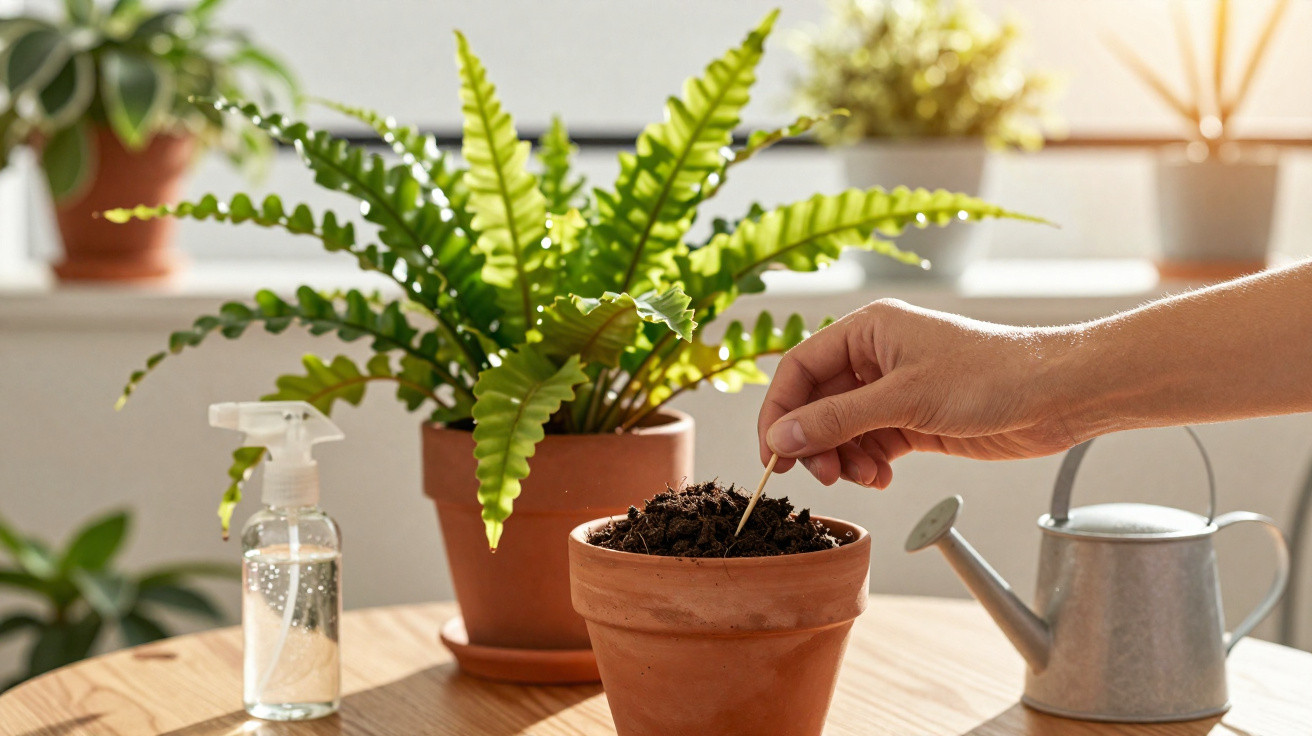
For people who grow ferns at home, uncertainty about the right time to water is a common concern. A plant’s appearance does not always immediately reveal whether it has too little or too much water, and overwatering can be just as harmful as underwatering. Simple techniques, such as using a toothpick, can therefore provide a clearer picture of compost moisture and the care routine required.
How does a toothpick help measure moisture in a fern?
A toothpick acts as a visual moisture indicator because it is made from porous wood, which readily absorbs water. Once pushed into the compost, it reaches the inner layers of soil, where the roots take up water most actively.
If there is plenty of water present, the toothpick will come out darker, slightly damp and with compost clinging to it. When the soil is drier, it will remain pale and nearly clean. This makes it easier to tell whether the root environment is balanced, preventing both drying out and prolonged waterlogging.
How do you use the toothpick trick for everyday fern watering?
Using a toothpick on a fern is quick and straightforward, and it works well for medium-sized pots. The aim is to reach the middle layer of compost, where many healthy roots are concentrated, without damaging the main clump.
- Choose a clean, dry wooden toothpick with no residue on it.
- Insert it to roughly halfway down the pot, keeping away from the centre of the clump.
- Leave it in place for around 2 to 3 minutes so that it can absorb moisture.
- Remove it and check its colour, texture and whether any compost has stuck to it.
In hot or dry conditions, the test can be carried out every other day. During milder or more humid periods, checking every three or four days is usually enough. This technique complements observation of the plant itself, helping to limit repeated watering mistakes and maintain more consistent moisture levels.
How should you interpret the toothpick result and decide when to water?
The toothpick test generally produces three possible results, each directly indicating when watering is needed. This “quick reading” prevents decisions based solely on the surface, which dries out faster and can lead to watering too soon.
- Toothpick dark, damp and with plenty of compost attached: the soil is still very wet, so watering should be postponed.
- Toothpick slightly damp, with only a little compost attached: moisture is at an intermediate level; wait another day before repeating the test.
- Toothpick pale, dry and with virtually no residue: the compost is dry at depth, so it is time to water until water runs out through the drainage holes.
Ferns need steady moisture rather than waterlogged soil. For this reason, it is common to water when the toothpick shows intermediate-to-dry conditions, adjusting the frequency according to heat, ventilation and the type of compost used in the pot.
What other practical tricks help get fern watering right?
Alongside the toothpick, a few simple methods can help you understand how the plant and compost behave over the course of the week. One is the finger test: push a finger around 3 centimetres into the soil to determine whether it feels damp, cool, or completely dry and crumbly.
Checking the pot’s weight is also helpful. It will be noticeably heavier after thorough watering and, over time, you will learn to recognise when it has become too light. The colour of the compost surface, which darkens when wet and becomes lighter as it dries, together with leaves that are wilted, yellowing or have dry tips, complete this “set of clues”, helping you fine-tune your indoor fern watering routine.



Comments
No comments yet. Be the first to comment!
Leave a Comment