
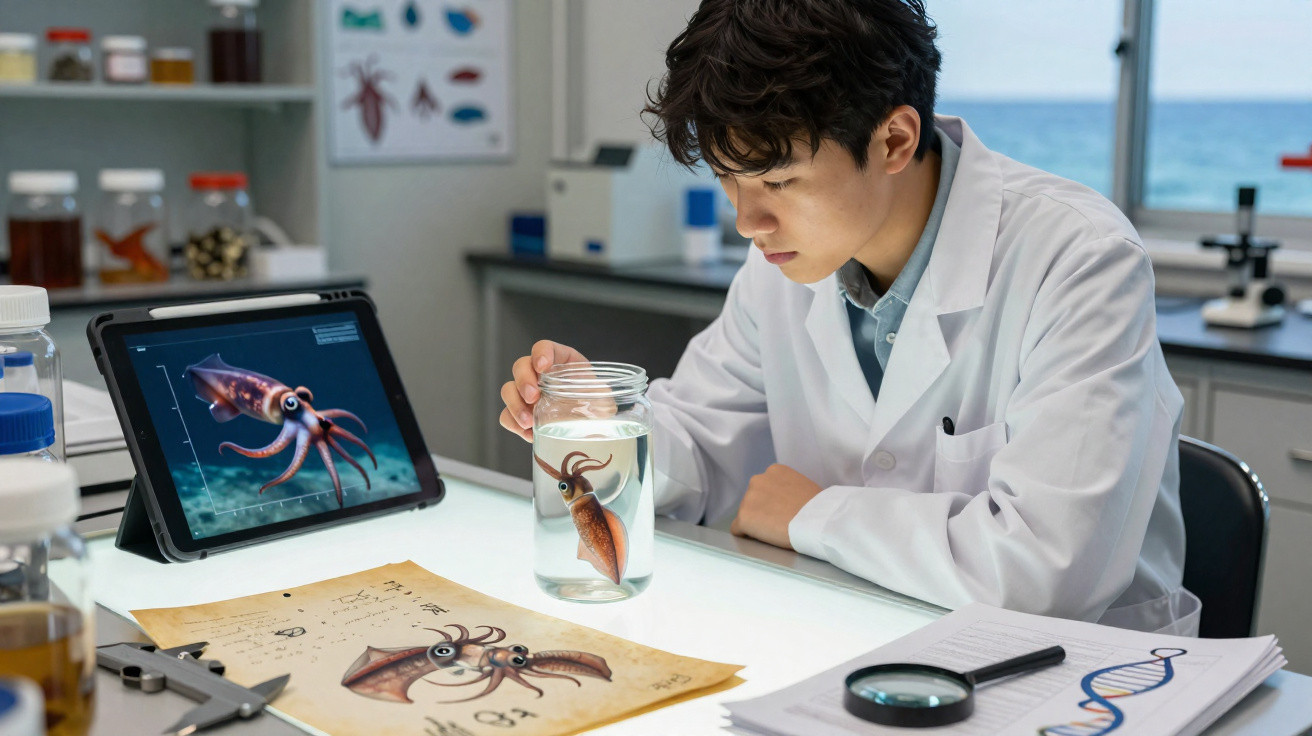
For more than a century, the vampire squid held an almost solitary position on the tree of life as the only known living representative of its ancient lineage. That appeared to change in 2024, when a second species was announced. Two years later, however, a fresh assessment delivered an unexpected finding: the “new” animal was probably the familiar *Vampyroteuthis infernalis*.
Why did scientists believe they had found another species?
The story began with a specimen collected in the South China Sea in 2016, at a depth of between 800 and 1,000 metres. In research published in the journal Zoological Systematics in 2024, Dajun Qiu and colleagues gave the animal the name Vampyroteuthis pseudoinfernalis.
The specimen appeared to show significant distinctions from Vampyroteuthis infernalis. The researchers noted a pointed mantle tip, differences in the lower beak, and a different arrangement of the photophores, organs involved in producing light. Genetic-sequence analyses also seemed to support treating it separately.
What caused the proposed new species to disappear?
A 2026 paper in the Bulletin of Marine Science revisited the proposal. The team, which included Smithsonian-affiliated cephalopod specialist Michael Vecchione, reassessed the anatomical traits and repeated phylogenetic analyses using the available data. Their findings did not support the existence of a second species.
According to the study by Heather Judkins and collaborators, none of the phylogenetic trees examined supported V. pseudoinfernalis as a separate species. The authors also identified variation within the vampire squid itself and recommended further collections in the South China Sea to investigate these differences more fully.
What makes the vampire squid so unusual?
The reclassification does not make the animal any less fascinating. Vampyroteuthis infernalis is a deep-sea cephalopod adapted to areas with extremely little oxygen. The Monterey Bay Aquarium Research Institute (MBARI) records animals measuring up to around 30 centimetres and notes that their diet consists chiefly of marine snow.
- It lives mainly in deep, oxygen-poor waters.
- It gathers marine snow made up of organic particles sinking from the surface.
- It has eight arms joined by a membrane resembling a cloak.
- Rather than ink, it can release bioluminescent fluid to confuse predators.
Its alarming name is misleading, too. Instead of hunting large prey, the animal uses long, sticky filaments to gather particles drifting down through the water column. If threatened, it can also wrap its body in the membrane between its arms and use bioluminescence as a distraction.
Watch the video shared by the YouTube channel Coruj4 Curios4, which shows the mysterious vampire squid on the ocean floor.
How did genuine differences confuse the classification?
The key point of the review is not that the original researchers simply “got it wrong”, but that defining species among rare deep-sea animals requires consistent evidence. The 2024 proposal arose from anatomical and genetic differences observed in a limited number of specimens, a situation that naturally calls for further comparisons.
After broadening the assessment, the 2026 team found that the data did not divide the animals into two reliable lineages. Traits initially regarded as evidence of a new species proved insufficient, while the genetic results likewise failed to form a distinct group for V. pseudoinfernalis.
The vampire squid is alone in its lineage again
Today, taxonomic databases such as the World Register of Marine Species classify Vampyroteuthis pseudoinfernalis as a junior synonym of *Vampyroteuthis infernalis*. This means that the name remains in the scientific record, but it does not denote a valid species separate from the already known vampire squid.
The episode illustrates why science can become even more compelling when it changes its mind. Discoveries do not end once a name has been published: they continue to be tested. And in the depths, where few specimens reach researchers’ hands, the next familiar creature may still surprise us again when fresh evidence reaches the surface.




Comments
No comments yet. Be the first to comment!
Leave a Comment