
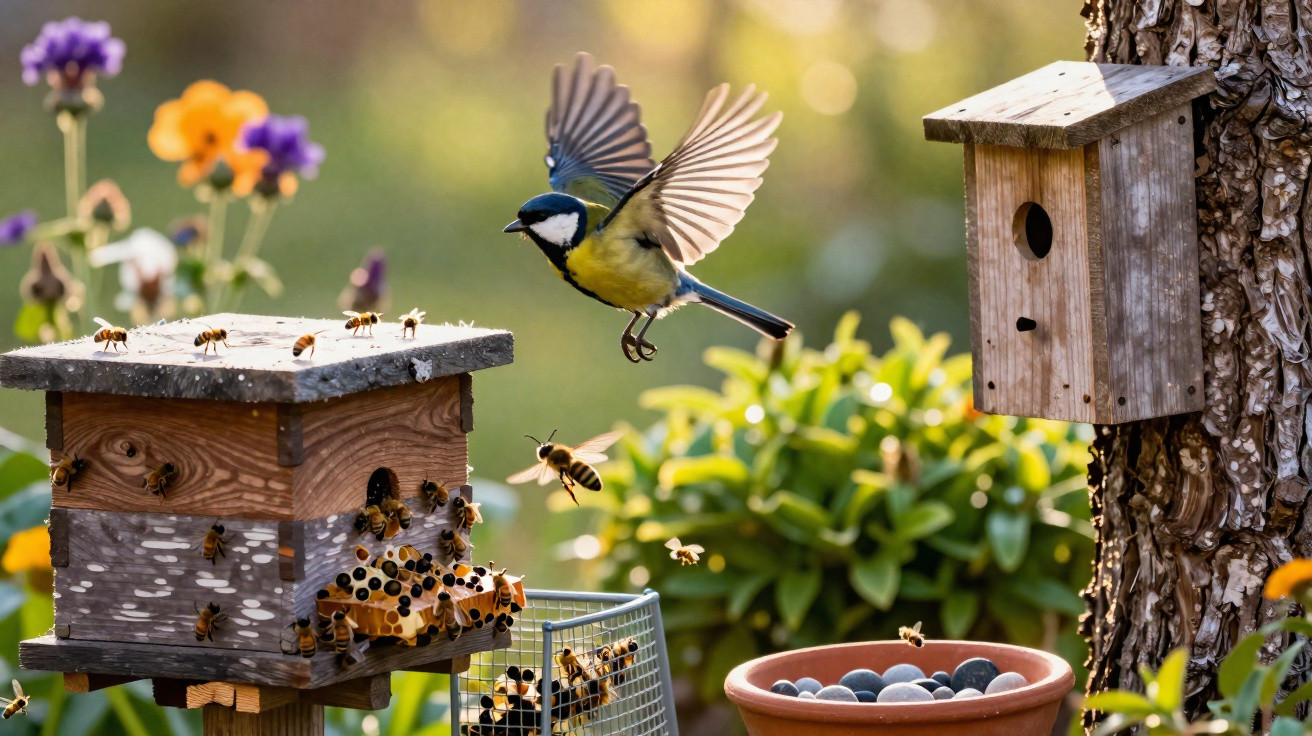
If you keep beehives in the garden or simply cherish fruit trees, you may know the worry: as soon as the first warm days arrive, invasive Asian hornets return and prey on pollinators. Many people immediately turn to traps or poison. Yet there is a natural ally that can be attracted with simple measures – and is especially industrious in March.
Why March is crucial in the fight against the Asian hornet
After winter, queens of this introduced hornet species emerge and search for suitable places to build their first nest. If they can settle undisturbed, the colony expands rapidly. Over a year, a single colony can consume several kilograms of insects, including large numbers of honey bees and other pollinators.
Anyone who waits until high summer, when the large nests are hanging high in trees, has almost already lost the battle. By then, worker numbers are so great that intervention becomes risky, and only professionals wearing protective suits can reach them. The key period is much earlier in the year, when the first small nests are being formed and there are still relatively few insects.
Experts agree that this hornet species can scarcely be eradicated in Central Europe. It reproduces very quickly and has few specialised predators. Although some rare birds do eat it, they do not do so on the scale required. This makes one animal helper, found in almost every garden, particularly interesting: the tit.
“Anyone who attracts tits into the garden early in the year weakens hornet colonies during their establishment phase and therefore protects honey bees in the long term.”
Tits: quiet allies for beekeepers and gardeners
Blue tits, great tits and coal tits are familiar visitors to bird feeders, but their greatest skill becomes apparent in spring. They feed their young almost entirely on insects and larvae. During this period, they constantly bring food back to the nest, inspecting every shrub, crevice and branch.
A single tit can make several hundred feeding visits to its young in one day. Over just a few weeks, one tit family eats thousands of caterpillars, grubs and other small creatures. If a hornet nest is within reach, its larvae may also end up on the menu, even though the birds do not specifically target them. Every larva eaten means fewer new queens later on.
The great tit is particularly notable to biologists. It often nests close to hornet sites and searches abandoned nests for leftovers. There it finds dead insects and remaining larvae that might otherwise have served as reserves for the next generation. This reduces the potential for a strong colony to produce many young queens in autumn.
Even so, these birds are no substitute for professional pest control. Tits do not deliberately hunt hornets; they feed opportunistically when they come across suitable prey. Their effect is broader: they reduce many pest insects at once, including part of the hornet brood.
How to attract tits to your garden
For the birds to make full use of their abilities, they need suitable nesting sites and an abundant food supply. Both can be provided surprisingly easily, especially if you start early in the year.
The right nest box at the right time
Competition for nest sites begins in March. Hollows in old trees have become scarce, so artificial nest boxes can fill the gap. A simple wooden box with a small entrance hole is enough, provided a few details are right:
- An entrance-hole diameter of roughly 2.6 to 3.2 centimetres, allowing tits inside while making access difficult for larger species.
- A mounting height of between two and five metres, away from a patio and preferably in a quiet location.
- Position the opening away from the prevailing weather and out of direct midday sun where possible.
- Provide adequate protection from cats, so do not place it directly on a trunk that is easy to climb.
Putting up the nest box before mid-March gives it a much better chance of being occupied in the same year. Many tit pairs are already looking for suitable cavities at this point.
A garden where insect-eating birds can thrive
Nest boxes alone are rarely enough. Tits need a territory where they can find sufficient food and cover. A slightly more “untidy” garden is far more helpful than a perfectly manicured lawn.
- In late winter, you can offer sunflower seeds and nuts. From the end of March, however, feeding stations should gradually be phased out so that birds return to searching more actively for insects.
- Native shrubs such as elder, hawthorn and hazel provide insects, berries and shelter.
- A shallow water dish or small basin containing regularly refreshed water helps birds drink and bathe.
- Leaf piles, dead wood and a slightly wild corner provide habitat for insects, becoming a pantry for tits in the process.
- Avoiding insecticides completely is essential; otherwise, birds can be poisoned indirectly through their prey.
“The more lively insect life is in the garden, the more active tits will be – and the more long-term pressure from pest insects and hornet larvae will fall.”
Combining natural help with professional action
If you discover a hornet nest in the garden, do not attempt to deal with it yourself. Stings can be very painful, especially once the nest has grown larger, and may be dangerous for people with allergies. Specialist services or local authority bodies are responsible for safely removing nests in hard-to-reach locations.
Tits do not replace this action; they complement it. While professionals remove large active nests, tits reduce the number of larvae and therefore potential young queens. The result is a dual effect: fewer large nests nearby, alongside constant background pressure from the birds that slows the spread over the long term.
| Measure | Benefit |
|---|---|
| Put up nest boxes in March | More tit territories near gardens and more intensive local insect hunting |
| Maintain a pesticide-free garden | A healthy insect population and less risk of bird poisoning |
| Report hornet nests | Safe removal of large colonies and less immediate danger |
| Plant native shrubs | More food, cover and nesting material for birds and insects |
What beekeepers and garden owners gain
In many areas, honey bees are already under pressure from disease, pesticide residues and food shortages. When an invasive hornet species is added to the mix, colonies can easily become unstable. Every factor that reduces predation pressure, even slightly, matters. Tits can make precisely this small but noticeable contribution.
Anyone who distributes several nest boxes and manages their garden in a wildlife-friendly way will usually notice changes after just one or two years: more bird song, fewer aphid outbreaks and shrubs that are less often stripped bare. Even if hornets remain in the surrounding area, their colonies are often weaker because brood is repeatedly removed during spring.
Background: why invasive species are so difficult to curb
Introduced species often have advantages: in their new environment, they have few predators, reproduce successfully and exploit gaps in the ecosystem. The Asian hornet hunts very efficiently around beehives and tolerates climatic differences well. This is why it is spreading so quickly across Europe.
Rather than relying on a single “miracle solution”, experts use many small measures: wildlife-friendly gardens, support for beneficial animals such as tits, proper handling of nests and close vigilance in spring. Together, these create a network of actions that noticeably reduces the impact without placing further strain on the ecosystem.
For amateur gardeners, there is another welcome side effect. Making a garden friendly to tits automatically creates a haven for many other species, from wild bees and butterflies to hedgehogs. In this way, a simple nest box becomes a small contribution against insect decline and towards more life right outside the door.


Comments
No comments yet. Be the first to comment!
Leave a Comment