
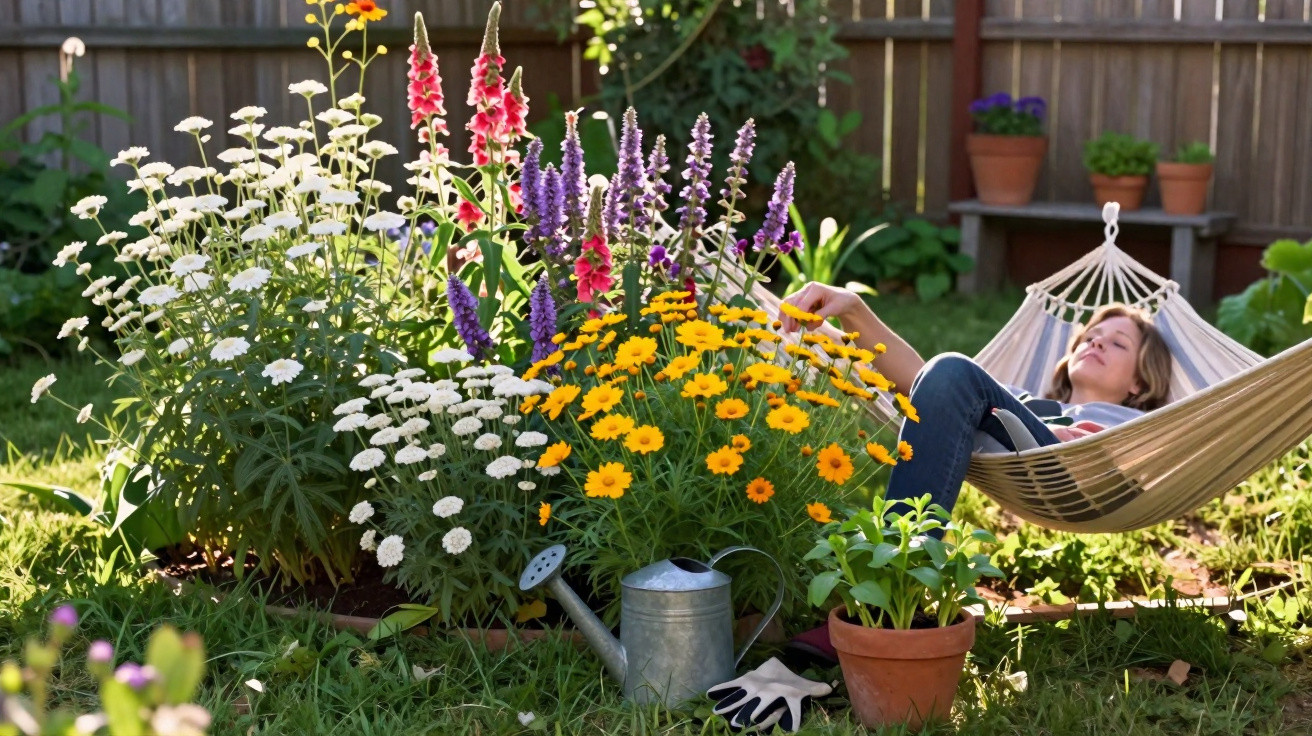
With carefully chosen long-flowering perennials, this is entirely achievable: plants that keep producing fresh buds for months, need little attention and also attract bees and butterflies. Anyone planting purposefully in spring can enjoy an almost uninterrupted ribbon of flowers well into autumn.
Why long-flowering perennials are so valuable in flower borders
Perennials with extended flowering periods have a special place in ornamental gardens. They provide structure, fill gaps and ensure a border offers interest from early summer through to autumn, rather than looking attractive only in June.
Long-flowering plants provide colour for many weeks without needing to be bought again every year – a definite benefit for both your budget and your patience.
Once established properly, most of these plants return reliably for many years. Unlike traditional bedding plants, they do not need to be raised afresh or bought from the garden centre each spring. Hardy perennial varieties are particularly useful for gardeners with limited time or those who do not want to water constantly.
Large-flowered tickseed: a cheerful perennial for sunny spots
Large-flowered tickseed (Coreopsis grandiflora) is among the best-known long-flowering perennials. The cultivar ‘Early Sunrise’ is especially popular. From June until November, it produces bright yellow blooms that resemble little suns dotted across the border.
Growing to around 45 centimetres, it is ideally suited to mixed perennial borders. It prefers:
- full sun or a very bright position
- fresh, humus-rich soil
- regular but not excessive watering
Large-flowered tickseed is also excellent for cutting into summer bouquets. Removing spent flowers regularly extends its flowering season even further. Cutting it back hard in late summer often encourages a second flush of blooms.
Gaura: a delicate cloud of flowers above the border
Gaura (Gaura lindheimeri), also known as prairie gaura, has an almost weightless appearance. Its fine white flower sprays dance above the beds from July to October, lending the garden an airy, light feel.
It reaches between 60 and 100 centimetres in height and is particularly effective for softening rigid planting schemes. The best conditions are:
- warm, sunny locations
- free-draining, fairly sandy soil
- moderately fertile ground with no waterlogging
Originally from relatively dry regions, gaura copes easily with brief dry spells. When planted in spring, it establishes well, then really comes into its own in its second year.
Giant hyssop: an aromatic flower magnet
Giant hyssop, often also called mountain mint, combines several advantages: it flowers for a long time, has an aromatic scent and is a true magnet for insects. Cultivars such as ‘Linda’ produce violet flower spikes from July to October, framed by dark red calyxes.
Hardly any other perennial attracts bees and butterflies as dependably as giant hyssop – an essential choice for naturalistic borders.
This perennial belongs to the mint family and thrives in full sun and relatively dry positions. It performs well in sandy, low-fertility soils and appreciates ground that has not been heavily fertilised. Too many nutrients encourage leafy growth and make it vulnerable to wind damage.
Double sneezewort: clouds of snow-white flowers
For pale highlights in a perennial border, choose double sneezewort (Achillea ptarmica ‘Snowball’). From June to September, it carries countless pure white flower heads that look like miniature snowballs.
At roughly 70 centimetres tall, this perennial works well in front of shrubs or dark hedges. It is best grown in:
- sunny to partially shaded positions
- lightly moist, nutrient-rich soil
- evenly supplied moisture without waterlogging
The plant is considered robust and dependable. Cutting it back after the main flowering period keeps its growth compact and encourages fresh shoots. Paired with violet or blue perennials, it creates striking contrasts that brighten even dull days.
Red valerian: a long-flowering plant for borders and wall crevices
Red valerian (Centranthus ruber) is familiar from many established gardens – and with good reason. It flowers tirelessly from June to September in shades ranging from light red to pink, always creating a cheerful, summery effect.
This perennial adapts to very different conditions. It grows happily:
- in sunny to lightly shaded places
- on dry, mineral soils
- as well as in ordinary garden soil
Its self-reliant nature is characteristic: red valerian readily colonises cracks in walls, gaps between steps and dry gravelled areas. Although regarded as short-lived, it usually maintains itself in the garden through vigorous self-seeding.
To restrict this spread, cut it back. Once the first wave of flowers has finished, shorten the stems by around half. This reduces seed production and often brings an attractive repeat flowering period lasting into October.
Other rewarding long-flowering perennials for lasting colour
Alongside these established favourites, many other perennials provide dependable colour in borders for weeks on end. One example is Welsh poppy (Meconopsis cambrica). It flowers from June to September, grows to about 30 centimetres and favours partially shaded sites.
Welsh poppy seeds itself freely and gradually forms loose, natural-looking colonies. It is therefore ideal for wildlife-friendly gardens, woodland edges and partially shaded corners that might otherwise remain bare.
Planning a perennial border that flowers for longer
A border that remains genuinely attractive throughout the season needs more than a handful of beautiful plants. The combination of flowering periods, plant heights and colours is what matters. It is useful to follow a broad plan such as this:
| Period | Examples of suitable long-flowering perennials |
|---|---|
| Early summer (June) | Red valerian, Welsh poppy, large-flowered tickseed |
| Midsummer (July–August) | Gaura, giant hyssop, double sneezewort |
| Late summer (September–October) | Gaura, giant hyssop, tickseed with repeat flowering |
Including at least three reliable species in every period prevents bare gaps. Mixing plants with different flower shapes is also helpful: spikes, umbels, daisy-like flower heads and panicles appeal to different insect species while creating visual variety.
Care tips for maximum flower power
For long-flowering perennials to reach their full potential, a few straightforward care measures make all the difference:
- Remove faded blooms regularly: This prevents seed formation and prompts plants to make new buds.
- Fertilise sparingly: Too much nitrogen encourages leaf growth rather than flowers. Small applications of organic fertiliser are preferable.
- Water correctly: Many perennials prefer infrequent but thorough watering instead of a small amount every day.
- Spring is planting time: Planting in April or May gives perennials enough time to root before the height of summer.
Later in the year, it is worth checking the root area. Many long-flowering perennials benefit from a thin layer of compost in spring, which improves soil life and nutrient supply without overwhelming them.
Where long-flowering perennials are especially worthwhile
Long-blooming perennials are particularly effective in places where regular maintenance is not possible. Popular locations include:
- front gardens that should look cared for all year round
- border planting beside patios and seating areas
- beds along paths or driveways
- insect-friendly garden areas, such as around fruit trees
By deliberately combining early-, mid- and late-flowering perennials in these spaces, you can create a low-maintenance, lively garden display for the long term. The effect becomes especially appealing when grasses, ornamental alliums or low shrubs are included. The result is a border that still has structure in winter, long after the flowers have faded.


Comments
No comments yet. Be the first to comment!
Leave a Comment