
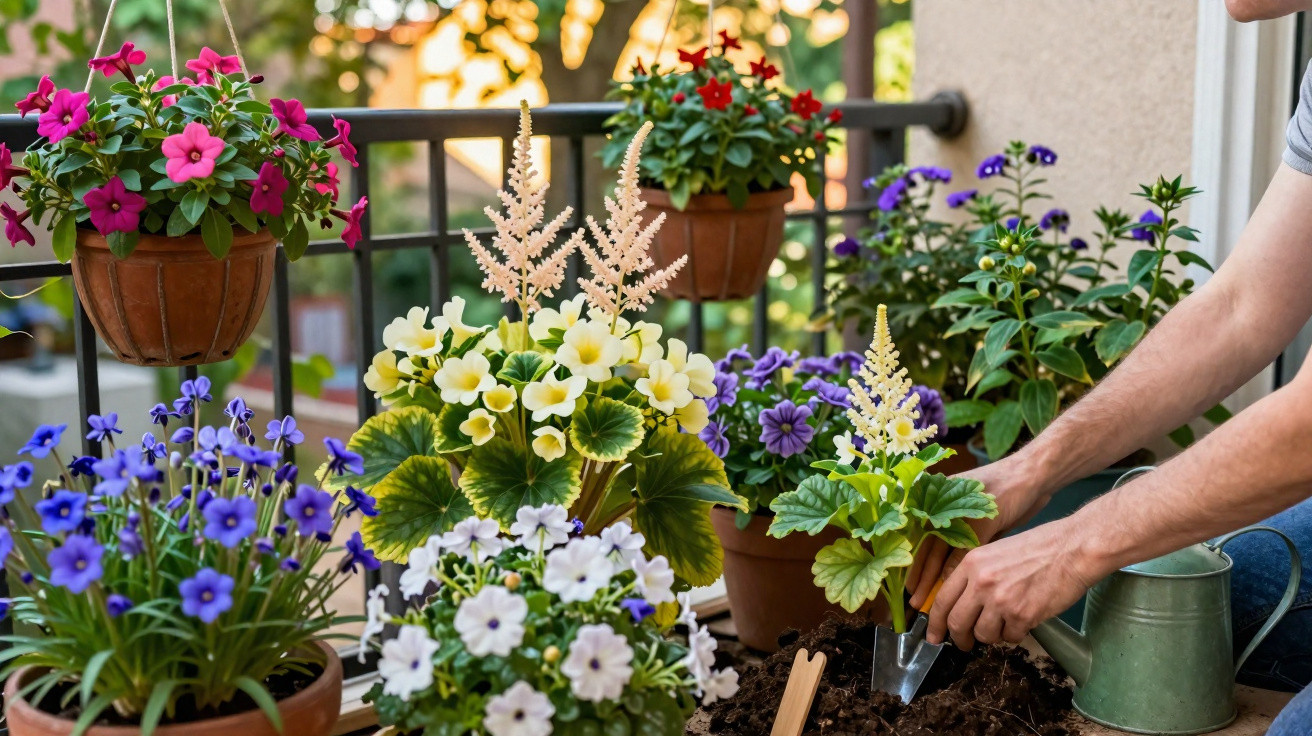
Much more is possible than many people realise.
Anyone with a balcony that receives no direct sun or a bed that remains permanently shaded often gives up in frustration. Just foliage and no colour is the common assumption. Yet there is a whole range of perennials and seasonal flowers that thrive in precisely these spots and flower for months, provided a few straightforward rules are followed.
Shade is not all the same
Before buying the first pot, it is worth assessing the available light carefully. A shaded position can take very different forms, and this determines which plants will genuinely last.
- Bright partial shade: Morning sun followed by shade. Perfect for many hardy flowering plants.
- Dappled shade: Sunlight is filtered through tree canopies or a balcony overhead.
- Deep shade: A north-facing wall, the corner of a house or the base of a tree, where scarcely any sun reaches.
Many campanulas and hardy geraniums, for instance, are happy in bright partial shade. Beneath densely leafed trees, ground-covering plants such as foamflowers are better suited: they cope with little light while still flowering for a long period.
“Anyone who reads their shade correctly avoids disappointing purchases and enjoys long-lasting, reliable displays of flowers rather than short-lived let-downs.”
Soil in the shade: cool, yet often heavy
Shaded areas take longer to dry out. Although this is an advantage, it can become troublesome if the soil stays constantly wet and sodden. Many shade flowers appreciate moist conditions, but not boggy ground.
A few simple steps will prepare the soil well:
- Work in more organic matter, such as mature compost.
- Mulch with leaves or fine woodchip to keep the soil cool.
- Prevent waterlogging, particularly in balcony pots, by keeping drainage holes clear.
This keeps roots comfortably cool even during hot spells. That, in turn, helps flowers continue from June into autumn instead of fading after the first midsummer heatwave.
Seven shade flowers that perform for almost the whole summer
A combination of long-flowering annuals and dependable perennials can transform any dark area remarkably quickly. These seven varieties are regarded as easy-going shade specialists:
Impatiens – the classic choice for north-facing balconies
Busy Lizzies, usually sold as Impatiens, are almost essential for shady window boxes. They flower from June until the first frost, as long as their root zone is never allowed to dry out completely.
- Ideal for window boxes and larger pots.
- Colours range from white and pink to vivid red.
- Water regularly; removing spent flowers encourages even more buds.
Tuberous begonias – made for deep shade
Tuberous begonias thrive when they are protected from strong, direct sunshine. In hanging baskets or bowls in partial shade, they create dense clouds of blooms from June through to September.
If the tubers are stored dry and frost-free in autumn, they can simply be started into growth again the following spring. This turns a “seasonal plant” into a small, long-term companion.
Fuchsias – flowering mobiles for the shade
Fuchsias add a sense of movement: their bell-shaped flowers hang above the foliage like tiny lanterns. On north-facing patios in pots or in hanging baskets, just a few plants can make a corner look far more inviting.
“With fuchsias above head height, begonias at eye level and Impatiens in the box, the north side becomes a true shelf of flowers.”
Astilbes – feathery plumes for shaded perennial beds
Astilbes are among the perennials that truly flourish in cool shade. Their colourful flower plumes, in white, pink, red or purple, shine from early summer into late summer.
They are especially well suited to pond edges or beds that never dry out completely. Humus-rich soil with consistent moisture makes the plumes noticeably fuller.
Carpathian bellflower – small blooms, striking impact
The Carpathian bellflower forms low cushions covered in pale bell-shaped flowers. In light shade or bright partial shade, it blooms from May until late summer.
It works well at the front of beds, along rock-garden edges and in window boxes that receive sun only in the morning.
Hardy geraniums – long-flowering ground cover
Modern varieties of hardy geranium, including the well-known type with violet-blue blooms, provide colour almost without interruption from June to October. They spread across the ground and fill gaps in borders.
In partial shade, they create a living carpet of flowers that weaves between taller perennials while covering the soil at the same time, which is useful for suppressing weeds.
Foamflowers – delicate flower spikes for cool corners
Foamflowers are close relatives of the popular coral bells. They form dense mats of decorative foliage, with delicate flower spikes hovering above them from spring onwards. In fresh, shady places, their blooms often continue into early autumn.
Under trees or beside shaded walls, they resemble a natural woodland edge, particularly when combined with astilbes and hardy geraniums.
How to combine shade flowers effectively
With a little planning, every dark corner can become a small stage. It helps to arrange plants in layers: low growers at the front, taller plants behind, and a backdrop at the rear.
| Position | Suitable plants | What to consider? |
|---|---|---|
| Under trees | Foamflowers, hardy geraniums, astilbes | Leave fallen leaves as mulch and work in compost in spring |
| North-facing balcony | Impatiens, tuberous begonias, fuchsias | Water regularly and avoid waterlogging in the container |
| Shaded house wall | Astilbes, Carpathian bellflower, hardy geraniums | Loosen the soil, enrich it with organic matter and do not let it dry out |
Beneath a tree, a mix of hardy geraniums and foamflowers is often enough to provide structure throughout the year and long-lasting flowers. A few astilbes at the back then create highlights in July and August.
Care: small routines, big results
Most shade flowers are not demanding. Straightforward, regular care rewards you with a much longer flowering season:
- Regularly pinch off faded buds from Impatiens, begonias, fuchsias and campanulas.
- Add a thin layer of bark mulch to large containers.
- Apply liquid fertiliser for flowering plants in the watering can every two to three weeks.
- During prolonged rain, empty saucers beneath pots.
“Anyone who gives this routine a few minutes each week will suddenly find their shady corner is the most colourful part of the garden.”
Useful extra information for shade enthusiasts
Many amateur gardeners mistake shade for difficult growing conditions. In reality, several common garden issues barely arise there: scorched leaves, extremely rapid drying and burnt flowers are rare. Shaded places instead offer a more stable microclimate, which supports extended flowering periods.
Things become particularly interesting when flowering times are deliberately staggered. Foamflowers begin early in the year, followed by Carpathian bellflowers and hardy geraniums. From early summer, astilbes and fuchsias take over the main display, until Impatiens and begonias usher in autumn. The result is an almost unbroken sequence that brings enjoyment even in “difficult” locations.
If you are unsure how dark an area really is, take a practical approach: on a sunny day, check briefly each hour whether direct sun reaches it. If no direct rays appear throughout the day, true shade specialists are required. If a little sun arrives in the morning or evening, many of the plants listed above become possible, creating the opportunity to turn an apparent problem spot into a secret favourite area of the garden.
Comments
No comments yet. Be the first to comment!
Leave a Comment