
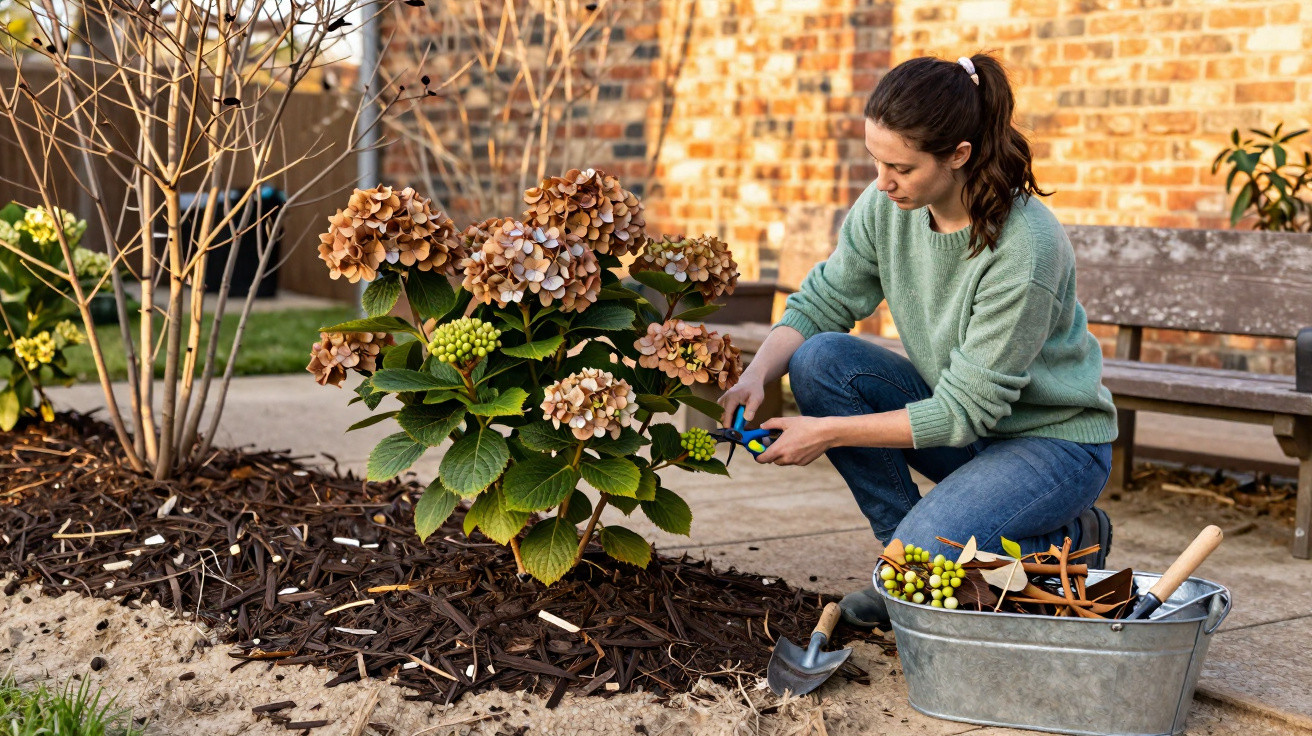
A tiny cut made at the right moment can determine whether you get a leafy green shrub or a spectacular wall of flowers. For Hydrangea macrophylla, TV gardener Monty Don favours sensitivity over drastic pruning in March, combined with thoughtful winter care.
Why March determines your hydrangea flowering
Hydrangeas are often considered easy-going, yet pruning is where many gardeners go wrong. The popular mophead and lacecap hydrangeas (Hydrangea macrophylla) produce their flower buds during the previous year. These buds are found high on the stems, frequently immediately beneath the old, dried flower heads.
Those who enthusiastically “tidy up” in late winter and cut shrubs back into old wood remove precisely these already formed buds. The consequences become clear a few months later: plenty of new leaves but scarcely any flowers.
The crucial point: many mophead hydrangeas flower on what is known as “old wood”. If this is cut back too severely in winter, flowering will be almost completely lost.
March brings uncertainty to many gardens. Buds begin to swell and the sun grows stronger, but late frosts can still arrive. It is this transitional period that defines Monty Don’s approach: do not prune to reshape the plant, but remove only what is genuinely necessary.
Do not confuse deadheading with cutting back
Part of the difficulty comes down to terminology. Many guides refer broadly to “pruning hydrangeas” without properly distinguishing between:
- Removing faded flowers (deadheading old flower heads) – a very light, surface-level cut
- Hard pruning – substantially reducing or rejuvenating the shrub
Monty Don and other gardening professionals stress that a severe cut is exactly the wrong treatment for most varieties flowering before June. One well-known rule helps many gardeners: radically pruning early-flowering shrubs in winter means sacrificing the following year’s flowers.
Beginners in particular may see the brown remnants of flowers in February or early March and assume that the shrub is spent or woody. In fact, these dry heads often shield the delicate buds beneath them from cold weather. They act as small umbrellas against frost and wind.
Monty Don’s tiny March trick for Hydrangea macrophylla
Monty Don’s technique sounds almost too straightforward, which is exactly why it works so well. He acts in late March or very early April, once the harshest frosts have passed and the buds have visibly started to swell.
How to make the March cut step by step
- Wait until the plant starts growing: buds should be noticeably plumper and slightly green.
- Locate the old flower heads: the dry, usually brown balls or lacecaps from the previous year sit at the end of the stems.
- Identify healthy pairs of buds: directly below the old flower head, there are usually two strong buds opposite each other on the stem.
- Cut just above them: using sharp secateurs, make the cut only a few millimetres above this pair of buds.
- Remove only genuinely dead stems completely: cut grey, hollow or shrivelled stems out close to ground level.
This minimal cut tidies the shrub visually and removes frost damage at the tip, while leaving every developing flower bud untouched. The plump buds will later grow into strong flowering shoots.
The skill is to cut as little as possible and only as much as necessary – a single cut a few centimetres lower can cost the entire display of flowers.
An account from the UK illustrates how significant the difference can be: gardeners who wait until after the last frosts and intervene very cautiously remove only frost-damaged wood without endangering live buds. Many gardening enthusiasts report noticeably fuller flower heads in the very first year after changing their approach.
Which hydrangeas need this treatment – and which do not
It is important to remember that hydrangeas do not all behave in the same way. Much confusion arises because several different types often grow alongside one another in the garden.
| Hydrangea type | Where flowers form | Recommended pruning approach |
|---|---|---|
| Mophead hydrangea (Hydrangea macrophylla, mophead and lacecap forms) | usually on old wood | Remove only old flowers above strong buds in March; do not prune hard |
| Panicle hydrangea (Hydrangea paniculata) | on new wood | Can be cut back more firmly in late winter, encouraging abundant flowering |
| Smooth hydrangea (Hydrangea arborescens, for example ‘Annabelle’) | on new wood | Can also be pruned back more heavily in spring |
| Climbing hydrangea (Hydrangea petiolaris) | mainly on old wood | Thin and shape only; do not shorten flowering stems heavily |
The tiny March cut described by Monty Don is aimed primarily at Hydrangea macrophylla. If you are unsure which type is growing in your garden, it is best to wait for a year, observe its flowering, and in the meantime remove only old flower heads just above the buds.
The quiet secret weapon: winter mulch
March pruning is only one part of the formula. Monty Don also relies on an understated winter routine: applying a generous layer of mulch in January or February. While beds may look bleak, his shrubs are already receiving a “head start” for the season ahead.
He uses well-rotted organic material such as:
- mature garden compost
- mushroom compost
- bark chips or bark mulch, preferably slightly acidic for hydrangeas, such as pine bark
The quantity matters as much as the material. A layer of at least five centimetres around the root area provides both insulation and a reserve of nutrients. Applying eight to ten centimetres gives plants considerably more support.
A thick layer of mulch retains moisture, protects roots from frost, suppresses weeds and gradually supplies nutrients – without any glossy fertiliser treatment.
Monty Don even advises mulching a smaller part of the garden properly and deeply rather than giving the whole garden a thin annual covering. For hydrangeas, which have shallow roots and react badly to drought, this method can mean the difference between drooping foliage and dependable summer flowers.
Common mistakes and how to avoid them
The same pattern plays out in many front gardens each year. A few changes in routine can prevent the most common pitfalls:
- Pruning too early and too hard: Cutting everything down in January eliminates the entire flowering display on mophead hydrangeas.
- Using blunt or rusty secateurs: Crushed wounds rather than clean cuts create an entry point for fungal diseases.
- Piling mulch directly against the stems: This can lead to rot at the base of the shrub. Leave a small gap instead.
- Allowing continual drought stress in summer: Shallow roots require consistent moisture, especially during hot spells.
- Choosing the wrong variety for the position: Full midday sun on sandy soil puts many Hydrangea macrophylla plants under strain.
Gardeners who adjust their care often notice changes in the first year: more buds, fewer scorched leaf edges and sturdier flower heads that do not immediately flop over.
What lies behind those large flower heads
Although hydrangeas appear robust at first glance, botanically they are sensitive plants. Their large flower heads are in fact showy sterile blooms made up of numerous individual flowers. To develop fully, they need sufficient water, nutrients and energy stored from the previous season.
Avoiding drastic winter pruning allows the plant to direct reserves from older stems into its existing buds, rather than having to labouriously produce fresh shoots from ground level in spring. Mulch and moderate watering support this process.
For many home gardeners, this means less impulsive action and more observation. A calm look at the buds in March, a precise cut just above the strongest pair of buds, and a generous winter layer of mulch are often all that is needed to turn a “temperamental shrub by the fence” into a real focal point with XXL flower heads.





Comments
No comments yet. Be the first to comment!
Leave a Comment