
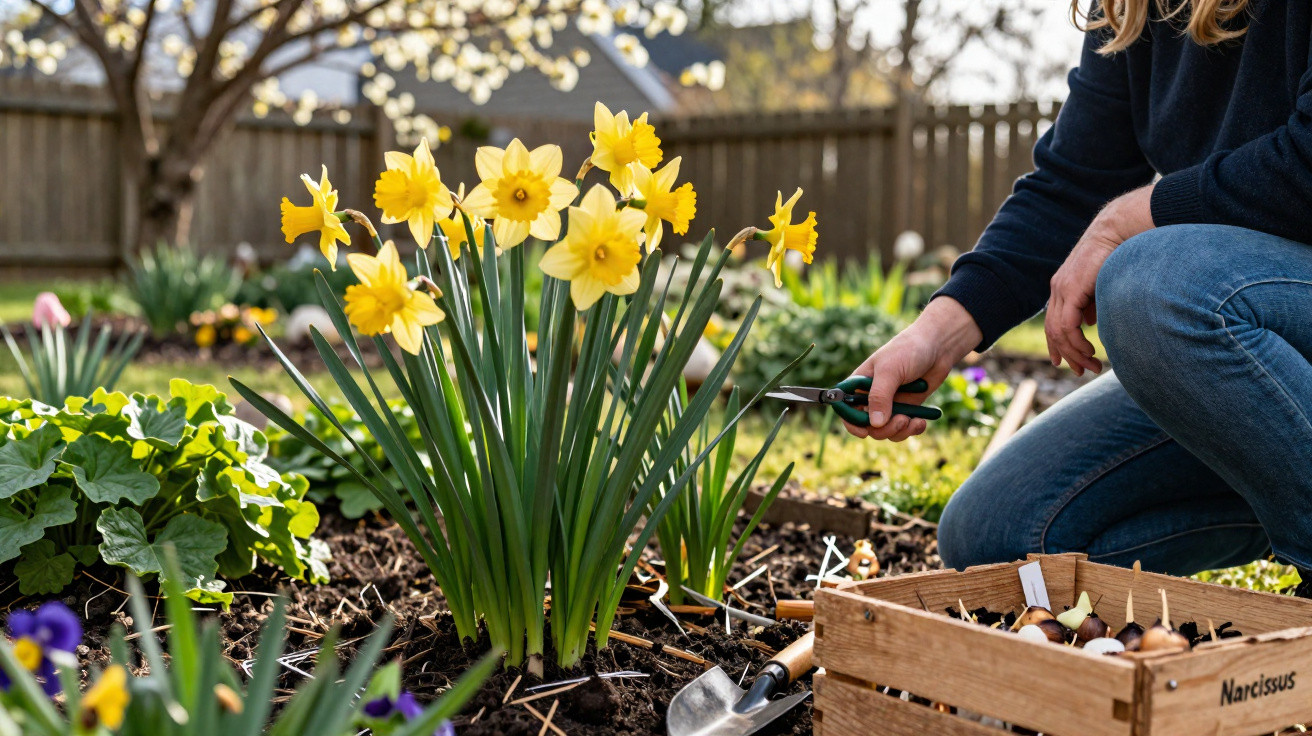
What looks wilted above ground is often still working at full capacity below: when daffodils, tulips and other spring bulbs have finished flowering, a crucial period begins beneath the soil. Tidying up now simply for appearances is one of the costliest mistakes in an ornamental garden – and the price is sparse flowering, or no flowers at all, the following spring.
Why apparently wilted daffodils are still working at full capacity in April
In March and April, beds of daffodils are usually the pride of the garden. Just a few weeks later, however, the scene can look rather dismal: flowers droop, stems flop over and leaves lie flat across the lawn. To many gardeners, it simply looks like “mess”.
Botanically, though, the most important part of the year is taking place at this point. The green leaves of bulb flowers act as miniature solar panels. They capture the bright spring sunshine and use photosynthesis to make sugars, which are then stored in the bulb.
Only after flowering does the bulb recharge its energy store for the following year – every patch of green leaf matters.
This recharging process takes time. Specialists allow at least four to six weeks of active photosynthesis after flowering, and some varieties need as long as eight weeks. During this period, the plant rebuilds its reserves, repairs tissue damage and forms the structures needed for the next flowering season.
If this period is cut short, the bulb develops an energy deficit: it lacks sufficient reserves to produce new flowers. The result is that only a few thin leaves emerge the following spring – or nothing at all. This often seems baffling to gardeners, who believe they have “done everything right”.
The common mistake: cutting back or tying up green foliage
As soon as the flowers drop, the desire for a neat garden often leads to two typical actions:
- cutting all foliage down at ground level
- tightly tying, twisting or plaiting the leaves
Although this may appear to be good maintenance, it causes considerable harm. Tying or plaiting bends the tissue, crushes the sap channels and can partly collapse the pathways that carry water and nutrients. Cutting everything back removes every green surface available for photosynthesis.
Anyone who cuts off or knots the green foliage is quite literally turning off the bulb’s tap.
One point creates further confusion: removing dry flower stems is actually beneficial. It stops the plant producing seed and prevents energy being wasted on seed heads. The mistake only begins when the green leaves are removed as well.
What gardeners should never do from April onwards
- Cut the fresh green leaves of daffodils, jonquils, tulips and hyacinths.
- Plait, knot or compress foliage with elastic bands.
- Mow over bulb foliage that is still green.
Every one of these actions removes the plant’s only means of “energy production” for that season.
Correct care after flowering: how daffodils flower reliably again
The good news is that achieving long-lived, free-flowering bulbs is remarkably simple. Above all, it requires patience and a few clear steps.
How to tell when foliage can genuinely be removed
Experts advise leaving foliage completely untouched for at least four to six weeks after flowering has ended; six to eight weeks is even better. The decision should not be based on the calendar, but on colour:
- deep green: the bulb is still working at full capacity
- yellowish but still succulent: the final phase of energy storage
- straw-brown, dry and almost brittle: the work is complete
Once the leaves nearly come away on their own with a gentle pull, they can be removed. Until then, they can remain in place – even if they are not particularly attractive.
Step-by-step routine after spring flowering
- Remove only the spent flower heads once they have turned brown.
- Leave green foliage in place, moving it carefully to one side at most so that it is not caught by the lawnmower.
- Water plants lightly in dry conditions, especially those in pots, so the bulbs do not dry out.
- Apply a thin layer of mature compost or a little wood ash (sparingly!) to the soil – this supplies nutrients and potassium.
- Wait until the leaves have dried naturally and can be pulled away without force.
- Remove only dead material, then keep the soil loose.
Giving bulbs rest, water and a little nourishment after flowering often keeps the plants in the garden for decades.
How deeply to plant and when to divide? Tips for long-lasting daffodil beds
Flowering performance is not determined by foliage care alone. Planting depth and available space are also crucial. Many gardeners set bulbs too shallowly because they do not want to work through much soil. This can result in frost damage, drying out and weak plants.
Garden specialists recommend planting spring bulbs much deeper in autumn than many people expect. A useful guideline is at least 15 centimetres of soil above the bulb. This keeps plants stable, protects them more effectively from temperature extremes and allows them to develop a strong root system.
Over time, daffodils multiply by producing daughter bulbs. When clumps become very crowded, flowering often becomes less abundant. Dividing them is then worthwhile:
- Wait until the foliage has died back.
- Carefully lift the clump with a garden fork.
- Separate large and small bulbs by hand.
- Replant them in fresh, loose soil with a little compost.
In historic gardens, daffodil colonies have flowered in this way for well over a hundred years – evidence of just how long-lived these plants can be when they are not “over-tended to death” every year.
Practical ways to disguise unattractive bulb foliage
For many people, fading foliage is simply an eyesore. Rather than reaching for the shears, the issue can be handled more elegantly. Mixed planting with perennials or ground-cover plants that emerge later and conceal the diminishing daffodil leaves is a proven solution.
Suitable plants include, for example:
- lady’s mantle, which forms dense green cushions in May
- cranesbill varieties with an airy habit
- compact grasses that add structure to beds
- cushion-forming perennials such as creeping phlox or low-growing baby’s breath
Anyone with bulbs growing in a lawn should embrace a “wild spring” and delay the first cut in those areas. A marked section or a small plant marker helps prevent accidental mowing too early.
Why avoiding the “spring tidy-up” pays off twice
Resisting the urge to tidy prematurely not only saves work, but also delivers several benefits:
- reliable masses of flowers year after year without replanting
- long-term colonies that sustain themselves
- less green waste and less composting work
- a more natural garden appearance that provides more food for insects
The learning effect also grows with every season. Anyone who has seen how vigorously daffodils flower after deliberately leaving the foliage alone will feel far less inclined to reach for the shears the following April.
For newcomers to bulb care, one short reminder is useful: flowers gone – leaves stay. Those who follow it will not need to keep buying new bulbs every autumn, and can instead look forward each spring to a free display in yellow, white and orange.


Comments
No comments yet. Be the first to comment!
Leave a Comment