
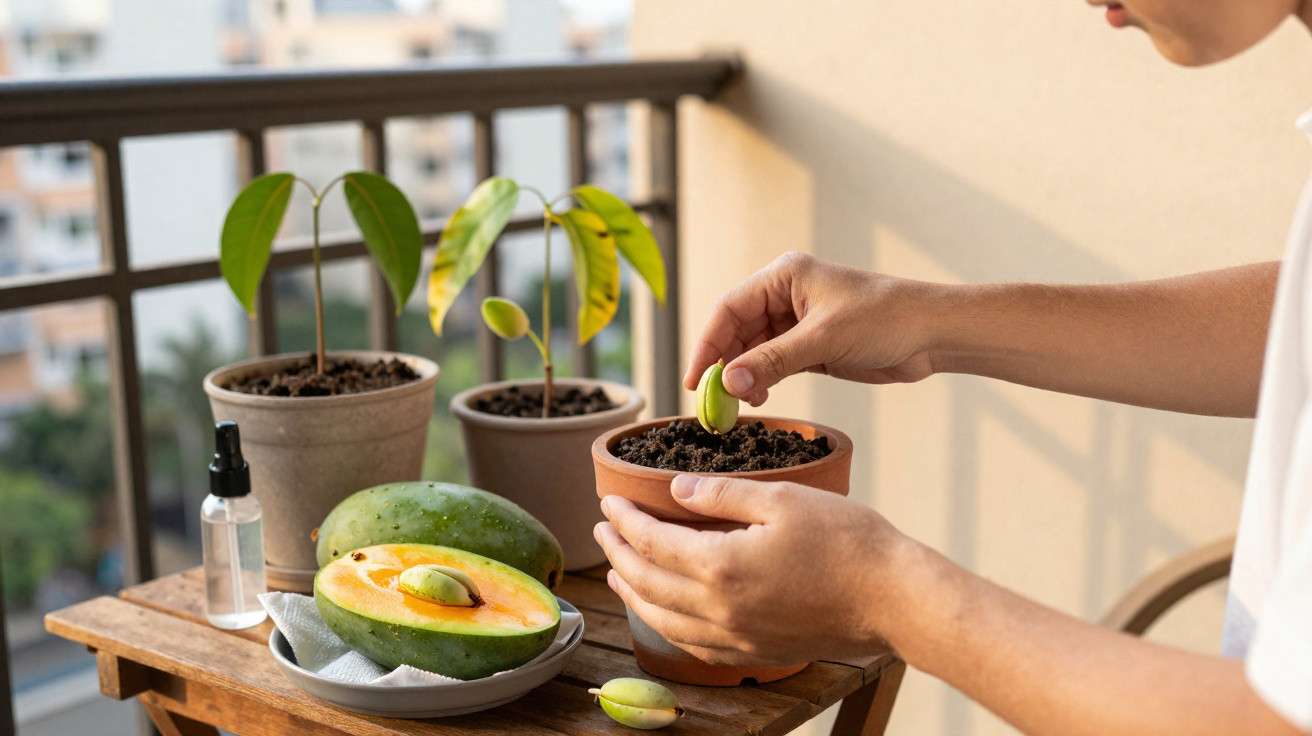
Growing a mango stone at home has become a popular activity for people who want to bring fruit growing closer to everyday life. As well as being straightforward, it lets you follow the process from germination through to the appearance of a strong young plant, observing its growth pattern, development time and the right point to transplant it into a permanent position.
How do you start planting a mango stone at home?
To plant a mango stone with a good germination rate, begin by selecting a ripe, sweet and healthy mango with no signs of rot. Once the flesh has been eaten, wash the stone thoroughly under running water to remove any residue and lower the risk of fungal problems during the early stages.
Next, carefully remove the hard outer shell surrounding the seed with a knife, taking care not to damage what is inside. Beneath this fibrous casing is an elongated, whitish seed, which may be briefly disinfected in a mild solution of water with a few drops of household bleach or fungicide. Always rinse it well before moving on to germination.
How can you germinate a mango stone with or without kitchen roll?
Once cleaned, the seed can be pre-germinated in damp kitchen roll or placed straight into the growing medium. For the kitchen-roll method, wrap the seed in moist sheets, put it in a partially closed plastic bag and keep it somewhere bright but away from direct sunlight, until roots appear after around 7 to 20 days.
If you choose to plant it directly in a pot, keep it in a well-lit place that is protected from strong sunshine during the first few weeks. As the shoot emerges and becomes sturdier, gradually increase its light exposure, avoiding sudden changes that could cause young leaves to wilt or scorch.
What is the ideal growing medium and how do you plant the mango stone?
Anyone planting a mango stone directly in a pot needs a well-draining growing medium that holds moisture without becoming waterlogged. A light, balanced mix supports root development and reduces the chance of the seed and early roots rotting.
A simple, effective potting mix includes:
- 1 part sieved topsoil;
- 1 part washed builders’ sand or coarse sand;
- 1 part well-rotted organic compost or worm castings.
The pot should have drainage holes and, if possible, a layer of small stones at the bottom. Lay the seed on its side a few centimetres deep, covering it with around 2 to 3 cm of growing medium. Water lightly and regularly, keeping the soil consistently moist but never saturated, to encourage a vigorous shoot to emerge.
How long does a mango tree take to grow and bear fruit?
The journey from mango stone to a fruiting tree depends on the climate, variety, soil and ongoing care. In favourable conditions, the young plant can reach 20–40 cm within a few months and, once its roots are well established, it can be moved into the garden or a larger pot with good light levels.
Generally, a mango tree grown from seed takes roughly 4 to 8 years to produce fruit, taking less time in warmer regions and longer in colder places. The tree will not necessarily reproduce the exact traits of the original fruit because of natural cross-pollination, making it an interesting plant to grow while observing changes in flavour, size and fruiting season over the years.
Comments
No comments yet. Be the first to comment!
Leave a Comment