
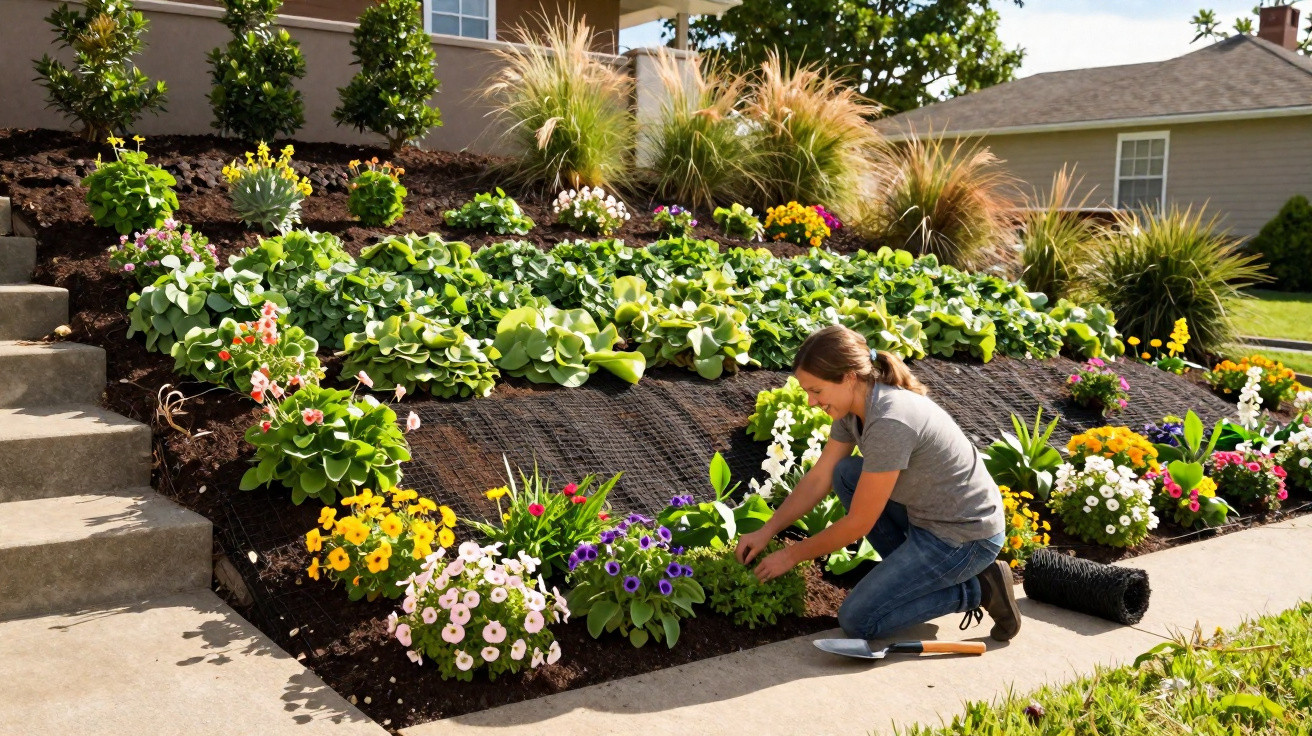
When faced with a bare slope, most people first think of concrete, costly retaining walls and heavy machinery. Landscape designers have long taken a different approach: by choosing the right plants, they can turn unstable banks into colourful, secure ‘flower cascades’ – at a cost that may surprise many homeowners.
Why a troublesome slope can become a garden opportunity
An unsecured slope is not merely unattractive. Rain washes soil away, channels form, stones slip downhill and, in extreme cases, even paths or terraces can become unstable. The conventional answer is substantial construction work. Retaining walls made from concrete or masonry can easily cost €150 to €300 per square metre.
Landscape architects are increasingly relying on ‘bioengineering’ – in simple terms, plants take on the role once performed by concrete. This can cut costs dramatically while delivering several additional benefits: more life in the garden, less heat and improved water management.
“With carefully selected perennials and shrubs, a slope can be stabilised for under €20 per square metre and transformed into a flowering cascade.”
The key is a tiered layout: a clear planting scheme running from the top down, combined with roots that weave through the soil like a net.
Phytostabilisation: how plants secure a slope instead of concrete
The technical term is phytostabilisation. Its principle is simple: deep-rooting and shallow-rooting plants create a dense structure beneath the ground. This network of roots holds the soil in place, reduces the force of rainfall and shields the surface from drying out and erosion.
Ground-covering perennials such as creeping St John’s wort or cotoneaster develop root systems that ‘wrap’ the slope in three dimensions. Their thick foliage acts as a green canopy: raindrops are intercepted rather than creating craters in the earth, while the soil retains moisture for longer.
Preparing the slope
- Clear it thoroughly: Remove weeds and dig out perennial weeds as completely as possible.
- Loosen the soil: Use a garden fork to break up compacted areas and remove large stones.
- Plan the spacing: Allow an average of four to five young plants per square metre.
- Plant in groups: Position six to seven specimens of the same species together to create a more cohesive visual effect.
Immediately after planting, spread a generous layer of mulch over the area, ideally heavy woodchip or ramial chipped wood (RCW), made from fresh woody prunings. Lightweight bark mulch, by contrast, is liable to slide down steep slopes.
Retention nets for steep slopes
From a gradient of around 15 per cent, conditions become more critical: soil can slip more easily and young plants dry out faster. A straightforward yet effective solution is to lay jute or coir fabric across the soil.
Secure the sheets at the top and along the sides using wooden or metal anchors. Then cut small crosses into the fabric and plant the pot-grown plants directly through these openings. Initially, the netting retains the soil; later, the roots take over this function. The natural fibres generally decompose after one to two years.
“The best time to plant a slope is from mid-September to the end of November, or during spring from March to April.”
Autumn is particularly good for establishing perennials, as the ground is still warm and evaporation remains low. Spring-planted young specimens need close attention and watering, especially during dry spells.
Three tiers for the perfect flower cascade
For a slope that is both stable and visually appealing, professionals work with three zones: the upper edge, the central section and the base. Each layer faces different conditions and therefore calls for different plants.
Top: resilient structure for wind and sun
The upper edge is usually the driest and most exposed to wind. This is where the ‘architects of the picture’ belong: shrubs and grasses that give the slope its outline:
- Ornamental grasses such as purple moor-grass or fountain grass
- Heat-loving shrubs such as bladder senna or broom
- Compact shrubs, including spindle, small amelanchier varieties or low ornamental woody plants
They cope well with little water, need only occasional shaping and give the bank a natural, almost landscape-like character.
Middle: ground cover as erosion-control workhorses
Rain has its greatest erosive effect in the middle of a slope. This is where the real stabilisers should be planted:
- Heuchera varieties with colourful foliage
- Purple stonecrop and other Sedum species
- Mat-forming perennials such as baby’s breath and fleabane
- Traditional ground covers including creeping St John’s wort or low-growing woody plants
These plants spread in a carpet-like layer, fill gaps quickly and use their roots to bind the topsoil, which is most vulnerable to erosion. Within just a few seasons, they create a continuous, living cover.
Bottom: a flowering band at the foot of the slope
Water is more likely to collect at the bottom of the bank, leaving the soil moist and richer in nutrients for longer. This area is ideal for floriferous species that benefit from these conditions:
- Saxifrage and cushion bellflowers
- Fragrant alyssums
- Violets and other low spring-flowering plants
- Robust Sedum and fleabane again, for year-round structure
Adding large fieldstones or broken stone among these plants creates small steps and pockets. These miniature terraces slow the water, retain soil and provide extra rooting space for further perennials.
“Jute or coir mats are ideally suited to this planting scheme – plastic sheeting blocks water and air, making the slope less stable over time.”
A practical example of what plants can achieve
A typical real-world case involved a slope of roughly 30 degrees, facing directly towards the prevailing weather, which suffered severe washouts during heavy rain. Rather than building an expensive wall, the solution combined ground-covering plants, jute fabric and woodchip.
Densely growing perennials, including periwinkle and creeping species, were planted across the site, with several structural grasses placed between them. Planting was carried out in autumn, the fabric was firmly anchored and a thick layer of woodchip was then applied.
After two seasons, the slope was fully covered with growth. Where channels had previously formed, rainwater now either runs off more slowly or soaks directly into the ground. Costs remained well below €20 per square metre, while maintenance requirements are minimal.
Where green engineering reaches its limits
Despite its many advantages, planting is not a replacement for structural measures in every situation. Very steep banks or particularly large slopes are often better secured with a combination of lightweight supporting elements and planting. Possible options include small dry-stone walls, natural-stone steps or wire baskets filled with stones to divide up the planted areas.
On extremely sandy ground or soils that repeatedly become heavily waterlogged and silty, the supporting fabric becomes almost essential. It protects the area during the sensitive early phase, until the root system can provide sufficient support. If cracks are already visible in the ground or buildings stand close to the slope, a specialist should assess whether additional structural reinforcement is required.
Maintenance, risks and useful additional benefits
During the first two years, young planting needs regular watering, particularly in dry periods. Replanting any remaining gaps speeds up the development of a continuous carpet. Afterwards, maintenance is generally limited to one or two visits a year: cut back faded growth and, where needed, restrain individual species that spread too vigorously.
One frequently overlooked advantage is that planted slopes provide habitat for insects, birds and small animals. Different flowering periods supply nectar over many months, while foliage and roots improve soil structure over the long term. Choosing native species deliberately provides an additional boost to local biodiversity.
Combining the planting with edible crops is also appealing. Strawberries or herbs can be integrated into the lower, damper sections, where they also work as ground cover. In the drier upper zones, Mediterranean herbs such as thyme or oregano can stabilise the bank while adding fragrance.
The outcome is not simply a secure slope, but a distinct garden feature requiring remarkably little maintenance – with the welcome reassurance that no concrete mixer had to arrive.



Comments
No comments yet. Be the first to comment!
Leave a Comment