
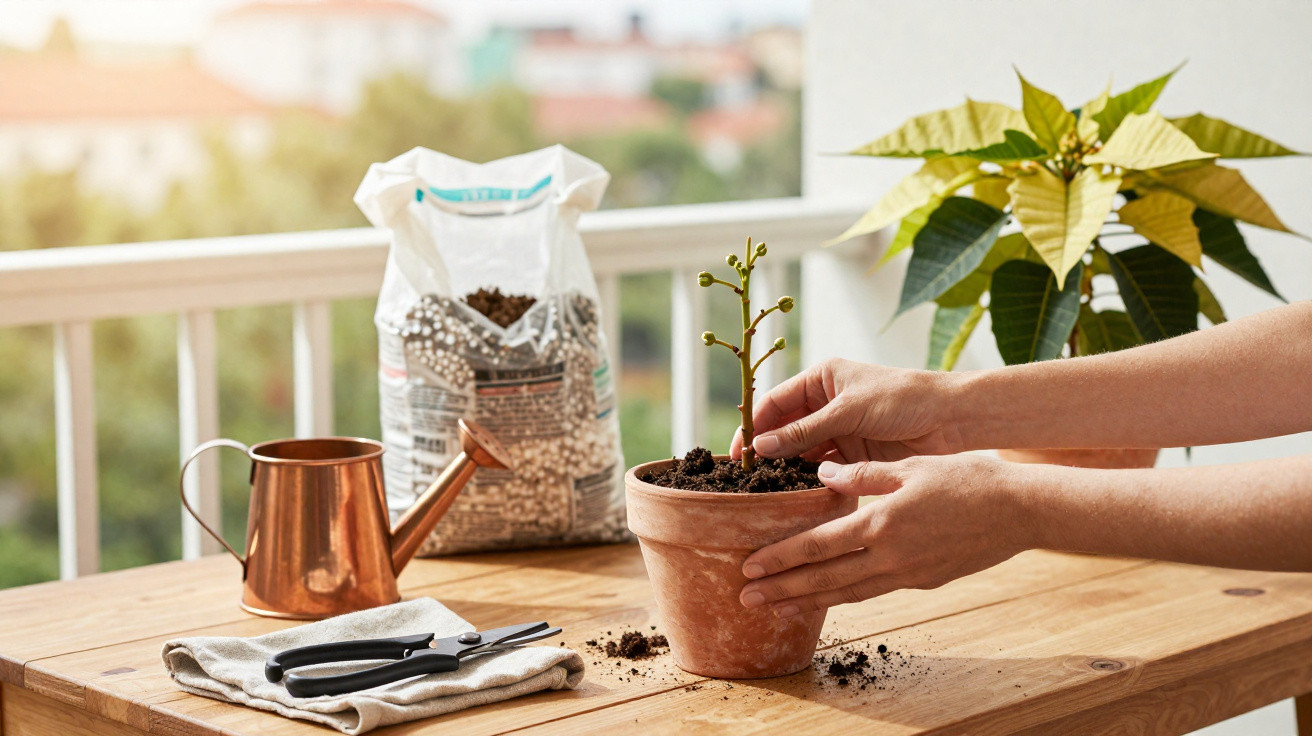
The red decorative star of Advent often looks tired, pale and half bare by spring. At precisely this point, many people make an instinctive decision: “It’s finished.” In reality, this is only the beginning of the period that determines whether the poinsettia survives the summer as a vigorous green plant – or quietly dies away.
Why the poinsettia seems to “give up” in March
The botanical name for the poinsettia is Euphorbia pulcherrima. In its natural habitat, it grows as a shrub in warm regions. Here, it tends to sit on a windowsill as a pot plant, exposed during winter to artificial light, heated indoor air and the stresses of the Christmas period.
After the festivities, something happens that is often misread: its colourful bracts fade, some leaves turn yellow and may drop off. Although this resembles a plant dying, it is usually simply a form of winter dormancy.
In late winter, the poinsettia enters a resting phase – putting it in the wrong place or watering it incorrectly now can be fatal.
During March, the plant stops running at full speed and conserves its energy. It is preparing for a fresh growth cycle. Continuing to care for it exactly as you did in December is one of the most common care mistakes.
The key March mistake: watering as though it were still Advent
Many owners continue watering in March as if their pot were still full of rich red bracts. The issue is that the plant’s water needs are considerably lower at this stage. The compost stays wet for too long, the roots receive hardly any air, and rot can develop.
How to care for a poinsettia during its resting phase
- Position: Keep it bright but away from direct heat from a radiator; 13 to 16°C is ideal.
- Watering: Water very sparingly, only once the compost is almost completely dry.
- No standing water: Always pour away water left in the saucer.
- No severe pruning: Carefully remove only brown or dead material.
If you reach for the watering can as soon as the surface starts to dry even slightly, you can literally drown the poinsettia. It responds by shedding leaves and looking even more unwell – something many people then take as “confirmation” that it cannot be saved.
There is another consideration: the poinsettia’s milky sap can irritate the skin. It is best to wear gloves while removing wilted parts, then wash your hands afterwards.
April brings a fresh start – with a new pot and more light
Anyone who has got through the critical month of March will notice in April that the plant is ready to grow again. Small, fresh shoots emerge from its stems. This is the time for the second important step: a spring inspection followed by repotting.
Repotting correctly: only slightly larger, but much fresher
Choose a new pot that is only a little larger than the old one, but make sure it has a drainage hole. A very large pot retains too much moisture, which can damage the roots again. Good-quality compost is worthwhile: use loose, free-draining houseplant compost, ideally with a mineral component.
Repotting moderately in April gives the poinsettia the foundation it needs to become a strong summer plant.
When repotting, proceed step by step:
- Carefully ease the plant out of its old pot.
- Gently shake old, compacted compost away from the roots.
- Cut away rotten or soft roots using clean scissors.
- Put a drainage layer of expanded clay or gravel in the base of the pot.
- Fill with fresh compost, position the plant, firm it in well and water moderately.
Afterwards, place the poinsettia somewhere bright, but do not expose it to relentless direct sunshine. Temperatures of around 18 to 20°C are suitable at this point. The watering rule remains the same: wait until the upper layer of compost has dried out. A simple finger test is enough.
From late April into summer: Christmas decoration becomes a green houseplant diva
As the days become longer and warmer, the poinsettia starts to thrive. New shoots lengthen and the foliage becomes denser. By this stage, it is clear that the plant is not a disposable decoration, but a genuine houseplant.
Summer care: a routine rather than a rescue mission
From late April onwards, a poinsettia follows almost the same care rules as other tropical foliage plants:
- Watering: Keep the compost evenly moist, but never allow the plant to stand in water.
- Feeding: Apply a liquid fertiliser for flowering plants every two to three weeks.
- Light: Provide a bright spot, ideally with some morning or evening sun, but no intense midday heat through glass.
- Air: Avoid draughts, but do not keep it in a stuffy corner directly beside a radiator either.
From May, once frost is no longer expected, the pot can go outdoors onto a balcony, patio or sheltered garden spot. Partial shade is ideal, such as an east- or west-facing balcony. Introduce the plant to outdoor conditions gradually so that the leaves do not scorch.
In fresh air, the poinsettia often develops a noticeably bushier habit than it does in the living room.
If you wish, you can trim the shoots back lightly in early summer to keep the plant more compact. Every cut encourages fresh side shoots and creates fuller growth.
How the poinsettia turns red again in autumn
Many people consider the reddening of the bracts to be magic, but the poinsettia is simply responding to day length. It is what is known as a short-day plant: it produces colourful bracts when the nights are sufficiently long.
This is how it works in autumn:
- For roughly 8 to 10 weeks, the plant needs around 14 hours of darkness each day.
- Even a lamp in the room can disrupt the effect.
- A cardboard box or dark cupboard can serve as a “night-time sleeping place”.
Those who have cared for the plant well throughout summer will enter this phase with a strong, healthy specimen. Its bracts will then usually colour more reliably and intensely than those of a poinsettia bought from the supermarket at the last minute.
Common misconceptions – and how to avoid them
Stubborn myths about poinsettias circulate widely, yet they are more likely to cause harm in practice:
| Misconception | What is actually true |
|---|---|
| “If leaves fall, the plant is dead.” | Leaf drop can indicate stress, but it is often reversible as long as the roots are healthy. |
| “The more water, the better.” | Waterlogging is the most common cause of death. The root ball should dry slightly between waterings. |
| “Direct sun makes the leaves a beautiful red.” | The red colouring depends on day length, not blazing sunshine. Too much sun is more likely to scorch the leaves. |
| “It is extremely poisonous to children and pets.” | The sap can cause irritation, and consuming a large amount may lead to symptoms, but fatal poisonings in normal household situations are very rare. |
Practical tips for stress-free everyday care
If watering cans and fertilisers feel slightly overwhelming, straightforward routines can help. Marking fertiliser applications on the calendar makes them easier to remember. A pot that feels light when lifted is a clear sign that the plant needs water.
The location can also be chosen wisely: a north-facing window is often too dark in summer, while a south-facing window behind glass is too hot. In many rooms, a bright place slightly to one side of the window works well, giving the plant plenty of light without the magnifying-glass effect of the pane.
If you already own several houseplants, the poinsettia can easily be included in the same watering and feeding routine. This reduces the risk of exceptions – those days when you give far too much water “just to be safe”.
Ultimately, it is not December that determines a poinsettia’s fate, but those unremarkable weeks in March and April. Anyone who stays calm then, waters less and repots at the right time will have an impressive green plant in summer – and, by the following Advent, their own carefully tended festive star rather than a disposable decoration from a supermarket shelf.

Comments
No comments yet. Be the first to comment!
Leave a Comment