
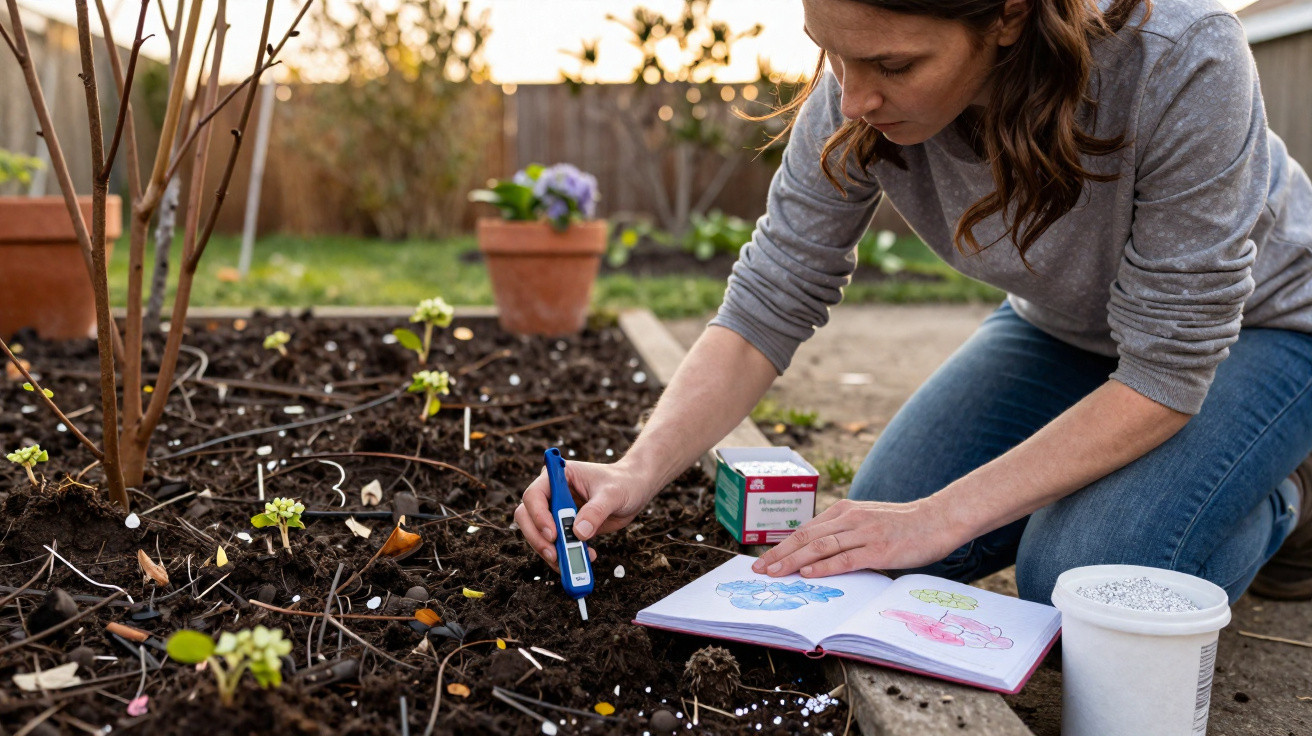
Although borders may look empty and lifeless, hydrangeas are quietly preparing for their display. In late winter, their roots begin to stir, take up nutrients and, most importantly, pick up the chemical cues that will make their eventual flowers blue, pink or a shade between the two.
Why late February marks the true beginning of hydrangea season
Hydrangeas can appear to be little more than dead-looking stems in February, yet they remain very much alive. As days grow longer and soil temperatures slowly rise, sap starts moving again. The roots ready themselves for the major spring growth phase, when fresh foliage and flower buds develop.
At the end of winter, the soil quietly locks in the colour script your hydrangeas will follow for the whole summer.
This period is important because changes in Hydrangea macrophylla colour are not instant. They rely on gradual alterations in soil chemistry. Once flower buds are visible, much of the process has already taken place. Trying to “correct” the colour in May is normally too late to affect that season’s display.
Applying amendments in late February allows several weeks for them to dissolve, travel through the soil and arrive at the delicate root tips. That is enough time for the shrub to take in the minerals that will eventually colour its sepals blue or pink.
First step: test your soil like a gardener-chemist
Before adding anything around your shrubs, establish one essential figure: your soil pH. It indicates whether the soil is acidic, neutral or alkaline. With hydrangeas, this one measurement controls almost everything about flower colour.
How to test pH in minutes
No laboratory or specialist knowledge is required. Basic soil pH testing kits are inexpensive and readily available from garden centres and online retailers. Most include a small tube, a powdered or liquid reagent, and a colour comparison chart.
- Clear away the surface mulch, then collect a small sample of soil from 10–15 cm below the surface, close to the hydrangea’s roots.
- Pick out stones and pieces of bark, then break the soil up finely.
- Combine the sample with the reagent or distilled water, following the kit instructions.
- Let the liquid develop its colour before matching it to the chart.
Knowing your pH number prevents random, expensive guesswork and keeps you from over-correcting a soil that was already suitable.
You can also test soil from several sides of the same shrub. In established gardens, buried lime, paving or builders’ rubble may cause pH to differ even across one border.
The real secret: hydrangea colour is chemistry, not genetics
With many hydrangeas, particularly traditional mophead and lacecap varieties (Hydrangea macrophylla), flower colour is not permanently determined by the cultivar. Instead, it changes according to the plant’s access to aluminium in the soil, which is itself governed by pH.
The pH–colour rule of thumb
The relationship generally works as follows:
- Acidic soil (pH 5–5.5): aluminium remains soluble and accessible, so flowers usually become blue.
- Neutral to slightly alkaline soil (pH above 6–6.5): aluminium is locked away, producing pink to red blooms.
- Borderline soil (around pH 6): flowers often develop mauve tones or uneven mixtures of pink and blue within one head.
| Target colour | Desired pH range | Aluminium availability |
|---|---|---|
| Deep blue | 5.0–5.5 | High |
| Lilac / mixed | 5.8–6.2 | Moderate |
| Pink / red | 6.3–7.0 | Low |
This explains why a strongly blue hydrangea in a pot may turn pink after being planted in a chalky border. The shrub itself has not altered; its soil chemistry has.
White hydrangeas are the exception. Their pigments are much less responsive to pH, meaning they generally remain white or cream, apart from slight tonal changes.
How to steer flowers towards blue or pink
After identifying both your pH and preferred colour, the late-winter approach is straightforward: carefully guide the soil in the desired direction without putting the plant under stress.
For blue and purple shades: lower pH and add aluminium
For stronger blues, you are aiming for both lower pH and a steady trickle of available aluminium around the roots.
If a soil test gives a result above pH 6 and you would like blue flowers, gardeners commonly use one or a combination of the following:
- Aluminium sulphate: commonly sold as “hydrangea blueing” products. Apply around the base in late winter, gently work it into the soil and water it in thoroughly.
- Ericaceous compost or leaf mould: use as a surface mulch around the shrub to introduce acidity gradually.
- Crushed slate or pine needles: these work more slowly, but can help sustain acidic conditions over time.
Follow the manufacturer’s application rates. Concentrated treatments may scorch roots or cause leaf burn later in the season. Modest applications in February and again in early spring are generally safer than one large dose.
For pink and red tones: raise pH and block aluminium
Where hydrangeas grow in naturally acidic soil but you want sweet pink flower heads, the aim is to reduce that acidity.
- Garden lime or dolomitic lime: standard materials for increasing pH. Dolomite also supplies magnesium, supporting the plant’s general health.
- Wood ash: apply only lightly, because it acts fast and can raise pH excessively if overused.
When you raise the pH, you effectively shut the aluminium door, and the hydrangea reveals its pink side.
Distribute lime evenly around the shrub’s drip line, lightly incorporate it into the upper few centimetres of soil and then water generously. Late February provides ideal timing, allowing the change to settle before rapid growth begins.
The technique: applying amendments without damaging roots
Hydrangea roots sit close to the surface and are easily harmed, so the method of soil preparation matters nearly as much as the chosen amendment.
- With a hand fork, carefully loosen just the top layer of soil around the shrub.
- Apply the selected material in a ring, leaving a gap of several centimetres around the main stems.
- Gently blend it into the loosened surface, without pushing the fork deeply into the ground.
- Water slowly and deeply, so the treatment filters down rather than washing away.
Many gardeners overlook the water they use. In hard-water areas, tap water often contains dissolved calcium carbonate, which gradually increases soil pH and can undermine efforts to maintain blue flowers.
For consistent blue shades, rainwater from a butt is your best ally, especially in regions with chalky tap water.
How long does a hydrangea colour change take?
Even when treatment begins at the ideal time in February, hydrangeas will not change colour within a few days. The plant requires several weeks to absorb the minerals, transport them through its tissues and use them in its forming flower buds.
Most gardeners notice some change during the first summer, with more intense and reliable colours in the second year of regular treatment. Hydrangeas in containers tend to respond more quickly than plants growing in open ground, as there is less soil to alter and it is easier to manage.
Common mistakes and quiet risks to watch for
Adjusting soil chemistry is usually safe if done with care, but certain approaches can create problems:
- Using too much aluminium sulphate: this may cause salt accumulation, scorched leaves and poor growth.
- Applying a large quantity of lime in one go: this can shock the roots and prevent uptake of other nutrients, including iron, leading to yellow leaves.
- Overlooking organic matter: exposed, compacted soil responds inconsistently to pH adjustments and dries out fast.
A sensible balanced approach is to combine minor pH adjustments with generous compost mulches. This encourages soil life, which softens sudden chemical changes and helps roots manage them.
Extra tips for creating a colour-themed hydrangea border
Once you understand the late-February technique, hydrangeas can become useful design features. By making gentle pH changes in separate areas, it is possible to create a colour gradient along a path: richer blues in areas receiving more aluminium sulphate and maintained at low pH, lilac in less acidic patches, and candy pink where lime has been added.
Mixed planting provides further visual interest. Blue hydrangeas work well beside silver-leaved plants and dark green ferns. Pink varieties complement warm-coloured roses or salvias. When choosing companions, bear in mind that altering pH for hydrangeas may affect nearby plants, particularly shallow-rooted perennials growing in the same soil area.
Key terms gardeners often ask about
Two terms regularly arise when discussing hydrangeas: pH and aluminium. pH is a 0-to-14 scale showing how acidic or alkaline a substance is. A reading of seven is neutral; values below seven are acidic and those above seven are alkaline. Most garden plants grow happily in soil between pH 5.5 and 7.5.
Aluminium is naturally present in many soils within clay and rock particles. Plants do not require it in substantial amounts, but hydrangeas use the small quantities they take up as a trigger for pigment production. At low pH, aluminium dissolves into a form that roots can absorb. At higher pH, it becomes bound again in solid particles that the shrub cannot access. Controlling this on-off mechanism from late February is the understated method behind the striking colour changes that make people pause by your gate in July.


Comments
No comments yet. Be the first to comment!
Leave a Comment