
Chapo: Overnight, the lawn is suddenly covered in molehills – and the first instinct is to go into battle mode.
That is precisely how many people unknowingly undermine their own garden.
Anyone looking out across the lawn in the morning and finding dozens of fresh heaps will think of destruction rather than assistance. Yet the very mole that so many people instinctively try to fight does work underground that would otherwise require costly garden equipment and treatments – provided you do not make one serious mistake when dealing with it.
Why moles in the garden are so irritating – yet remain
A mole’s tunnels usually run 15 to 30 centimetres below the surface. In places, the animal pushes soil upwards, creating small volcanoes of loose earth. What was once a smooth lawn can look scarred from above, while walking or playing on it may quickly create trip hazards.
In a vegetable garden, young plants can be pushed up slightly and their roots may lose their grip. That is understandably frustrating. Many home gardeners then turn to drastic measures: smoke, poison or exhaust fumes from a vehicle. This is where the real problem starts – not for the mole, but for the garden soil and your own health.
Anyone who completely eradicates moles gives up free soil aeration, natural pest control and the finest “organic humus” from molehill soil.
What moles really do beneath your lawn
The European mole (Talpa europaea) is a specialist tunnel builder. Using its cylindrical body and powerful front paws, it moves through loose, humus-rich, damp soil. In the process, it creates a branching network of tunnels that is far more than merely an annoyance for perfectionists.
Continuous natural soil care
- Aeration: The tunnels break up compaction, allowing oxygen to penetrate further into the ground.
- Improved drainage: Waterlogging is reduced and water is distributed more evenly.
- Loosening heavy soils: Clayey, loamy or waterlogged areas in particular benefit.
- Light fertilisation: Mole droppings and urine add small quantities of nutrients to the soil.
Many people assume that moles eat plants. In reality, they are almost entirely carnivorous. They feed on creatures living in the soil that cannot put up much resistance.
Moles as pest hunters
Their diet mainly includes:
- Earthworms (in large quantities, especially in very humus-rich soil)
- Grubs, meaning beetle larvae such as those of the cockchafer
- Wireworms, the larvae of various click beetles
- Larvae of crane flies and other insects
- Slugs and other invertebrates
A single mole can consume roughly its own body weight every day. Many of the larvae it catches cause considerably more damage to roots and turf than the mole itself. Removing this hunter therefore indirectly encourages the actual pests in the soil.
The typical heaps may be an eyesore, but they also indicate that something is working free of charge against larvae that slowly eat away at your lawn from below.
The one chain of mistakes that harms your garden in the long term
The biggest mistake starts with the belief that moles must be removed at any cost. Chemical treatments, smoke bombs, exhaust fumes and even homemade attempts involving explosions repeatedly appear on gardening forums. What may feel briefly “liberating” leaves behind weakened soil in the long run.
The consequences of such radical treatments include:
- Poison in the soil: Pollutants can remain in the ground for years, affecting soil life and groundwater.
- Health risks: Exhaust fumes and chemicals are dangerous to people and pets as well.
- The loss of a helper: Without moles, populations of larvae and slugs can spread more easily.
- More maintenance: You must take on aeration, drainage and pest control yourself.
From a legal perspective, moles are even specially protected in many countries. Using aggressive methods is therefore not only unwise but often simply prohibited. Anyone trying to “sort things out” with harsh measures damages their garden – and can quickly stray beyond what is allowed.
How to benefit from moles without sacrificing the lawn
The sensible approach is not to eliminate the mole, but to guide it. It can be allowed to occupy certain areas, while you protect others with practical measures.
Protecting lawns and vegetable beds
Anyone maintaining an immaculate ornamental lawn or a sensitive high-performance growing bed can take precautions during installation. A specialised mesh barrier placed beneath the turf has proved effective.
| Area | Recommended measure |
|---|---|
| Ornamental or play lawn | Install mole-proof mesh 40–50 cm deep |
| Vegetable beds | Use mesh or fine wire beneath the entire area |
| Orchard meadow, edge areas | Deliberately leave open and let moles work |
The animals encounter the mesh boundary and move into other zones. Sensitive areas stay stable, while the rest of the garden continues to be loosened and cleared of larvae.
Moving moles on gently rather than fighting them
If a mole appears exactly where it causes the greatest disruption, gentle methods can be used to “persuade” it to move elsewhere:
- Metal rods with bottles: Drive rods into the ground and place empty plastic bottles on top. The wind creates vibrations and noises in the soil that moles avoid.
- Ultrasonic devices: Commercially available devices send sound pulses into the ground to keep the animals away from particular zones.
- Levelling molehills: Simply flatten the heaps, use the soil and reseed the lawn. Many animals move on if an area remains unattractive.
Anyone who gives the mole places to retreat to and protects only selected areas can reduce damage significantly – without poison or violence.
Molehill soil: free premium soil for home gardeners
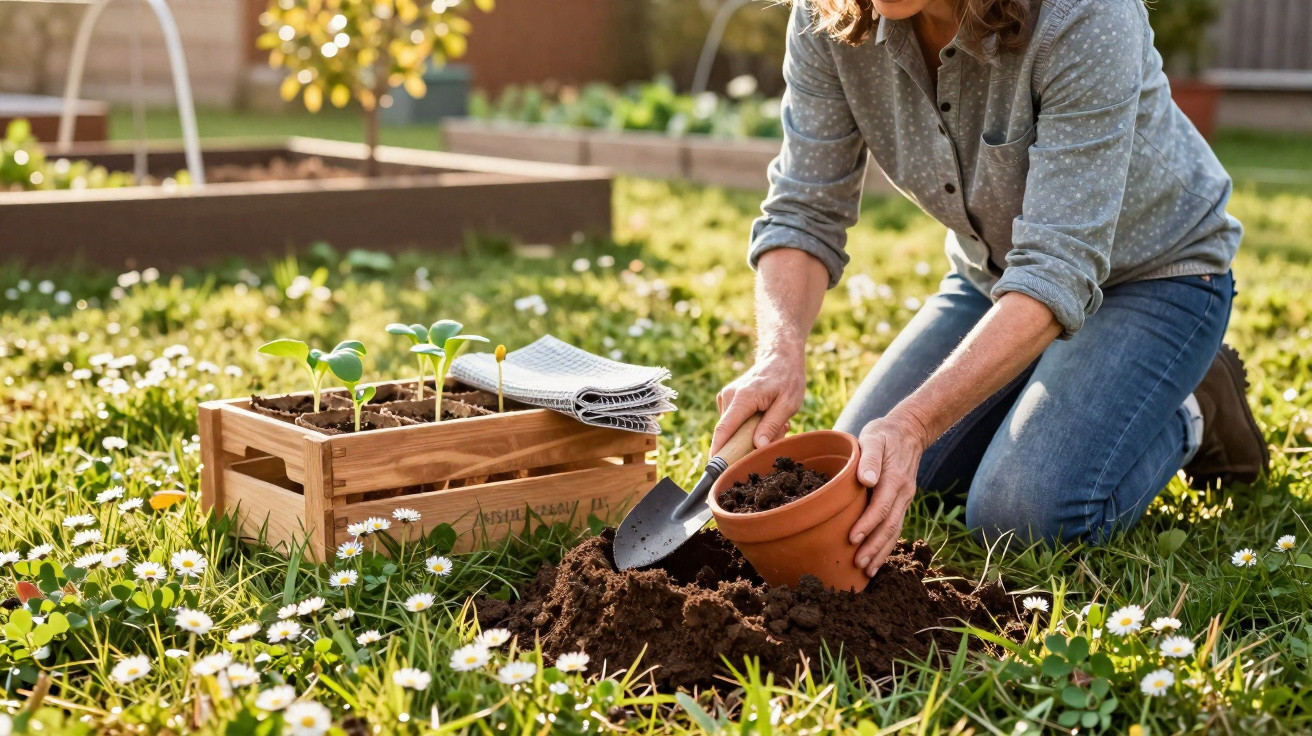
The loose earth from molehills is not an annoying pile of spoil, but a small treasure. It is finely sifted, free from root debris and ideally aerated. Many gardeners buy expensive soil while perfect material for filling planters is sitting right outside the door.
It can be used, for example:
- As a filling for seedling pots, mixed with a little compost
- To top up window boxes and containers
- To fill shallow dips in the lawn
- As an addition to leaner herb beds, lightly loosened with sand
Important: molehill soil is usually low in nutrients, but pleasingly loose. For hungry plants such as tomatoes, it is best mixed with well-rotted compost or plant-based organic fertiliser.
How to assess mole damage realistically
Much of the damage looks worse than it actually is. In most cases, raised sections of turf can be pressed back down and watered. Only on sports or play lawns, golf courses or football pitches does molehill building create genuinely serious problems – in an ordinary home garden, it is usually a matter of appearance and a little unevenness.
It is useful to consider the overall condition of the soil:
- Does water often sit on the lawn? If so, the mole may be indicating compaction or a drainage problem.
- Is the lawn growing poorly while many heaps appear? There may be large numbers of larvae feeding on the roots.
- Does the mole appear only in autumn and spring? It is then following the supply of earthworms and insect larvae.
Those who see molehills not only as a nuisance but also as a diagnostic tool will understand the animal as an indicator of soil life and water balance.
Why a “living” lawn does not have to look perfect
A flawless, deep-green carpet without any unevenness is primarily an aesthetic ideal – biologically, such a lawn is rather poor. It offers hardly any habitat and requires plenty of water, fertiliser and maintenance. A lawn with occasional molehills, dandelions and clover may be less “Instagram-worthy”, but it indicates active soil fauna and usually a more stable balance.
Anyone who can accept a somewhat more natural appearance saves time, money and stress. Moles play their part: they aerate the ground, keep certain pests in check and also provide free potting soil. The real danger to the garden often does not come from them, but from impatience with the natural world beneath your feet.



Comments
No comments yet. Be the first to comment!
Leave a Comment