
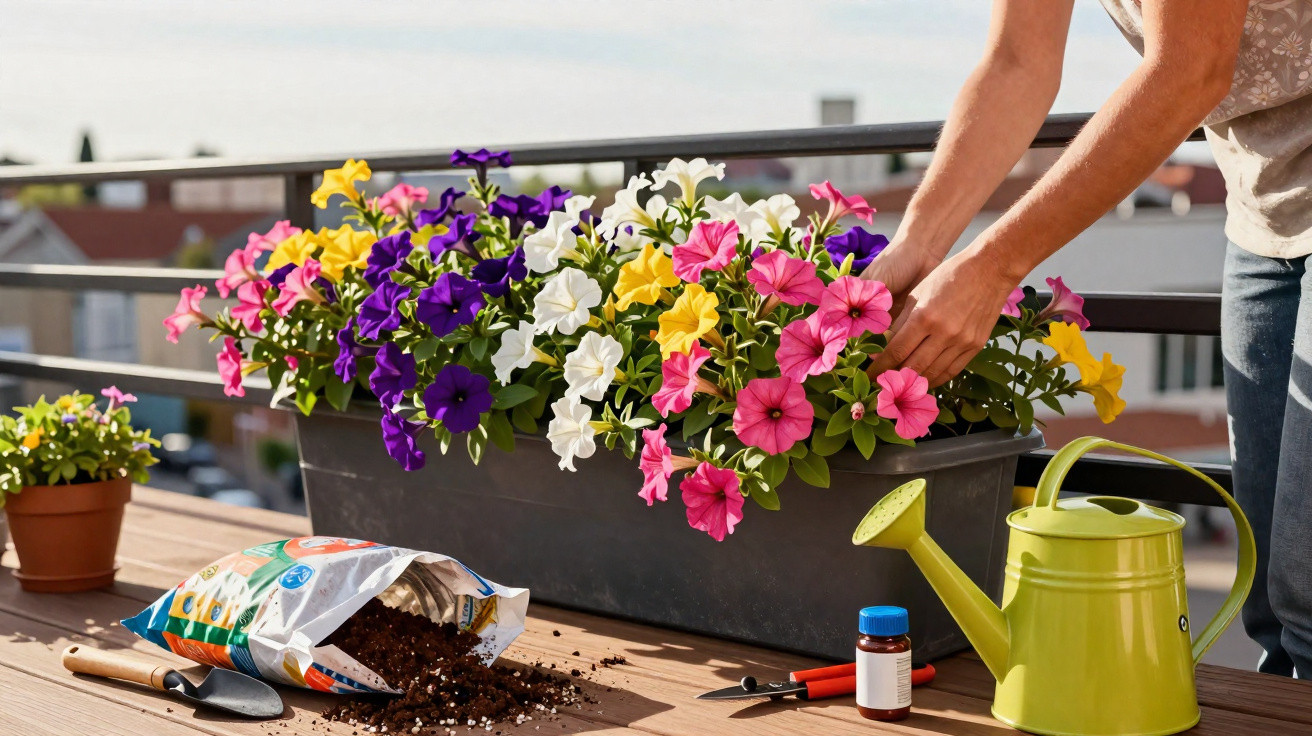
Glossy photographs of balconies spilling over with cascades of flowers can seem impossible to recreate. In reality, there is no magic involved: the effect comes from a remarkably low-maintenance flowering plant and a well-timed spring planting schedule. Put this plant in now and you can enjoy overflowing containers for months, without spending every Sunday standing beside them with pruning shears.
The secret star: Calibrachoa, the mini-petunia favourite
Many spectacular trailing planters rely on the same plant: Calibrachoa, commonly sold as “Million Bells” or mini-petunia. It is closely related to traditional petunias, but has a more compact habit and develops thick, trailing mounds.
A single plant generally grows to 15 to 30 centimetres tall, while spreading 30 to 60 centimetres wide. In window boxes and hanging baskets, this creates a rounded, cascading mass that produces hundreds of tiny bell-shaped blooms throughout summer.
Calibrachoa provides an almost continuous carpet of flowers from spring into autumn – perfect for balconies and patios.
The choice of colours is vast, ranging from pure white and lemon yellow to orange, pink, rich red and near-black violet. There are also bicoloured varieties with star-shaped or edged markings, alongside newer introductions such as “Superbells Magic Double Grapefruit”, whose double flowers shift from yellow to pink. These “chameleon” varieties can make a planter look as though several plants have been combined, when it may actually contain just one variety.
Another benefit that saves many balcony gardeners time is that the flowers are self-cleaning. Spent bells drop away naturally, so there is no need to spend hours deadheading to keep the container neat.
The key timing: when to plant in spring
Calibrachoa originates in warmer areas and is sensitive to frost. In central European gardens, it is essentially grown as an annual summer plant. Planting too early can cause growth to stall or lead to complete loss after a cold night.
The basic rule is to plant only once there is no longer a frost risk and night-time temperatures consistently remain above 8 to 10°C. Depending on the area, this planting window is roughly from mid-April to late May.
- Cooler locations and areas near the Alps: usually from late April to late May
- Towns, cities and wine-growing regions: often possible from mid-April
- For the safest option: allow one to two weeks after the Ice Saints
If planted prematurely, young plants can sit in cold, wet compost and barely begin growing. Setting them out shortly after the final frosts, into a properly warmed growing medium, allows their roots to fill the container calmly before high summer arrives. By July and August, the shoots will then spill attractively over the edge, producing the familiar “cascade of flowers”.
For a medium-sized window box or hanging basket, three to four young plants are recommended. Fewer can look sparse, while more soon results in competition for water and nutrients.
Turning a window box into a waterfall of blooms
Choosing the right container and compost
Calibrachoa does not tolerate waterlogged roots. Standing water quickly causes root rot, leaving plants stunted and liable to collapse. It therefore needs:
- A container with generously sized drainage holes
- A drainage layer of expanded clay or coarse gravel at the base
- Loose, free-draining compost for balcony containers
Many inexpensive multi-purpose composts retain too much water. Compost formulated specifically for window boxes or trailing plants is a better choice, often containing a higher proportion of structural ingredients such as bark or coconut fibre. This keeps the compost airy, lets excess water drain away and gives the roots sufficient oxygen.
Position: plenty of light, but plan for heat
In principle, Calibrachoa loves sunshine. A spot receiving at least four to five hours of direct sun each day will produce the most abundant flowers. However, a very hot south-facing position above heat-reflecting paving can become challenging if nobody is able to water regularly.
| Position | Suitability | Note |
|---|---|---|
| East-facing balcony | ideal | Morning sun, with gentler afternoons |
| South-facing balcony | very good | Intense heat – ensure there is enough water |
| West-facing balcony | good | Warm evening sun; watch for intense sun in high summer |
| North-facing balcony | problematic | Too little light, resulting in poor flowering |
Summer care: watering, feeding and light trimming
To keep flowering continuously, plants need a balance of steady watering, plentiful nutrients and occasional shaping.
Watering correctly
Allow the top of the compost to dry slightly between watering sessions. Constant wetness is harmful, but so is prolonged drought. Hanging baskets in particular dry out exceptionally fast on hot days.
- Water thoroughly in the morning, until water runs out from the bottom
- Empty saucers after a few minutes so that no water remains standing
- On exceptionally hot days, water again in the late afternoon if necessary
Anyone who is often away could consider planters with an integrated water reservoir or a drip-irrigation system. These can reduce periods of stress for the plants.
Feeding for continuous flowering
Calibrachoa is considered a “heavy feeder”. Producing countless flowers requires energy, and nutrient-poor compost soon leads to yellowing leaves and thinner flowering.
A starter feed when planting, followed by liquid fertiliser every 14 days, keeps the flowering machine running.
A controlled-release fertiliser, for example in cone or granular form, is practical when planting up. In addition, a liquid flower fertiliser every two weeks provides ongoing nutrients, especially in smaller containers with limited compost volume.
A light trim for the second flush of flowers
By around mid-summer, some plants may start to look tired, with individual shoots becoming long and thin. This is the time for a brief use of the shears:
- Shorten some of the longest shoots by around one to two centimetres
- If needed, cut back a few particularly thin, bare shoots more firmly
- Water well afterwards and apply a light feed
Trimming encourages fresh branching, and within a few weeks the container looks fuller again. This is often followed by a second, particularly generous flush of blooms lasting into early autumn.
Calibrachoa varieties especially worth choosing
Alongside single-colour favourites, an increasing number of specialist varieties are available. Particularly interesting options include:
- Chameleon types, whose flowers change colour as the season progresses
- Double varieties with rose-like flowers, ideal for romantic planting schemes
- Mini varieties with especially small but extremely numerous blooms
- Robust series that cope better with rain and wind
In Germany, many of these series are sold under protected brand names. If you are unsure, ask specifically for varieties that flower profusely and need little maintenance – garden centres usually know the reliable long performers well.
Smart companions for window boxes
Calibrachoa is happy to take centre stage, but it also works well with companion plants. Suitable choices have similar watering and feeding requirements, including:
- Trailing thyme or compact lavender for fragrance and bees
- White-flowering Diamond Frost (Euphorbia) for an airy addition
- Small grasses to add structure and movement
- Nemesia for extra splashes of colour in spring and early summer
Less suitable are exceptionally thirsty plants, such as some fuchsias that need considerably more water, or very vigorous geraniums that can quickly overwhelm Calibrachoa.
Common mistakes and how to avoid them
Most unsuccessful balcony displays involving Calibrachoa can be traced back to a small number of causes:
- Compost that is too heavy: water accumulates and roots rot.
- Too little light: plenty of foliage but few flowers.
- Irregular watering: alternating drought stress and wet conditions causes leaves to fall.
- Lack of fertiliser: plants become pale and flower numbers decline sharply.
Anyone who keeps these points in mind and uses the right planting time in spring has an excellent chance of achieving those overflowing, cascading window boxes otherwise seen only in catalogues.
For beginners, a small trial is worthwhile: use one box filled only with Calibrachoa, choose a variety you like, place it somewhere reasonably sunny, and maintain it consistently from April or May until September. Many amateur gardeners say afterwards that they rarely choose other summer flowers again. Its combination of appearance, flowering period and manageable effort is difficult to beat.

Comments
No comments yet. Be the first to comment!
Leave a Comment