
When you prepare the first beds towards the end of winter, you are likely to think about variety selection, frost protection and slugs. Hardly anyone expects that as little as one extra millimetre of soil over the seed can ruin the prospect of crisp carrots. An inconspicuous rule from professional vegetable growing determines whether spring brings a bare strip of soil or a rich green row of carrots.
Why carrot rows stay bare even when the packet was full
Many gardeners have experienced it: after waiting for weeks, perhaps a seedling appears here and there, while the rest of the bed looks completely lifeless. It is easy to blame supposedly “poor” seed or the whims of the weather. In reality, carrots usually fail much earlier, at the moment they are planted in the soil.
Carrot seeds are exceptionally small and delicate, with only very limited energy reserves. Every extra obstacle in the soil, and every additional millimetre, demands more energy. If those stored reserves run out, the seedling becomes trapped below ground and dies before it ever reaches daylight. From above, it simply appears as though nothing ever grew.
“The most important factor in successful carrot growing is not the variety, and rarely the temperature – but the exact sowing depth.”
The overlooked enemy: physical resistance in the soil
At the beginning of February, soil is generally damp and cool. When germination does not happen, many people point to the supposedly “too cold soil”. Yet early carrot varieties can cope with low temperatures, provided they receive reasonable protection beneath horticultural fleece or a tunnel.
Heavy, lumpy ground is a far greater issue. If the seed drill is made only roughly and then covered with the same clay-rich soil, it effectively creates a concrete seal for such fine seed. The germinating shoot tries to push upwards, meets a compacted or crusted layer, and uses its last remaining reserves there.
The result is that the carrot has already died while the gardener is still patiently waiting for the first hint of green.
The crucial half centimetre for carrots
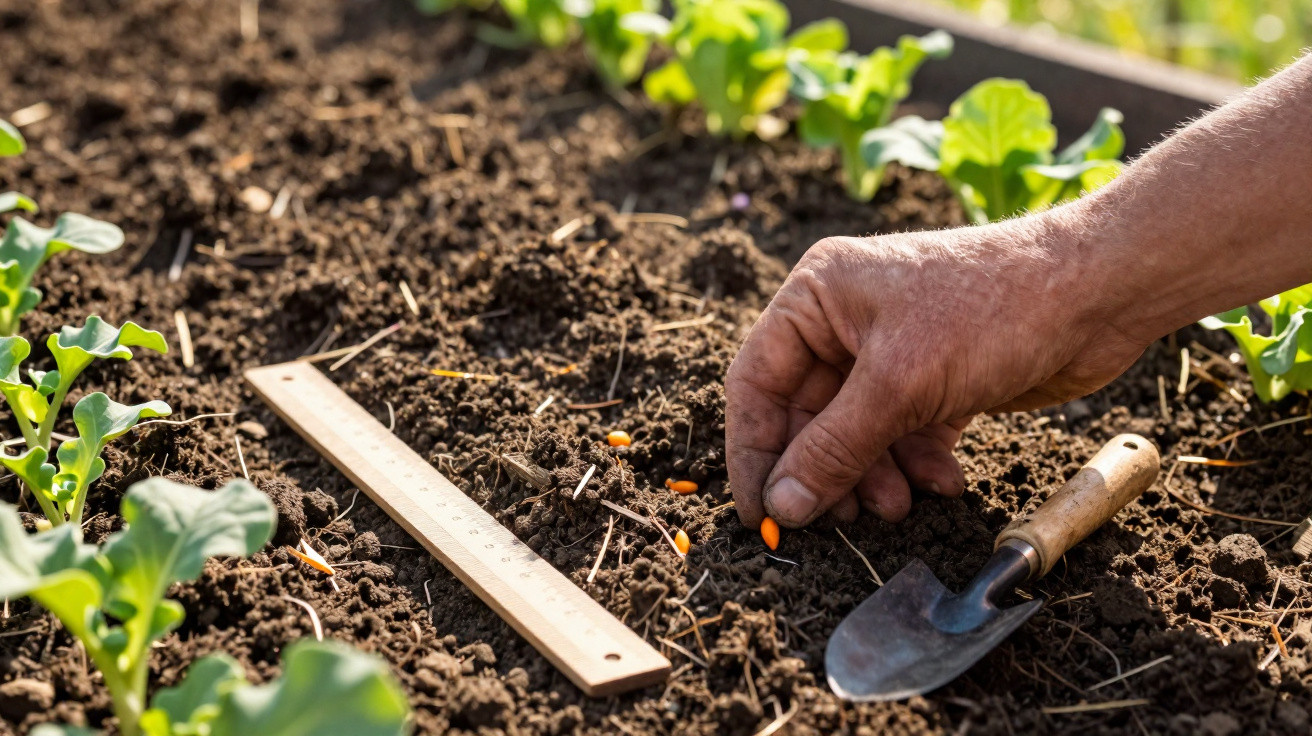
Professional vegetable growers follow a straightforward but strict rule: carrots must be sown extremely shallowly. This means a sowing depth of 0.5 to a maximum of 1 centimetre. No deeper.
Why must it be so precise? The answer is simple:
- Too deep (2–3 cm): The seed may germinate, but it expends all its energy trying to reach the surface. The seedling suffocates in the soil.
- Too shallow (simply laid on top): Wind and sunshine quickly dry the seeds out before they can germinate.
- Ideal (5–10 mm): A short route to the surface, sufficient moisture and minimal resistance allow the plant to break through.
The key range is therefore literally measured in millimetres. Anyone who draws a deep furrow with a hoe and then covers it generously is, quite literally, accidentally burying their carrots.
The sand and fine-soil method
Once you have established the correct depth, the next vital question is what to use to cover the seeds. A common mistake is to throw the heavy garden soil that was moved aside straight back over them. On wet clay soil, this can dry into a hard crust that tender seedlings cannot penetrate.
The following approach is considerably more reliable:
- Make a shallow drill in the bed, no deeper than 1 cm.
- Scatter the carrot seeds as evenly as possible.
- Cover them with a very fine, sieved material:
- either good-quality, finely sieved vegetable compost;
- or, even better, washed river sand.
Sand offers two clear benefits:
- It does not form a hard crust, even after heavy rain.
- Its lighter-coloured line marks the row, making later weeding much easier.
“Covering carrots with sand gives them a kind of lift to the surface: light, permeable and free from barriers.”
Water gently rather than washing seeds away
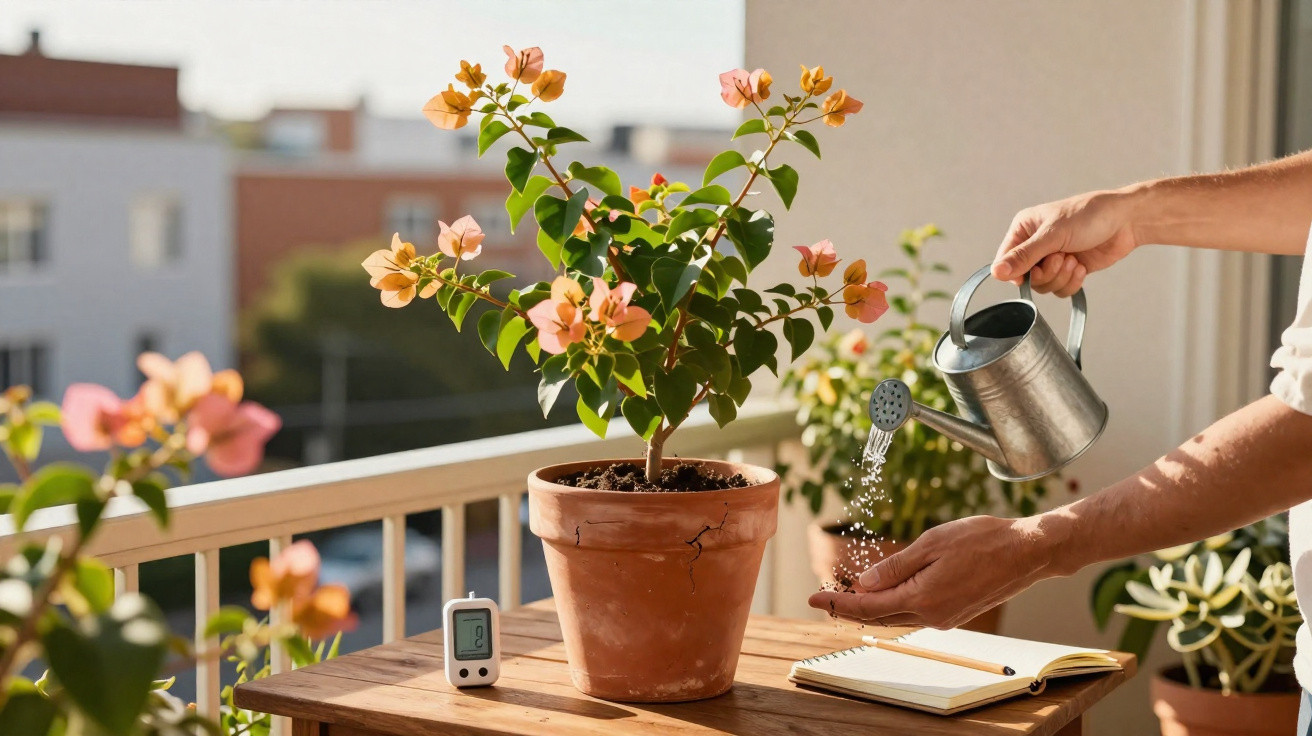
Even the ideal sowing depth is of little use if watering disrupts everything afterwards. A powerful stream from a watering can may wash seeds away or force them further into the ground. That carefully achieved half-centimetre sowing depth is then lost.
The best options are:
- A watering can fitted with a very fine rose, held slightly upwards so that the water falls like gentle rain.
- For small areas, a sturdy spray bottle that keeps the surface evenly moist.
During the first few weeks, the seed bed must never dry out completely, but it must not sit in water either. Aim for soil that is moist and crumbly. Depending on the temperature, the first green threads can take up to four weeks to appear in late winter. During this period, patience and consistent re-watering are essential.
When precision genuinely pays off
Working to millimetre accuracy in a vegetable bed may initially seem excessive. However, anyone who does it once will see a clear difference: patchy rows are replaced by dense, even bands of carrots. This not only saves seed, but also reduces the fiddly task of thinning seedlings.
It also makes more efficient use of the bed space. Where previously only every third or fourth plant emerged, nearly every seed position can now produce a proper carrot plant.
Other vegetables that benefit from the same rule
The millimetre rule is not exclusive to carrots. Other fine seeds respond just as sensitively to incorrect depth and coarse soil:
- Radishes: They can be placed slightly deeper than carrots, but do very well at 1 cm.
- Leaf lettuces: Their seeds are also small, so a heavy covering layer is harmful here too.
- Parsley: It germinates slowly and benefits from a fine, loose covering.
Applying the same care to these crops – a shallow drill, fine material and careful watering – greatly reduces frustration in the spring vegetable bed.
A practical check: how to test sowing depth in the bed
In everyday gardening, estimating millimetres in soil is difficult. A small aid can provide quick certainty:
- Use a ruler or wooden stick, marking 0.5 cm and 1 cm in colour.
- Place the stick in the drill as a test before sowing.
- Note how deep the furrow looks in relation to the stick; after preparing one or two beds, you will develop a good feel for it.
If you like using gardening aids, you can also make a simple sowing board with notched depth markings. It may sound almost like a children’s craft project, but it can prevent many failed attempts in spring.
The risks of ignoring sowing depth
Sowing too deeply does not only cause complete failure. Sometimes, part of the seed will still germinate, but late and weakly. The plants remain thin, develop little leaf growth and subsequently form much smaller roots. In the worst case, the surviving carrots may look “sort of okay”, but would have fulfilled their potential far more effectively with a better starting position in the soil.
There is another consequence: gaps in the row create space for weeds. Where carrots do not establish themselves, unwanted plants quickly take hold. This increases the work involved in hoeing and weeding because no closed canopy develops to shade the soil.
Why this millimetre question is more than gardening fussiness
Anyone growing their own vegetables invests time, water, space and patience. Carrots are among the vegetables that occupy a bed for a long time while requiring comparatively little space – provided they grow densely and evenly. A simple rule on sowing depth, applied consistently, turns this crop from a gamble into a dependable project.
At its heart, this is about recognising that small seeds offer very little margin for error. Every excess millimetre requires energy that they do not have. Those who sow according to the idea that “a little more will do no harm” seriously underestimate this effect. Precision on sowing day pays off weeks later in the harvest basket – visibly, measurably and, above all, in flavour.

Comments
No comments yet. Be the first to comment!
Leave a Comment