
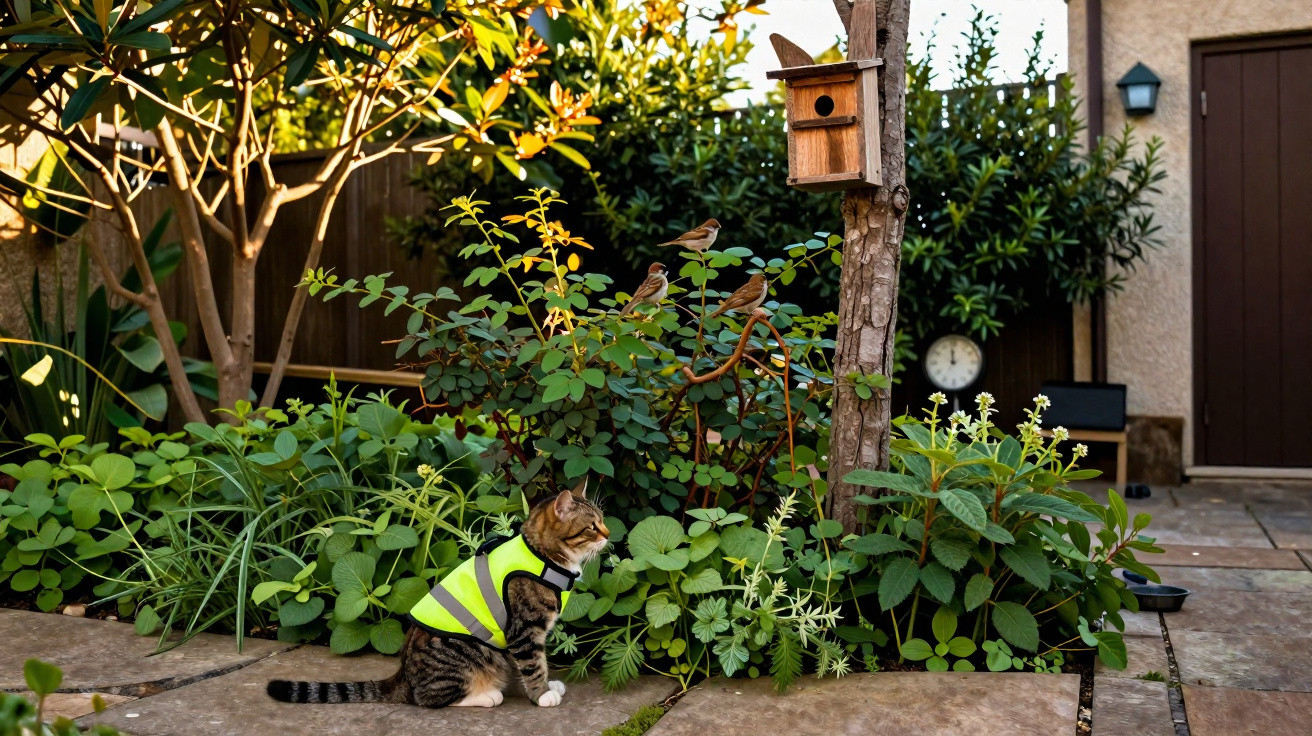
? There is no need to choose – a few smart measures make both possible.
Many owners know the uneasy feeling when their beloved feline companion walks through the patio door with a bird in its mouth. You love your house cat, but do not want to stand by as the garden gradually becomes a bird-free zone. The good news is that nobody has to choose between cats and birds. With a well-planned garden design, the needs of both can be balanced effectively.
Cats as pets – and hunters at heart
Domestic cats may seem tame and relaxed in the living room, but their instincts switch on in the garden. Studies from several European countries show that free-roaming cats catch millions of birds every year. The figures differ by region, yet the overall pattern is clear: their impact on bird populations is substantial.
“Even cats that are very well fed still hunt – not because they are hungry, but because of instinct and their urge to play.”
The period from March to July is especially sensitive. At this time, many nests are found in hedges, among ground-cover planting or in low shrubs. Young birds are making their first attempts at flying, sitting on the ground or just above the grass. For cats, this is like an easily accessible buffet.
Anyone who believes the issue can be solved by keeping the garden immaculate and ultra-tidy will usually achieve the opposite. Closely mown lawns, bare beds and cleared corners remove birds’ hiding places and secure nesting sites. They are then left exposed in plain sight – an ideal situation for any hunting cat.
The 3-2-1 rule: making the garden a refuge rather than a hunting ground
A bird-friendly garden does not have to be wild or chaotic, but it does need layers and cover. The practical 3-2-1 rule can be used to create a kind of “green fortress” for songbirds.
Dense ground cover as a secure foundation
The lowest layer is crucial. Birds need cover here to forage on the ground or conceal their young. Strong, thick-growing plants are ideal, including:
- various sedge species (Carex)
- cranesbill (Geranium), especially perennial varieties
- mat-forming perennials such as lamb’s ear or periwinkle
- taller grasses that are not cut back completely
These plants create a canopy of foliage just above ground level. Birds can dart beneath it, while cats find it considerably harder to follow them or even spot them at all.
Thorny shrubs as a natural protective barrier
The second layer consists of shrubs, ideally those with thorns. What is troublesome for cats is perfect for birds. Suitable choices include:
- hawthorn
- blackthorn
- field rose or dog rose
- barberry
- hazel, combined with thorny species in a hedge
Blackbirds, sparrows and finches can rest and nest among the branches. Cats have far more difficulty getting into these areas and, if they do, are more likely to hurt themselves or give up in frustration.
Trees as an upper storey and visual screen
Trees form the third layer, including smaller ornamental trees or tall standard shrubs. They provide:
- high perches for birds that want to assess the situation from above
- “breaks in the view” so that a cat cannot see every square metre
- space for elevated nests or nest boxes
Combining these three layers does not turn the garden into a no-go area for cats, but it does make it a much more confusing and safer environment for birds.
Safe nest boxes: build, hang and position them properly
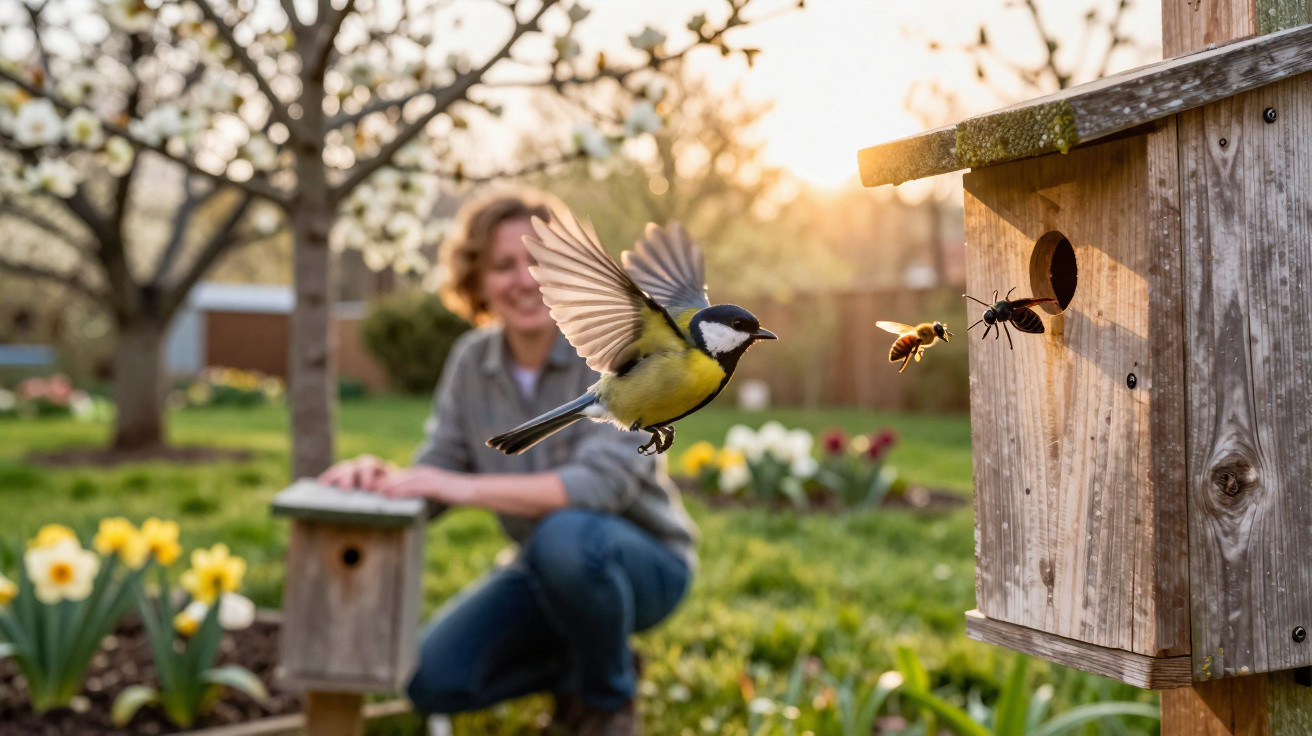
A second key element is nest boxes that do not become an easy cat feeding station. Many commercially available designs look attractive, but are constructed in a highly unsuitable way.
“A good nest box protects against the weather – and against paws curiously reaching through the entrance hole.”
Garden owners should pay attention to the following:
- Height: around 3 metres above the ground, rather than directly beside a balcony, shelf or a thick horizontal fork in a branch.
- Orientation: ideally, the hole should face east or south-east so the box is not constantly exposed to rain or overheated by the midday sun.
- No perch: the decorative “perch” beneath the hole mainly helps predators gain access.
- Internal depth: there should be 15 to 20 centimetres between the entrance hole and the base, so a cat cannot reach the nest with its paw.
It is also worth checking the immediate surroundings: are there ivy stems, a dense fence or pieces of furniture right beside it that would allow a cat to jump up easily? If so, choose a different location.
Time restrictions for outdoor cats: a small limit with a big effect
One factor that is often underestimated is when cats are allowed outside. Most cats are most active at dawn and dusk. Those are precisely the times when many birds are on the ground or feeding their young.
Keeping an outdoor cat indoors during the critical hours in spring and early summer can save the lives of many young birds. In practical terms, this means:
- not letting the cat out at first light
- bringing it back indoors from late afternoon, or at the latest by sunset
- shifting the most intensive hunting periods to birds’ “night-time rest”
Naturally, this will not work smoothly with every cat. Some will protest loudly. A little training, indoor enrichment such as puzzle toys, hidden food and clicker training, plus consistency, can help.
Bright warning collars for cats: what specialist collars can do
Another useful measure is a coloured collar with a wide fabric ruff. Products are available that are specifically intended to warn birds. Their vivid colours and patterns stand out strongly against the garden’s greenery. Birds notice the movement sooner and can fly away in time.
“The more noticeable a cat appears to birds, the lower the chance of a surprise attack.”
With any collar, the animal’s safety comes first. A breakaway fastening that releases if the cat gets caught is essential. Bells, by contrast, are less effective than many people assume and can also irritate many animals.
Gentle deterrents: scents, plants and barriers
If you want to make certain areas, such as the space directly beneath a nest box, less appealing to cats, scents and physical obstacles can help. Popular options include:
- coffee grounds in beds, beneath hedges or around feeding areas
- bowls containing citrus peel in sensitive locations
- scented plants such as the “scaredy-cat plant” (Coleus canina), whose smell cats avoid
- metal guards or mesh around tree trunks to make climbing more difficult
Such measures should always be used in moderation. The aim is not to drive the cat out of the whole garden, but to make particularly vulnerable areas unattractive.
Long-term responsibility: care, neutering and the local environment
The debate around hunting domestic cats also raises a fundamental question: how responsibly do owners look after their animals? It involves more than good food and affection.
- Neutering: reduces feral cat populations and therefore the total number of hunting cats in an area.
- Identification: a microchip or tattoo helps prevent animals from ending up classed as “ownerless” and breeding without control.
- Talking to neighbours: where several cats live in the same neighbourhood, shared agreements can help – for example, on outdoor hours or garden areas that need particular protection.
Many local authorities now support measures to protect biodiversity, from natural-style front gardens and wildflower strips to information campaigns about outdoor cats. Anyone who adapts their own garden is sending an important message and showing that care for animals and nature conservation do not have to be mutually exclusive.
Practical examples for a peaceful garden routine
What might this look like in practice? One typical scenario involves a family with two outdoor cats planting a mixed hedge of hawthorn, blackthorn and hazel along the garden boundary, with dense perennials beneath it. In the middle of the garden, they retain a wild corner with leaves, dead wood and long grass. Nest boxes are hung high in an apple tree, while the cats wear bright collars and are kept indoors in the early morning. After a year, the result is clear: more birdsong and fewer “gifts” outside the front door.
Examples like this are encouraging. There is no need to redesign the entire garden at once; it is possible to proceed step by step: start with a few ground-cover plants, add a thorny shrub, then later install a securely positioned nest box. Every measure reduces the risk to birds a little further without depriving cats of fresh air and exercise.
Ultimately, a realistic view is needed: hardly any outdoor cat will live without catching prey altogether. Yet with some planning, creativity and goodwill, the garden can change from a quiet arena into a lively retreat – for curious paws and for everything that sings, flutters and rustles in the undergrowth.



Comments
No comments yet. Be the first to comment!
Leave a Comment