
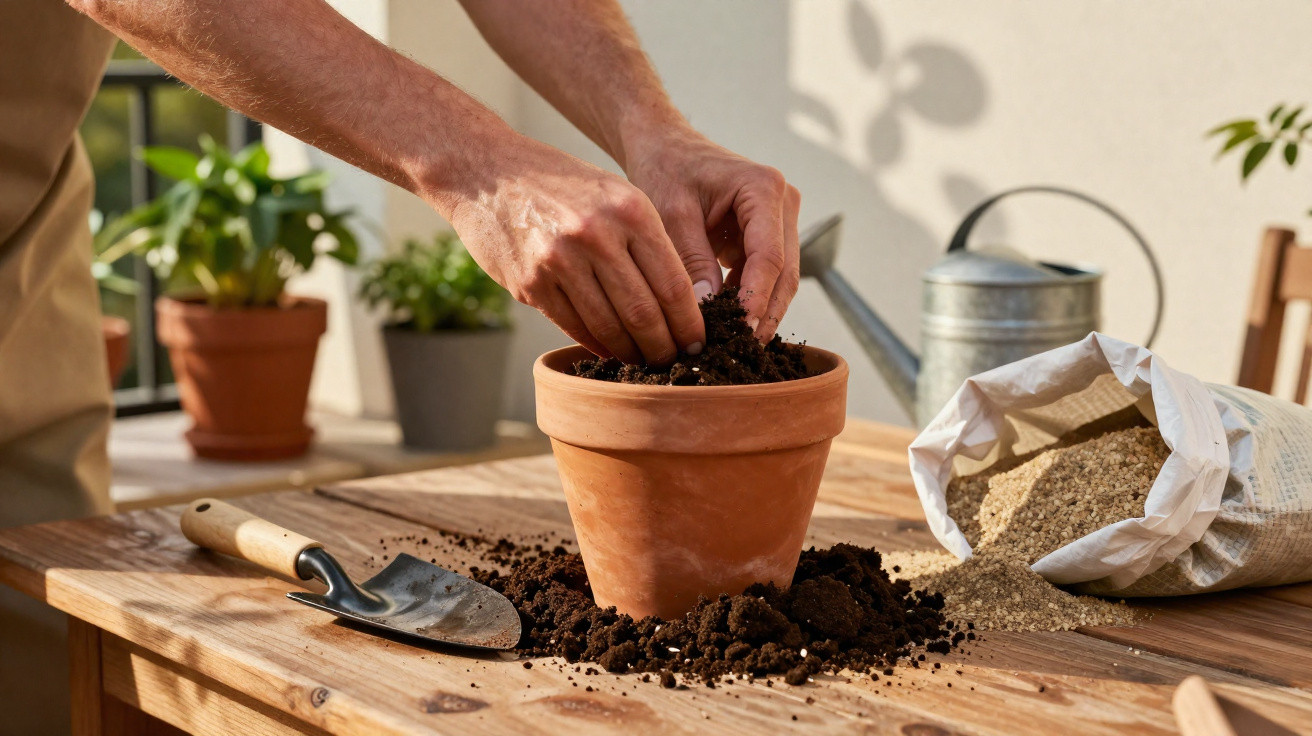
The balcony planters were still dripping from the overnight rain when I opened the bag of potting compost. That rich dark brown colour, the familiar scent of peat, a little compost, a little hope. Beside it sat an unremarkable bucket of building sand left over from some DIY job. “Mix some of that in and they’ll grow better,” said the neighbour with the perfect tomatoes. So I tipped the sand into the compost and worked it through with my hands as if I were mixing an oversized cake batter, noticing how the texture changed. Suddenly, the compost was lighter, more crumbly and less claggy.
As the first drops of water seeped through the new growing medium, a quiet question arose – one that many amateur gardeners secretly wonder about.
What really happens when you mix potting compost with sand – and why does seemingly every other gardening legend swear by it?
What happens in a pot when potting compost meets sand
Anyone who has lifted an old, thoroughly soaked plant from its container will recognise the sight: a compact, weighty mass that holds water back rather than letting it drain away. On its own, potting compost can start to feel like concrete after a few months. Add sand, however, and something interesting begins to happen. The compost becomes more open, tiny air channels form, and water passes through more quickly. Roots suddenly find routes through the pot instead of meeting a wall of sludge.
It may sound unremarkable, but it makes a real difference in everyday gardening. Watering-can moments become less stressful, waterlogging is less common, and repotting feels less like a gamble. For plants that hate “wet feet” – herbs, Mediterranean plants and succulents – this type of mix can often make the difference between merely surviving and putting on a genuine burst of growth.
We all know the moment: you push a finger into the compost in high summer and think, “Dust-dry on top, probably a swamp underneath.” This is exactly where sand helps. Take a potted tomato as an example. In pure potting compost, it receives water every day; the surface dries out while a wet core develops below. The roots remain in constant dampness, fungi thrive and the leaves turn yellow. If the potting compost is mixed beforehand at a ratio of 3:1 with sand, water moves through more evenly, the tomato develops a denser root system and diseases occur less often.
Horticultural studies show that an open growing medium with stable air spaces measurably encourages root growth. Sand itself supplies hardly any nutrients; within the mix, it is more of a quiet structural engineer. It separates the particles of potting compost, creating gaps where air and water can circulate. That may sound dry when expressed in technical terms, but in practice it simply means fewer rotten roots, less musty odour and less drama when watering.
Take a step back and the effect is almost obvious. Potting compost contains plenty of organic material, which gradually settles and compacts over time. Without a material to maintain its structure, it clumps together, water lingers and oxygen becomes scarce. Sand – particularly coarse, washed quartz sand – acts like an internal framework in the pot. Its grains do not rot away, retain their shape and keep cavities stable. Plant roots use those gaps like little motorways. Let’s be honest: nobody repots every Ficus plant every six months just to restore its structure. Mixing in sand slows this decline in the compost and gives plants more room before the next major repotting is needed.
How to mix potting compost with sand without stressing your plants
The easiest method feels almost childlike: a bucket of potting compost, some sand, then get your hands in. For most houseplants and balcony flowers, a blend of around 3 parts potting compost to 1 part sand works well. For herbs such as rosemary, thyme and lavender, it can be sandier, at roughly 2:1. Succulents and cacti prefer an even more extreme blend; many gardeners use 1:1, or even more sand, often with a little expanded clay or fine gravel added as well.
What matters is that the sand is preferably washed and fairly coarse. Damp mortar sand from a building site often contains fine particles and salts that nobody wants in a plant pot. The process is straightforward: put the potting compost in a tub, add the sand, combine everything thoroughly with your hands, break up any lumps and feel the texture. Only once the blend appears even should plants and water enter the picture. This small extra step can save a great deal of frustration later.
Common mistakes happen precisely when the mix is thrown together “just quickly”. Too much sand certainly makes compost free-draining, but it also causes it to dry out very rapidly. Anyone who then carries on watering as before may be surprised by limp shoots and scorched leaf edges. Sand that is too fine can create the opposite problem: it blocks the pores, leaving the mixture heavy and compact. There is another point many people overlook: sand dilutes the nutrients in potting compost. Unless you feed a little more regularly, sensitive plants can gradually develop a deficiency.
To put it sympathetically, nobody wants to look at yellow leaves three weeks after a hopeful repotting session and feel bad about it. It helps to keep an eye on plants, especially during the first month after their sand treatment. Slightly more frequent watering, a gentle feed and some shade in blazing sunshine are small adjustments that can make a major difference. You do not need to be an expert to notice it – just a little attentive.
An experienced urban gardener once said something to me that has stayed with me ever since:
“Sand is not the answer to everything, but it prevents the most common watering sins we commit in our pots.”
With that in mind, a few simple guidelines almost follow naturally:
- Mixing potting compost with sand is especially worthwhile for potted plants that suffer from waterlogging.
- Herbs, Mediterranean plants and succulents can cope with a considerably higher proportion of sand.
- Use coarse, washed sand – not purely fine building material.
- After mixing, water a little more often but moderately, and plan for regular nutrient feeds.
- Watch plants during the first few weeks: they will “tell” you whether the mix has turned out too dry or too dense.
Why this simple potting compost and sand mix changes how we see gardening
Once you have consciously felt a sand-mixed potting compost in your hands, you will never look at a standard bag from the DIY shop in quite the same way again. You begin to understand that compost is not a static material but a changing system. Mixing in sand does not mean knowing a secret magic formula; it means actively shaping the balance between water, air and roots. Gardening suddenly seems less mysterious and more like a quiet craft that becomes easier to understand with every pot.
At its heart, there is an emotional side to it too. We become attached to these plants: a grandmother’s geranium, the basil in the kitchen, the Monstera in the living room. When they die, it can feel disproportionately sad. Something as simple as reaching for sand can address the point where frustration and guilt would otherwise set in. Rather than thinking, “I don’t have green fingers,” you realise that the roots simply did not have enough air. That takes away some of the pressure – and makes you want to start again.
Perhaps that is the quiet truth behind mixing potting compost and sand: it makes us look more closely at the unseen world inside a pot. At the paths water takes, the fine roots and the small ecosystem living on the windowsill. Once you have felt these connections, you start experimenting, comparing and sharing what you find. And that is exactly how the stories end up back on the neighbour’s balcony – with a bucket of sand, a bag of compost and the quiet hope that this time, it really will work better.
| Key point | Detail | Benefit for the reader |
|---|---|---|
| Sand loosens potting compost | More air spaces, better drainage, less waterlogging | Healthier roots and a lower risk of rot and fungal attack |
| The right mixing ratio | Usually 3:1 (compost:sand), with a higher sand content for herbs and succulents | Practical guidance for different plant types |
| Avoiding mistakes | Do not use overly fine, unwashed building sand; account for nutrient dilution | Fewer disappointments and more efficient use of compost, water and fertiliser |
FAQ:
- Can you mix any potting compost with sand? Yes, most commercially available potting composts can be combined with sand. With specialist composts that are already heavily fertilised, such as compost for rhododendrons, the mix is more likely to improve structure than be necessary.
- Which sand is best? Washed quartz sand with a fairly coarse grain size is ideal, for example play sand or filter sand. Very fine building sand can clog the pores and make the compost compact again.
- How does sand change watering needs? The compost dries faster at the surface and water runs through it more readily. You will tend to water slightly more often, but greatly reduce the risk of waterlogging.
- Do plants in sandy compost need more fertiliser? Yes, because sand provides no nutrients and effectively stretches the existing potting compost. Regular but fairly gentle feeding keeps the balance right.
- Is mixing in sand useful for garden beds too? Only to a limited extent. In heavy clay soils, a large amount of coarse sand can improve the structure, but in many garden soils compost and mulch offer more because they also add nutrients.
Comments
No comments yet. Be the first to comment!
Leave a Comment