
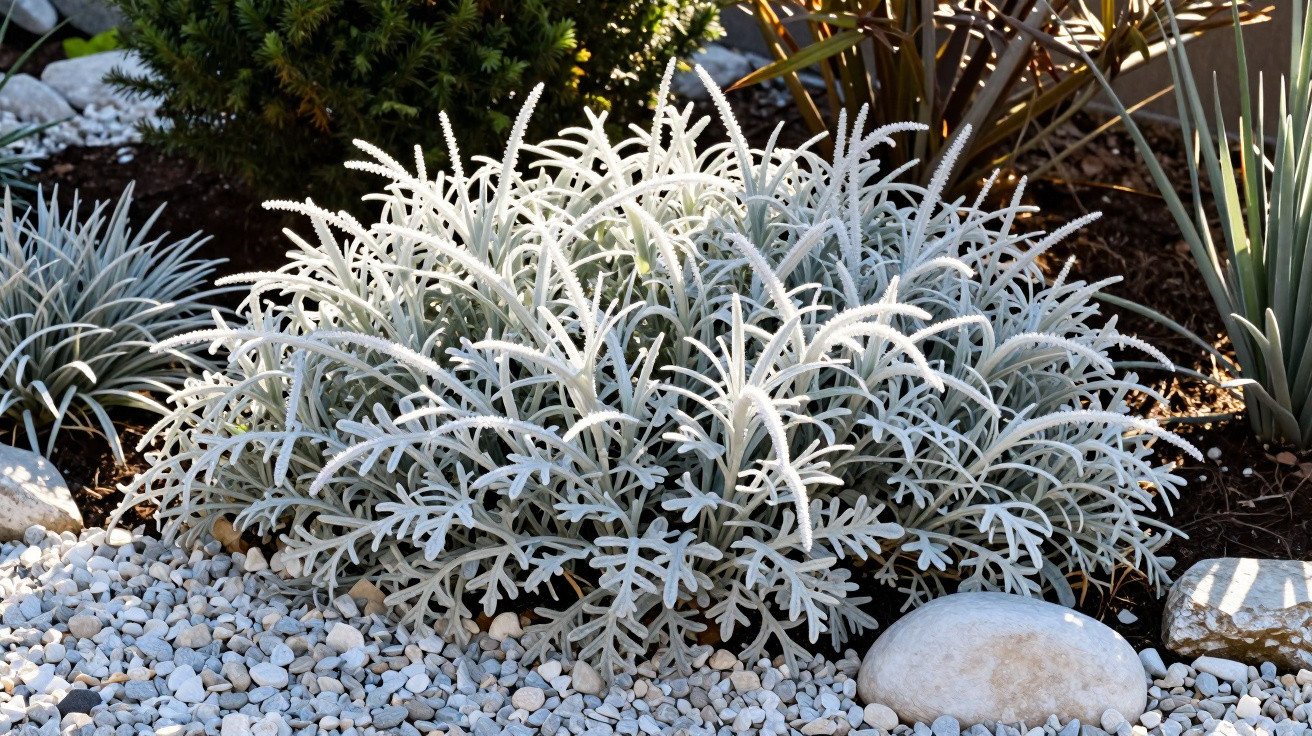
A straightforward pairing of silvery-white plants can give even the plainest border an almost wintry charm.
When the first mild days arrive, the garden can often feel disappointing: there are barely any flowers, plenty of bare soil, and everything looks more tired than newly awakened. In this in-between period, when it is still too early for a full floral display, a thoughtfully planted perennial border can look as though patches of snow remain among the plants – without frost or cold, simply through the right choice of plants and materials.
A snow illusion in the March border
Why pale foliage suddenly makes the garden seem larger
The appeal of this scheme comes from its striking contrast: dark, still-damp soil meets pale, almost white foliage. Even a narrow strip of these plants beside a path or along a border edge is enough to draw the eye immediately. Pale areas are perceived as light, reflection and sometimes even hoar frost.
This effect is particularly powerful in small town gardens or narrow front gardens. Light areas visually open up the space, while darker ones recede into the background. Anyone who feels their garden is closing in around them can create a surprising sense of lightness with a silvery edging of perennials and stones.
“Pale, silvery foliage against dark soil creates the impression of thawing snow in March – and cleverly conceals the remaining brown gaps.”
How light turns silver foliage into a focal point
The impact increases as soon as the sun breaks through the clouds, even briefly. The fine hairs on some leaves reflect the light, creating tiny points of sparkle like those on a thin layer of frost. These surfaces glow even in low evening sunshine, adding structure to an otherwise grey spring scene.
This approach works so well mainly because, at the end of winter, most gardens are dominated by brown and green shades. Silvery foliage introduces a third colour group, creating interest without appearing garish.
The ideal duo: a velvety carpet and silvery “lace”
Stachys byzantina: the soft foundation
The basis for this “snow effect” is a tough perennial: Stachys byzantina, commonly known as lamb’s ear. It forms dense cushions of soft, felted leaves with a velvety texture. Their surfaces are covered in fine down that scatters light in countless directions.
Lamb’s ear is ideal for sunny, relatively dry positions. Once established, it manages with little water and spreads slowly but reliably. In gardens with children, its soft leaves often become a favourite thing to touch.
- Position: full sun to partial shade
- Soil: rather poor, well-drained, dry to moist
- Care: pull away brown or soggy leaves after winter
- Benefit: forms a dense, weed-suppressing carpet
Artemisia: an airy veil of frost above the carpet
Rising above this soft ground cover is the second leading plant: Artemisia, often called wormwood or southernwood. Many varieties have finely divided, almost fern-like leaves in a pale silvery grey. Their delicate shoots resemble fine lace above the velvety foliage of lamb’s ear.
Artemisia adds height and structure to the border without making it feel heavy. Its foliage shifts gently in the wind, making the “snow veil” appear to shimmer. It too prefers dry, poor ground, which makes it an excellent companion for its soft partner.
For beginners, compact, bushy varieties commonly sold as ornamental wormwood or southernwood are particularly suitable. They remain manageable, do not become overly woody and are easy to keep in shape.
The third trick: stones that resemble frozen snow
A pale chipping layer as the connecting element
The scene only truly resembles lingering slushy snow at the edge of a path once a mineral layer is added. Spread a 3 to 5 centimetre layer of pale decorative pebbles or chippings between and around the perennials; pearl grey, crushed marble and pale granite are particularly effective choices.
This layer visually ties the two plants together. The transitions become blurred: where does a leaf end and a stone begin? That is exactly where the illusion of a small drift of leftover snow is created. At the same time, the border edges look neat, defined and contemporary.
Stone mulch: protection and easier maintenance
The pale gravel layer does more than look attractive: it also supports plant health in the background. Between warm daytime conditions and cool spring nights, the stone provides a modest buffer against temperature changes. Root temperatures remain more stable, so short cold snaps affect the perennials less.
It also reduces water loss, while allowing the soil surface to dry more quickly without drying out completely. This particularly suits plants that dislike waterlogging. Weed seeds also find it much harder to establish themselves in the stone layer. Anyone who does not enjoy constant weeding will appreciate this additional benefit.
“A 3–5 centimetre layer of pale pebbles not only creates the snow effect; it also saves the garden owner a great deal of weeding.”
Creating a “snow-covered” spring border step by step
Prepare the soil: dry rather than boggy
Silver-leaved perennials strongly dislike sitting in wet soil. Some preparation is therefore especially important on clay soils. Add a layer of coarse sand or fine gravel to the planting holes, mixed with the existing garden soil. This creates a free-draining base through which rainwater can run downwards.
If the soil is very heavy, you can also make a slightly raised border. Even a difference in height of only a few centimetres encourages better drainage. In these subtly raised sections, the pairing of lamb’s ear and Artemisia thrives much more successfully and remains vigorous for longer.
Planting and positioning correctly
For a border edge around two metres long, you will generally need:
- 2–3 pots of Stachys byzantina for ground cover
- 1–2 strong Artemisia plants to provide structure
- one bag of pale, medium-grade decorative pebbles for the mulch layer
Place lamb’s ear at the front, close to the path or edge of the border. Position the Artemisia plants behind it or between the cushions, leaving them some room to develop. Once everything has been planted and watered in thoroughly, add the gravel layer. Important: do not tip gravel directly over young shoots; work it carefully between them instead.
Spring tidy-up: minimal effort, major impact
A quick inspection in late winter or very early spring is worthwhile. Carefully pull off any black, soggy or very old lamb’s ear leaves. Lightly cut back old, dry Artemisia stems using clean secateurs. This gives the young shoots light and air, while the “snow carpet” regains an even, fresh appearance.
Dark companions make the silver shimmer stronger
Contrasts that maximise the snowy magic
Silver is most impressive when surrounded by darker planting. Perennials with almost black or deep-purple foliage are therefore ideal in the background. Heucheras in dark berry shades, or the jet-black mondo grass Ophiopogon planiscapus ‘Nigrescens’, bring drama to the arrangement.
When planning a border, begin with a simple combination of three:
- At the front: Stachys byzantina as a soft edging
- In the middle: Artemisia for silvery height
- At the back: dark-leaved plants as a backdrop
This creates a natural spotlight effect: the silvery duo seems almost luminous as its surroundings become darker.
Silver plants – more than decoration
Many grey and silver perennials originate from regions with abundant sunshine and little rainfall. In nature, their pale down or grey waxy leaf coating protects them against excessive water loss. By using these plants in the garden, you are also creating a more robust, drought-tolerant border.
At a time of more frequent heatwaves and dry periods, an area like this can become an example of low-maintenance, climate-adapted garden design. The apparently “purely decorative” silver duo of lamb’s ear and Artemisia therefore also becomes part of a garden designed for the future – with the pleasing additional effect that, in March, it genuinely looks as though someone has scattered a dusting of snow along the border edges.


Comments
No comments yet. Be the first to comment!
Leave a Comment