
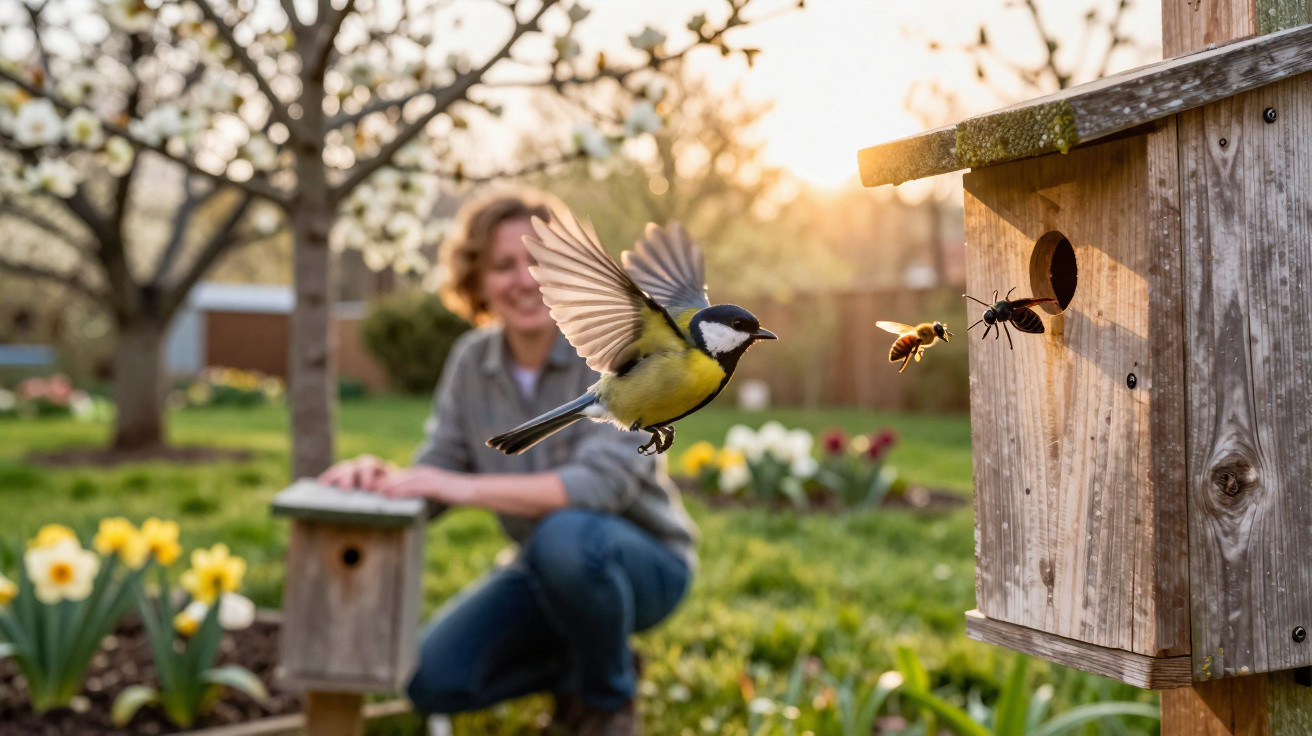
In more and more gardens, the same concern emerges each spring: an introduced hornet species is hunting bees and other pollinators. Those who respond too late have usually already lost the battle. Yet a familiar songbird, the tit, can help contain the threat – provided you offer it suitable accommodation in good time.
Asian hornet in the garden: why March is so crucial
The Asian hornet has spread rapidly through many parts of Europe. Introduced at the beginning of the 2000s, it has now become very well established in our climate. The problem is that it consumes large quantities of honey bees and other insects that pollinate flowers.
The hornet’s annual cycle begins at the end of winter. Queens that have overwintered emerge from dormancy and look for a sheltered location in which to establish a new nest, such as a garden shed, a tall tree or beneath a roof. If they are left undisturbed, the colony can grow quickly.
Estimates suggest that a single colony can consume up to eleven kilograms of insects each year. A substantial proportion are pollinators – precisely the animals amateur gardeners generally want to protect. Anyone who only reacts to the large number of hornets in high summer is often too late: by then, the nest is large, there are numerous workers, and any attempt at control becomes risky.
“Those who act in March can significantly reduce pressure from hornets – and noticeably ease the burden on bees and wild pollinators.”
Experts agree that completely eradicating the Asian hornet is unrealistic. It reproduces prolifically, has very few specialist predators and spreads across entire landscapes. Individual predators, such as bee-eaters or certain birds of prey, occur only locally. For the home garden, something is needed that is present almost everywhere and readily eats insects: the tit.
Why tits become discreet hornet hunters in spring
Blue tits, great tits and coal tits are among the most common garden birds. Their appetite for insects is particularly immense during the breeding season. They feed their young almost entirely on small creatures: caterpillars, larvae, spiders and beetles – as well as hornet larvae where available.
During the feeding period, a pair of tits flies back and forth tirelessly. Experts estimate between 500 and 900 feeding trips each day. Over just a few weeks, the birds consume thousands of caterpillars and larvae. If a hornet nest is nearby, its larvae can also end up in their beaks, as long as the tits can reach them safely.
The great tit in particular shows a certain preference for nests in its surroundings. It readily settles close to such structures and takes advantage of the opportunity: dead hornets in an old nest, leftover larvae or weak individuals are eaten. This removes some of the colony’s future potential for young queens.
However, tits should not be regarded as a miracle solution. They are opportunistic, eating whatever is plentiful and easy to access. No bird, nor any single animal species, can fully control the Asian hornet on its own. Tits instead create ongoing but moderate pressure on the hornet population – like a gentle brake within the system.
“Tits do not replace professional control; they complement it – while also strengthening the ecological balance in the garden.”
How to attract tits to your garden from March
For tits to assist with insect hunting, they need to settle in the garden. Suitable nesting sites and plentiful food are key.
The right nest box: dimensions, position and timing
Natural tree cavities are scarce in many gardens. Nest boxes fill this gap. Anyone who is prepared in March has a good chance of attracting a pair, as competition for nesting holes is especially fierce then.
- Material: untreated wood, or wood given only light weather protection on the outside
- Design: an enclosed box with a round entrance hole
- Entrance-hole diameter: around 2.5 to 3 centimetres – ideal for tits
- Height: 2 to 5 metres above ground level, to keep cats and martens away
- Position: as sheltered from the wind as possible and away from strong midday sun
- Timing: put it up before the middle of March, so searching pairs can find it in time
Once accepted, a nest box is often used by tits for many consecutive years. Simple cleaning in late autumn, once the box is certainly empty, is normally sufficient.
Making the garden friendly for tits
Nest boxes alone are not enough. These birds also need food, cover and water. A few targeted measures can turn a garden into an ideal territory:
- Food towards the end of winter: sunflower seeds, nuts and vegetable fats. Stop supplementary feeding from the end of March so the birds switch fully to insects.
- Plant native shrubs: such as elder, hawthorn or hazel. They provide insects, berries and shelter.
- Allow wild corners: a little dead wood, piles of leaves and unmown areas support many insect larvae.
- Provide water: use a shallow dish or a small pond, cleaned and refilled regularly.
- Avoid poisons: pesticides harm insects and therefore directly reduce the tits’ food supply, while often harming the birds themselves too.
- Respect nesting sites: do not open or move nest boxes during the breeding season, and do not disturb nests.
“A lively, slightly ‘untidy’ garden is considerably more valuable to tits and other beneficial creatures than a perfectly maintained lawn.”
Help from tits is not enough: what else you must do against Asian hornets
Useful as tits are, they do not remove the need for targeted action against specific hornet nests. If you find a nest at your home or in the garden, do not attempt to deal with it yourself. The insects defend their home fiercely; stings are painful and can be dangerous during group attacks.
A two-pronged approach makes sense:
| Measure | Aim |
|---|---|
| Encourage tits | Permanently increase pressure on larvae and young queens |
| Report nests | Ensure large colonies are professionally removed |
| Avoid pesticides | Protect pollinators and beneficial creatures, strengthening natural enemies |
| Create a structurally varied garden | Provide habitat for birds, wild bees and other insects |
If you spot a nest, contact local authorities, beekeeping associations or specialist pest-control professionals. Many areas have already established formal reporting routes. Using traps or poison independently often harms protected insects as well and may do more damage than good.
What else bees and gardens gain from tits
The benefits of tits are not limited to the Asian hornet. They consume large numbers of caterpillars, aphids and other pests on fruit trees, roses and vegetable plants. In some areas, fruit growers deliberately install nest boxes in orchards to reduce the use of sprays.
For hobby beekeepers, a garden that welcomes tits is worthwhile twice over. On the one hand, it reduces pressure from insect-eaters such as the hornet; on the other, bees benefit from a generally richer plant and insect environment around the apiary. More wild plants mean more forage, while fewer toxins in the garden reduce stress and losses within the colony.
Another factor is often underestimated: tits are extremely faithful to their territory. Once established, they usually remain nearby. Over the years, they therefore form a type of natural “insect police”, regularly searching the area for possible prey – including hornet larvae whenever the opportunity arises.
Practical tips for getting started this spring
Anyone wishing to take action now can begin with very little effort. Three steps are enough to improve the chances of visits from tits this year:
- Buy or build one or more nest boxes and put them up no later than the middle of March.
- Deliberately leave part of the garden “wild” and avoid poison throughout the entire area.
- Set out a shallow water bowl, then clean and refill it regularly.
Many garden centres, DIY shops and online retailers sell suitable boxes. Those with some practical skills can easily find building instructions with precise dimensions. The correct entrance-hole diameter and a secure fixing that remains stable even in windy conditions are always important.
A small shift in perspective soon makes one thing clear: not every insect in the garden is an enemy, and not every bird is simply pleasant birdsong. Tits are small, hard workers with an appetite for precisely the larvae that worry many gardeners. Giving them an opportunity in March supports bees, pollinators and your own garden over the long term.



Comments
No comments yet. Be the first to comment!
Leave a Comment