
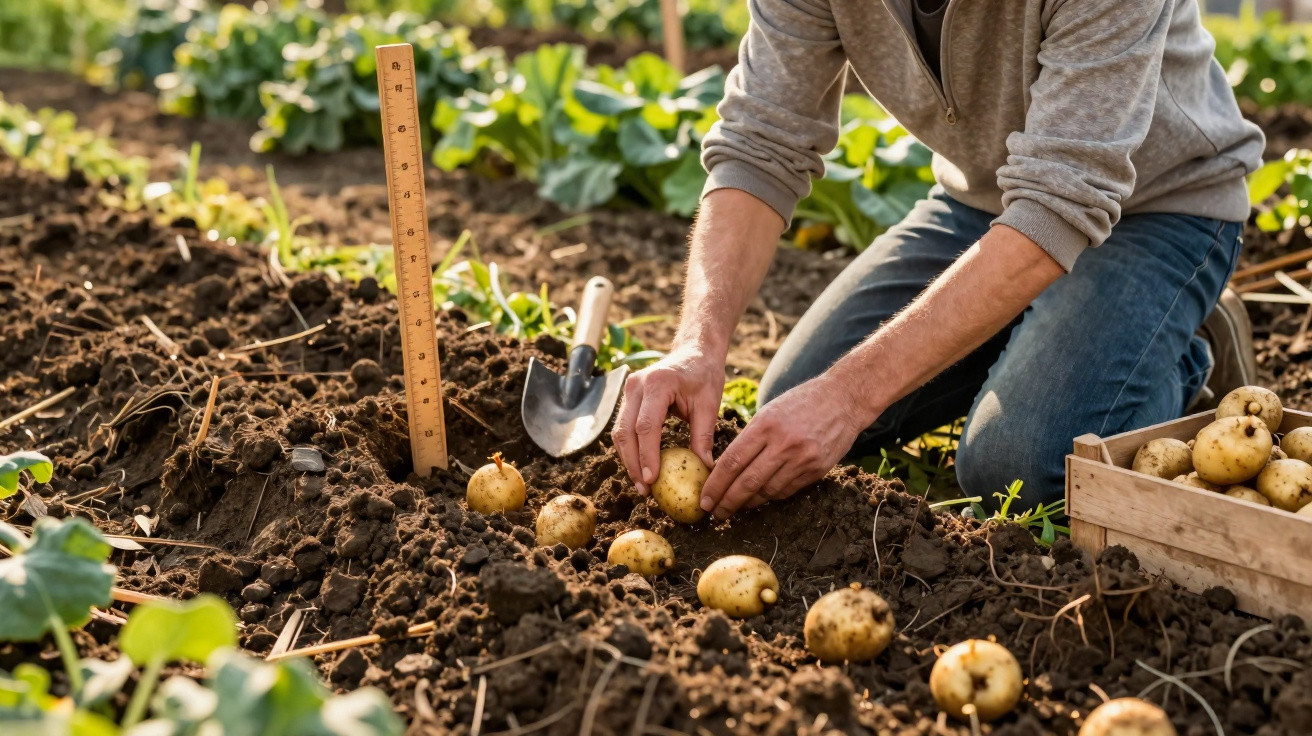
Anyone planting potatoes in spring usually thinks about varieties, fertiliser or slugs – yet often overlooks what may be the most important variable: planting depth. This seemingly minor detail determines whether the boxes are overflowing in autumn or whether you only just manage to fill a small bucket.
The crucial range: how deep potatoes should really be planted
A seed potato is essentially a small store of energy. It must produce roots, stems and, later, new tubers. It needs sufficient soil above it for protection against cold and light, but it must not be buried so deeply that its shoots struggle for ages to reach the surface.
“In most gardens, the ideal range is around 10 to 15 centimetres of soil above the potato.”
In practical terms, make the planting hole so that the tuber ultimately sits roughly 10 to 15 centimetres below the final soil surface. If using a hoe or plough, draw a furrow, place the tubers inside and cover them so that this depth is achieved.
This range works especially well for several reasons:
- Soil at this depth retains moisture more effectively without becoming waterlogged.
- Late frosts are less likely to reach the tubers.
- Young shoots do not have to force their way through a heavy layer of soil and can emerge quickly.
- The soil layer blocks light, which would otherwise turn tubers green and make them inedible.
Planting potatoes substantially deeper delays emergence. The plant uses too much energy on its journey upwards and reaches the light weakened. If potatoes are planted too shallowly, they are at risk of sun scorch, drying out and developing green patches.
How soil affects the right potato planting depth
The recommended 10 to 15 centimetres is a useful guide, but it does not perform identically in every soil type. Anyone familiar with their soil can adjust the depth more precisely.
Heavy, loamy soils: plant slightly shallower
Water readily accumulates in heavy soils containing clay or loam. If tubers are planted too deeply in this wet zone, they may rot.
A sensible approach for these plots is:
- Loosen the soil thoroughly before planting and break up clods.
- Ideally, work the ground when it has dried out and is not sticky.
- Place seed potatoes towards the middle of the range, at around 10 to 12 centimetres deep.
On wet ground, a slightly raised bed or ridge is also worthwhile. This allows excess water to drain away more easily, preventing the tubers from sitting in mud.
Sandy, loose soils: planting a little deeper is beneficial
Light, sandy soils allow water to drain rapidly downwards. In these conditions, potatoes can suffer from drought stress and nutrient loss.
“On dry, sandy plots, it is worth using the full 15 centimetres so that the potatoes sit in a moister zone.”
It also helps to enrich the soil with compost or well-rotted farmyard manure. This keeps moisture in the root zone for longer and ensures the plants can access sufficient nutrients.
Climate, frost and planting depth – how the factors work together
Soil type is not the only consideration: weather around planting time also matters. In areas prone to late frosts, correct depth alone is not always enough.
Frost-prone areas: plant deeper and protect with soil ridges
Gardeners in cooler locations should place tubers towards the upper end of the recommended range, at roughly 15 centimetres deep. As soon as shoots emerge, it is worth making an initial soil ridge to shield the young growth from cold snaps.
If temperatures drop sharply again, there is still some flexibility:
- Earth up the shoots with more soil until only their tips remain visible.
- If necessary, cover them with horticultural fleece so that the soil does not cool as severely.
Dry spells: do not plant too deeply, protect from above instead
Many amateur gardeners in dry regions tend to plant potatoes particularly deeply in the hope of finding more moisture. This offers very little benefit. Shoots take longer to reach the surface, while the soil below may still dry out.
“In dry conditions, a mulch layer helps far more than excessive planting depth.”
Straw, dried grass clippings or leaves spread over the soil reduce evaporation. The ground stays moist for longer, while the tubers remain in the ideal zone.
Spacing, earthing up and care: without these, the harvest stays small
The correct depth only delivers results when the rest is right as well. Spacing between plants and regular earthing up are particularly important.
Spacing in the bed: enough room for plenty of tubers
| Parameter | Recommendation |
|---|---|
| Spacing within the row | 30–40 cm |
| Row spacing | 60–75 cm |
| Planting depth | 10–15 cm |
These measurements give potato plants enough room to form strong foliage. More leaf area means more photosynthesis, and therefore more energy for numerous well-developed tubers.
Earthing up: the understated extra for a noticeably bigger yield
Once shoots are around 15 to 20 centimetres tall, the most important care task after planting begins: earthing up. Soil is pulled from between the rows towards the stems, creating a small ridge.
This process serves several purposes at once:
- Newly forming tubers remain in darkness and do not turn green.
- It creates extra space where additional tubers can develop.
- Plants are better supported and less likely to bend over in the wind.
- Weeds are covered over and struggle to regrow.
One to three rounds of earthing up during the season are sufficient. Those who do this consistently can get considerably more from the same square metres.
How to plant potatoes step by step
For anyone wanting a particularly practical guide, here is a general sequence that has proved effective in the home garden:
- Loosen the soil to a depth of 15 to 20 centimetres and remove large stones.
- Mark out rows 60 to 75 centimetres apart.
- Create planting holes or hollows so that the tubers will sit 10 to 15 centimetres below the surface.
- Set out chitted seed potatoes, with the eyes facing upwards, 30 to 40 centimetres apart.
- Cover with loose soil without firming it down.
- Water carefully in dry weather, without washing soil away and exposing the tubers.
Following these straightforward steps and matching the depth to the soil and climate lays the groundwork for full boxes in autumn.
Why a few centimetres make such a difference
The benefits of the correct depth show up in several ways: potatoes emerge evenly, the crop develops a uniform appearance, and plants are more resilient under stress. Inconsistent depths, by contrast, create a patchwork of vigorous and weak plants.
Disease can also develop differently. In very wet zones where tubers sit too deep, the risk of rot and fungal infection increases. Planting too shallowly, meanwhile, encourages green tubers with elevated solanine levels, which are no longer suitable for eating.
Anyone unsure can plant two or three rows at different depths in one bed and compare them later. Small trials like these quickly reveal how strongly your own soil responds – and provide ideas for more targeted planting the following year.

Comments
No comments yet. Be the first to comment!
Leave a Comment