
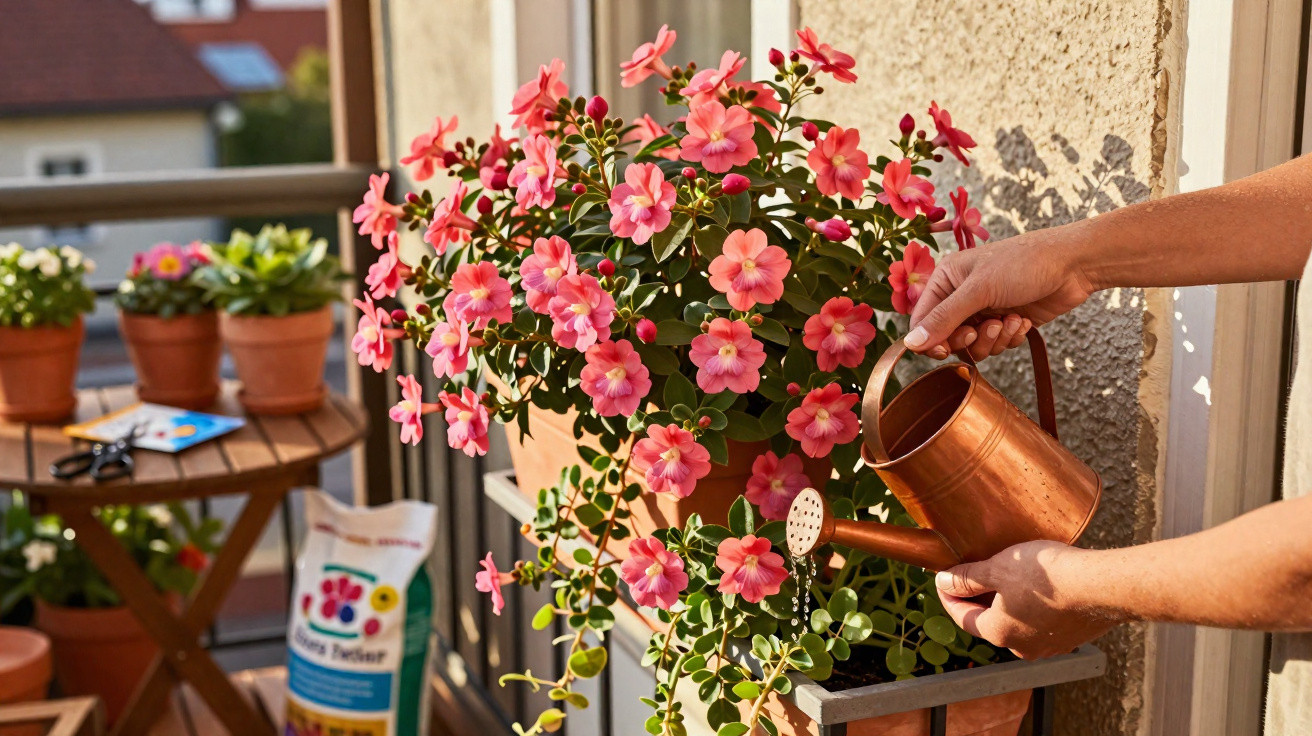
Many amateur gardeners are familiar with geraniums and petunias, but a rather overlooked balcony plant is quietly making an impression: Diascia, often sold as twinspur. This delicate-looking trailing flower drapes itself over planters and hanging baskets like a carpet of blooms and, with the right care, can flower continuously from spring into autumn.
Why Diascia transforms the look of balconies
Native to southern Africa, Diascia belongs to the figwort family. In the UK climate it is usually grown as an annual, although in mild areas it can behave like a perennial. It typically forms compact, bushy plants with several soft stems that spill gracefully over the sides of containers.
Depending on the variety, Diascia grows to around 25 to 40 centimetres tall and can spread up to 60 centimetres wide. Its numerous small, five-lobed flowers are especially striking, often appearing closely packed together. Colours range from apricot and salmon pink to rich raspberry pink, orange, mauve and white.
“Anyone wanting a balcony planter full of colour without complicated care will find Diascia a surprisingly good choice.”
Its gently trailing habit creates the effect of a miniature cascade of flowers. It is well suited to:
- balcony planters on railings or windowsills
- hanging baskets and containers
- planted bowls on outdoor tables
- the front edges of raised beds
- rock gardens and borders in front gardens
Diascia looks particularly impressive when partnered with other sun-loving plants, such as verbena, fan flowers, calibrachoa or low-growing ornamental sage varieties.
The right time to plant in spring
One of the most common mistakes is putting balcony plants outside too early. Diascia is sensitive to frost, so it should only be placed in its final planter or pot once the last night frosts have passed - usually from late April to mid-May, depending on the area.
Sowing or young plants: which option is best?
Gardeners with enough patience and indoor space can raise Diascia from seed from March onwards. The seeds germinate at around 15°C in a loose propagation compost. Once the seedlings are sturdy enough, they can be pricked out and planted outdoors later on.
For most balcony gardeners, however, young plants from a nursery are much more convenient. They save time and effort while also providing more robust plants. Choose only vigorous, well-branched specimens with no wilted leaves.
| Container | Recommended number of plants |
|---|---|
| 30 cm planter or pot | approx. 3 plants |
| 50–60 cm balcony planter | approx. 6 plants |
| 80 cm-long planter | approx. 8 plants |
Finding the ideal Diascia position on a balcony or terrace
Diascia enjoys bright conditions but does not cope well with extremes. It flowers reliably in partial shade and performs especially well in full sun, provided it is not exposed to relentless midday heat on a south-facing balcony.
An ideal position offers:
- morning or evening sun
- light shade during the hottest part of the day
- sunshine in spring and autumn
A very hot south-west- or south-facing balcony combined with high humidity can put the plant under strain. It may soon appear tired, produce fewer buds and begin to die back. A shade sail or positioning it behind taller plants can help shield it from the harshest sunlight.
Diascia is undemanding when it comes to compost, but it does not tolerate waterlogged roots. A loose, humus-rich compost for balcony plants with good drainage is ideal. The pH can be slightly acidic to neutral; its roots thrive at roughly pH 6.0 to 7.0.
Watering, feeding and pruning to maintain masses of flowers
A little care once a week can reward you with flowers for months. The good news is that the work involved remains modest as long as a few basic rules are followed.
Water correctly: moisture is welcome, waterlogging is not
Diascia prefers compost that stays evenly and lightly moist. The root ball must never be allowed to dry out entirely, but it should not sit in water either.
- Water directly around the roots rather than over the flowers.
- Let the top layer of compost dry slightly between waterings.
- Check planters and hanging baskets more often on warm evenings during hot weather.
Limp stems and drooping leaves are typical signs that the plant needs more water. If it is kept too wet, however, leaves turn yellow, the roots begin to rot and flowering slows down.
Feeding strategy: less really is more
Many people assume that more fertiliser means more flowers. With Diascia, too much feed quickly has the opposite effect: it produces long, soft shoots, branches less effectively and develops fewer blooms.
A practical feeding routine for balcony planters is:
- Mix a slow-release fertiliser for balcony plants into the compost when planting.
- From June onwards, feed every 3–4 weeks with a liquid fertiliser for flowering plants.
- Avoid daily or excessive feeding, as this puts the plants under stress.
More flowers with the help of secateurs
Summer pruning often determines whether a planter looks exhausted in August or produces another impressive display.
“Lightly cutting back Diascia in high summer gives the plant a second youthful phase - including a fresh wave of flowers.”
Important care measures include:
- Regularly remove faded flowers so that new buds can follow.
- In high summer, when flowering begins to decline, shorten the stems by about one third.
- Occasionally pinch out long, thin shoot tips to encourage denser branching.
The response is usually quick: the plant produces fresh shoots and new flowers, often continuing well into autumn.
Propagating, overwintering and combining Diascia
Anyone who has grown fond of this plant can multiply it easily using cuttings. The best time is spring or early autumn.
Take sections around 10 centimetres long from non-flowering shoots, remove the lower leaves and place them in a specialist rooting compost. Keep the compost lightly moist rather than wet. Autumn cuttings should remain over winter in a cool, bright, frost-free spot at around 10 to 15°C.
Overwintering whole plants works mainly in regions with mild winters, roughly climate zones 8 to 11, or in protected winter quarters. Balcony planters should then be moved to a bright, frost-free location, watering should be reduced and the plant will enter partial dormancy.
Practical tips for especially attractive combinations
To get more from a balcony, it helps to plan planting around colour schemes. Diascia is excellent for filling gaps in displays or softening hard edges. A few possibilities include:
- Apricot varieties alongside a blue carpet of lobelia and white calibrachoa.
- Pink shades with pale green, richly textured foliage such as willowherb or ornamental grasses.
- Strong orange varieties as a contrast to purple verbena.
The plant provides an additional benefit too: its many small flowers often attract bees and other insects. Especially on urban balconies, this creates a small, lively habitat without making maintenance overwhelming.
Those who wait for the right planting time in spring, choose a suitable position and remember these few care tips can turn plain balcony planters into eye-catching cascades of flowers that provide colour throughout the summer - without needing to be a gardening expert.



Comments
No comments yet. Be the first to comment!
Leave a Comment