
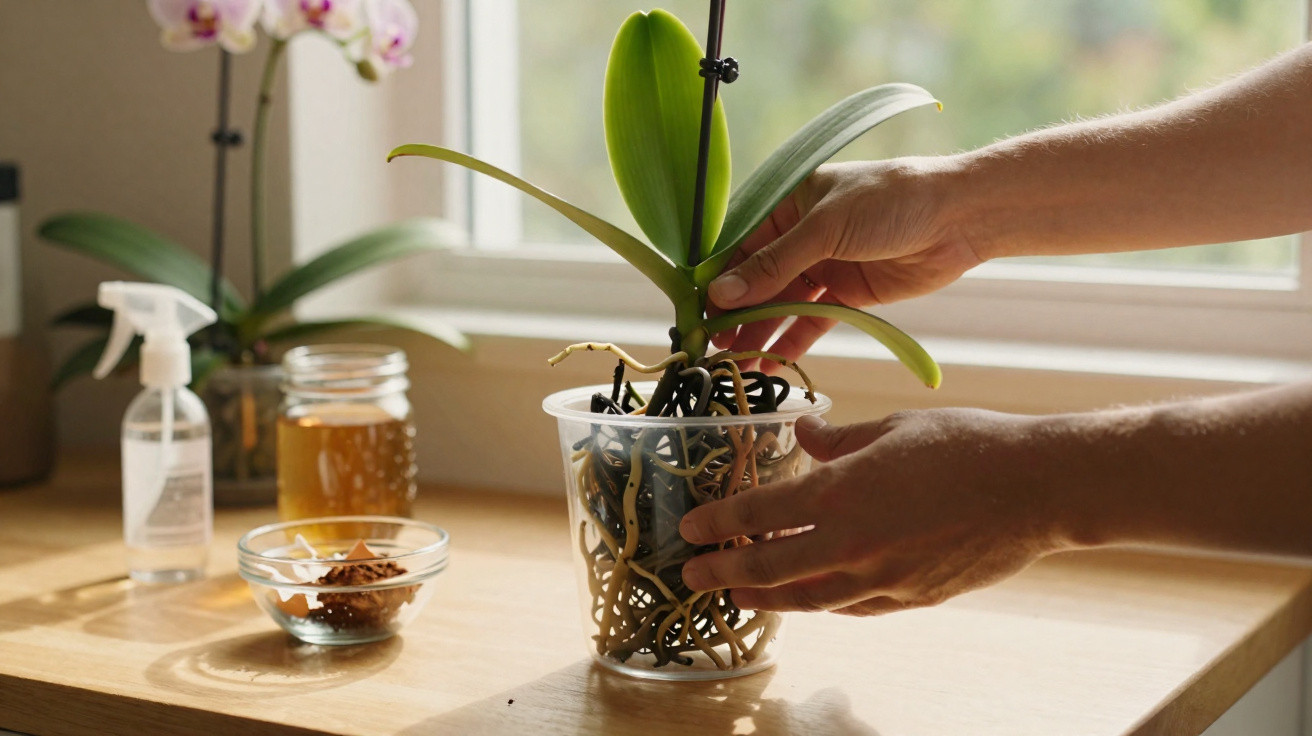
If you keep a moth orchid in the living room, you may know the feeling: every flower has dropped, the stems look bleak and putting the plant in the bin suddenly seems sensible. Yet many of these plants still have a surprising amount of life left in them. An unassuming kitchen leftover can stimulate the roots and help prepare for another flowering period – without any chemical laboratory.
When the orchid is bare: check the roots first
Before trying any household remedy, inspect the pot. Phalaenopsis orchids are generally grown in transparent containers, so make the most of this.
- Healthy roots: green or silvery grey, firm, with no rotten smell
- Unhealthy roots: brown, soft, hollow and often accompanied by a musty odour
- Leaves: slightly soft is acceptable; very limp, yellow leaves are more of a warning sign
If the root system is firm and looks healthy in colour, the plant is probably simply resting. This is entirely normal for Phalaenopsis. If, however, most of its roots are brown and soft, no miracle treatment will help: a rescue repotting is the first priority.
Carefully remove the orchid from its pot, cut away every soft root with clean scissors, then place it in fresh, coarse bark substrate. Water it less for a few days so the cut areas can dry, and only consider fertiliser afterwards.
Humidity and climate: no flowering miracle without the right conditions
Phalaenopsis originate in tropical regions, where the air is far more humid than it is in our living rooms. Specialist growers recommend humidity of roughly 50 to 70 per cent for this species. In a well-heated home, levels can quickly fall below 40 per cent – a major source of stress for the plant.
One straightforward method can help: place the pot on a saucer filled with expanded clay pellets or pebbles. Add water to the saucer, but only enough to ensure the base of the pot stays dry. The rising moisture surrounds the orchid like a small tropical cloud, without leaving its roots standing in water.
Light matters just as much. Bright window positions away from harsh midday sunlight are ideal. East- or west-facing windows usually work best. Behind a south-facing window, direct sunshine can genuinely scorch the leaves.
“Without sufficient light, reasonably high humidity and a clear temperature difference between day and night, no secret trick can bring the flowers back.”
Many indoor orchids will not flower again until they experience slightly cooler nights. A difference of around 4 to 8 degrees between daytime and night-time temperatures encourages the formation of new flower spikes. The plants are comfortable at 18 to 22 degrees during the day, while 12 to 15 degrees at night can work well – for example, near a slightly open bedroom window or in a cooler stairwell, provided there is enough light.
The kitchen leftover that gets roots growing
Once the position, humidity and temperatures are reasonably suitable, the main idea comes into play: ordinary cooked maize can act as a gentle, natural root booster. This is not because it is magical, but because its components can encourage a small microbial ecosystem within the pot.
Cooked maize provides starch, fibre and antioxidants. Within the substrate, the starch serves as food for microorganisms, including certain fungi that live symbiotically with the roots, known as mycorrhiza. These helpful organisms improve nutrient uptake and support the development of strong new root tips.
This is similar to the familiar “rice water method” already used by some orchid enthusiasts: the starch in the water is also intended to provide a mild, organic fertilising signal. Cooked maize performs a very similar role, while being at least as easy to obtain in everyday life.
How to prepare the natural root booster
The preparation is simple and requires no specialist equipment.
- Leave around 100 grams of cooked maize to cool, without salt or sauce.
- Blend it thoroughly with 1 litre of lukewarm water.
- Pour the mixture through a very fine sieve or cloth so that no pieces remain trapped in the substrate.
- Store the liquid in a clean glass bottle in the fridge.
This maize solution keeps for only a short time. If sediment forms, mould appears or it develops a sour smell, pour it down the sink. It is best used within 24 to a maximum of 48 hours.
Using it on an orchid: less is more
The maize mixture is not intended for every other watering, but as an occasional addition. Use it as follows:
- Moisten the substrate lightly first, for instance by briefly soaking it in clean water.
- Then apply 1 to 2 teaspoons of the maize solution directly to the surface of the substrate.
- Repeat this treatment every 3 to 4 weeks during the growing period.
Between applications, give the orchid plain water only. Many professionals favour brief soaking: place the pot in lukewarm water for a few minutes until the substrate is saturated, then allow it to drain thoroughly. Depending on the indoor climate, one such soak every 10 to 15 days is enough.
If you are already cooking maize in unsalted water, the cooled cooking water can be used in tiny quantities. A few tablespoons on already moist substrate, once or twice a month, are entirely sufficient. The important thing is that it contains no salt, spices or oil residue.
“The maize trick does not replace a fertiliser specifically formulated for orchids; it works more like a small prompt for roots and microorganisms.”
Common mistakes that hold back flowering
Many Phalaenopsis struggle not because they lack nutrients, but because of care mistakes. Knowing the most common pitfalls can save you from buying expensive specialist products.
- Permanently wet roots: these quickly lead to rot, so the pot always needs a drying period.
- Ordinary potting compost: this suffocates the roots; orchids require airy bark substrate.
- Draughty windowsills: cold air from gaps or constant ventilation puts the plant under stress.
- Strong sunlight through glass: this burns leaves and causes buds to dry out.
- Overdosed fertiliser: this burns roots, particularly when using organic household treatments.
Avoiding these traps creates the conditions in which the maize solution can have any effect at all. Without healthy roots, reasonably stable humidity and the right window position, its impact will remain limited.
How long until the next flowering?
Even with ideal care, a weakened orchid needs patience. New roots and leaves generally appear within a few weeks. It may take months for the next flower spike to emerge – particularly if the plant has been badly affected.
A realistic timeline could look like this:
| Time period | Likely development |
|---|---|
| 0–4 weeks | Roots stabilise and leaves look slightly plumper |
| 1–3 months | New root tips, possibly a fresh leaf |
| 3–9 months | First new flower spike, depending on the season |
The maize trick can often speed up this development or at least stabilise it, especially when the plant has been weak for some time. There are no guarantees – every orchid responds differently – but many amateur gardeners report visibly more vigorous roots.
What terms such as mycorrhiza mean
Anyone looking into orchid care will quickly encounter technical terms. Mycorrhiza describes the partnership between fungi and plant roots. The fungi spread their fine network of threads through the substrate, access nutrients and pass them on to the plant. In return, they receive sugars and other organic substances from the orchid.
Epiphytic species such as Phalaenopsis, which naturally grow on tree trunks, benefit greatly from these partnerships. Starchy household treatments such as maize water or rice water do not directly “fertilise” this fungal network, but they provide extra food for microorganisms – setting the system in motion.
Those who enjoy experimenting can try different natural additions, including diluted nettle feed, compost tea or ready-made organic orchid fertilisers. The key point is to introduce every new method carefully and in small amounts, so the sensitive roots are not overwhelmed.
A conclusion without clichés: bin less, try more
A Phalaenopsis without flowers rarely belongs in the bin. By checking its roots, creating a reasonably tropical indoor climate and making smart use of leftover cooked maize, the plant often gets a second chance. The effort is minimal, the risk manageable – and the pleasure of an unexpected new flower spike is all the greater.

Comments
No comments yet. Be the first to comment!
Leave a Comment