
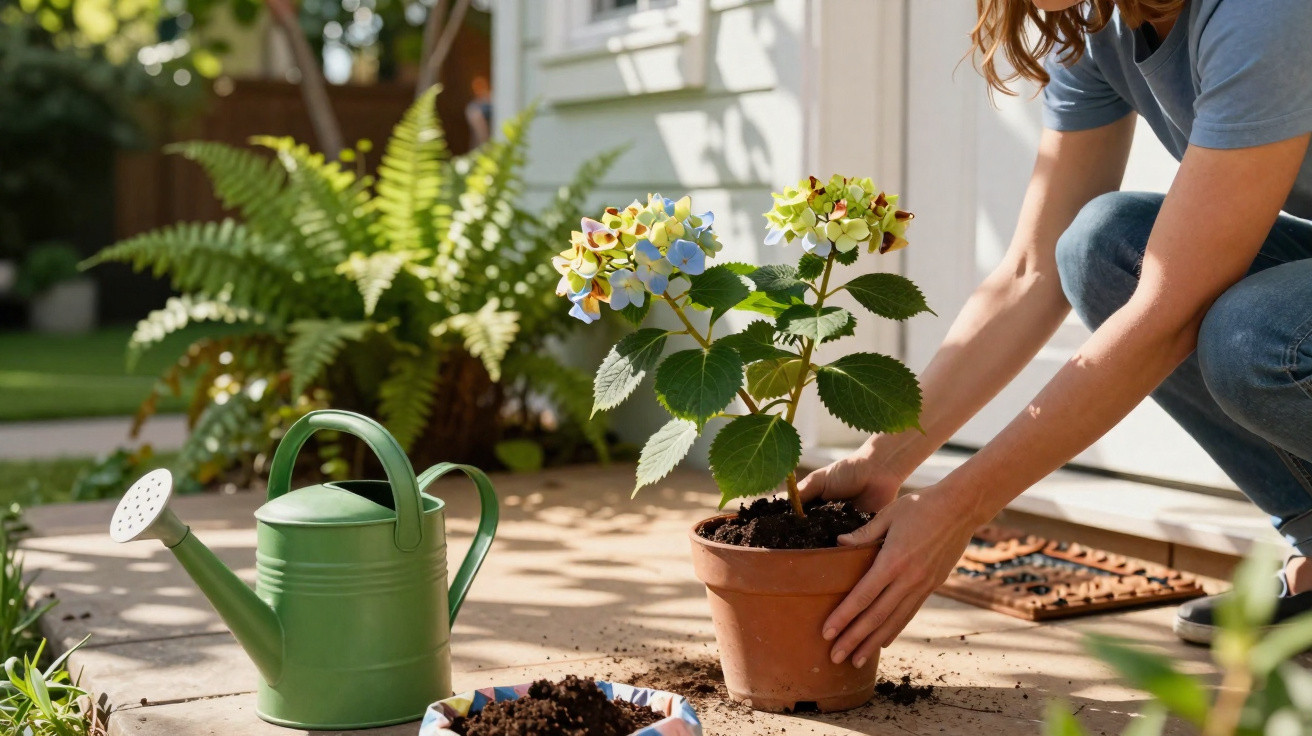
Hydrangeas are nearly always struggling because they have been planted in the wrong position.
Many amateur gardeners put hydrangeas where they will make the biggest visual impact: immediately in front of the house wall, beside the patio or in full sunshine. It may look magnificent at first, but after a few summers the picture changes: scorched foliage, brown blooms and constant watering. Understanding what hydrangeas genuinely require can prevent these problems – and may still save plants that are already under stress.
Why a favourite spot by the house can become a death trap for hydrangeas
It is a familiar scene: a white façade with a broad bed of hydrangeas in front, clearly visible from the street. This arrangement often succeeds in the first year, but hotter summers soon expose its weaknesses.
South- and west-facing sides of a house are particularly challenging for these shrubs. The full afternoon sun beats down, while the wall retains heat and radiates it back. Paving, gravel and patios act like additional radiators. As a result, the soil dries out exceptionally quickly.
A typical warning sign: by midday, the leaves are drooping badly, while by evening the flowers look papery and develop brown edges.
Signs that a location is dangerously unsuitable include:
- The soil cracks only two days after thorough watering.
- Leaf edges scorch during the first hot spells in June or July.
- The flowering period is noticeably shorter than in the previous year.
- Even frequent watering provides relief for just a few hours.
Extra strain occurs when shrubs are kept in containers on a stone patio. Sunlight heats the pot from every direction, causing the roots to overheat and water to evaporate extremely fast. Planting beneath large trees is even more problematic: the roots of oak, maple and similar trees are far stronger, taking the water before the hydrangea has any real opportunity to use it.
What hydrangeas really need: woodland light rather than a south-facing balcony
Hydrangeas originally come from moist, open woodland. They do not grow in blazing sunshine, but in the dappled shade provided by trees and shrubs. This is the kind of atmosphere they should be given in the garden.
Light: plenty of brightness, but little direct sun
A site in partial shade is ideal: it should be bright, but protected from direct midday sun. Morning sunshine is welcome, yet from late morning through to the evening, shade should be cast by a house wall, fence, trees or an overhang.
In more northerly areas, a north- or north-east-facing side of the house is often sufficient. In places where summer temperatures of 30 to 35 degrees are common, hydrangeas need filtered light for most or all of the day, such as beneath lightly foliaged trees or against a bright but shaded house front.
Soil: moist, rich in humus and slightly acidic
Soil conditions are equally important. These shrubs tolerate neither waterlogging nor bone-dry ground. They need a loose growing medium that stays consistently moist.
- Rich in humus, for example through compost or leaf mould
- Slightly to mildly acidic (pH around 5.5–6.5)
- Free of compaction, allowing water to drain through properly
A thick layer of mulch made from leaves, bark chippings or grass clippings helps retain moisture. This means watering is needed far less often, while the roots stay cooler.
A mulch layer 5–8 centimetres deep can reduce evaporation around the roots by up to half – a major advantage during hot summers.
Which hydrangea types are especially sensitive
Not all hydrangeas respond to sunlight and heat with the same degree of sensitivity. The much-loved bigleaf hydrangeas, with their large round flower heads, suffer particularly badly in the typical south-facing position beside a house wall.
| Type / group | Tolerance of sun | Recommended location |
|---|---|---|
| Bigleaf hydrangea (Hydrangea macrophylla) | very sensitive | bright partial shade, with no midday sun under any circumstances |
| Mountain hydrangea (Hydrangea serrata) | sensitive | similar to bigleaf hydrangea; ideally beneath lightly shaded woody plants |
| Panicle hydrangea (Hydrangea paniculata) | relatively robust | can tolerate more sun provided the soil remains moist |
| Smooth hydrangea (Hydrangea arborescens) | moderately robust | morning sun and afternoon shade |
Those living in a very dry area, or without a suitable shady position, will generally fare better with panicle or smooth hydrangeas than with sensitive bigleaf hydrangeas.
Moving hydrangeas: how to save weakened plants
There is good news for anyone who has positioned their shrubs incorrectly: moving them only a few metres is often enough to set them back on the right course.
The best time to transplant
Hydrangeas are safest to move in autumn or late winter, when the ground is frost-free and the plant has no leaves. At this time, very little water evaporates, allowing the roots to establish themselves again without disturbance.
To move a hydrangea:
- Select a new site that is partially shaded, sheltered from wind and has loose soil rich in humus.
- Dig a generous planting hole at least twice as wide as the root ball.
- Water the plant well so that the root ball is thoroughly moist.
- Lift the shrub carefully, retaining as many roots as possible.
- Place it in the new hole, ensuring it is no deeper than it was in its former position.
- Refill with compost and soil, then water thoroughly.
- Apply a generous mulch layer to keep the soil cool and moist.
Anyone who changes only the location, without improving the soil and watering routine, will not be happy in the new spot either – the two are inseparable.
The worst location mistake with hydrangeas
A classic garden error is a single shrub placed directly in front of a south-facing wall, with no shade and no mulch, but with the well-intentioned plan: “I’ll simply water every evening.”
This approach does not work in the long term. Intense sunshine and heat radiated by the wall increase evaporation so dramatically that watering alone can barely keep pace. The plant is permanently living at its limit; leaves and flowers become smaller each year until the shrub eventually dies.
Practical ways to prevent heat and drought damage
A few simple measures can make hydrangeas considerably more resilient to stress:
- Water early in the morning: This gives the plant time to take up moisture before sunshine accelerates evaporation.
- Water less often, but deeply: It is better to soak the root area thoroughly at intervals than to give a small amount from above every day.
- Use mulch: Leaves, bark chippings and grass clippings insulate the soil.
- Underplant the area: Low perennials or ground-cover plants provide extra shade for the roots.
- Insulate containers: Do not place pots in blazing sun; instead, set them in saucers containing a little water and, ideally, inside an outer pot.
When a hydrangea still suffers: interpreting the signs correctly
Not every drooping shoot immediately means the plant is in the wrong place. On exceptionally hot days, some shrubs temporarily lower their leaves to reduce evaporation. If they recover by evening, there is no reason to panic yet.
The situation is critical when:
- Leaves stay limp permanently, even after heavy watering.
- Leaf margins appear brown and dry.
- Flower heads fade and shrivel within a few days.
- New shoots are short and thin.
In this situation, relocating the plant is usually more useful than adding still more water from the watering can. Acting in time can often stabilise even severely weakened plants – particularly when the new position better matches the hydrangea’s natural requirements.
Comments
No comments yet. Be the first to comment!
Leave a Comment