
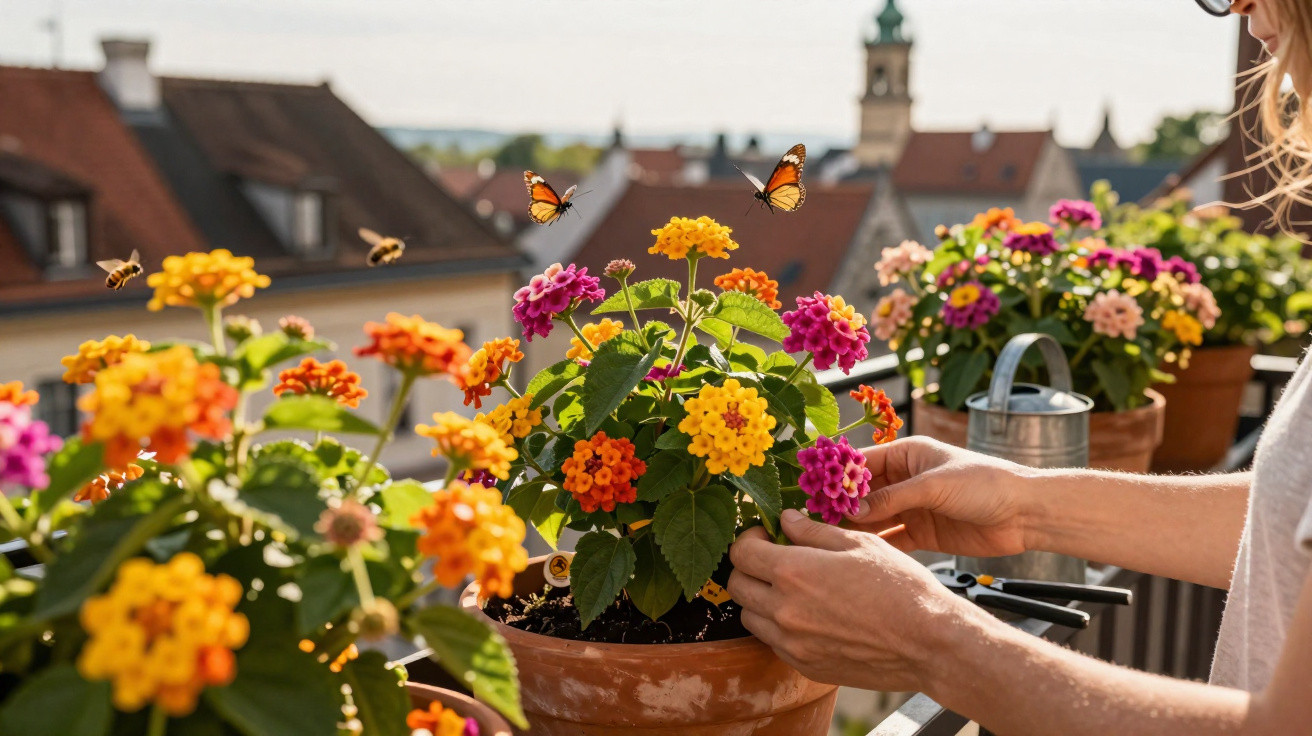
There is a compact shrub that can flower continuously from spring well into autumn, producing vivid colour while requiring remarkably little attention. It remains something of a niche plant in garden centres, yet gardeners who try it rarely want to be without it again: Lantana, a tropical plant that proves surprisingly well behaved and dependable on balconies, patios and in gardens.
A tropical flowering shrub that thrives in Central Europe
Lantana camara originally comes from tropical parts of the Americas and Africa and belongs to the verbena family. Grown in a pot, it generally stays compact at 30 to 60 centimetres tall, while plants in borders in mild locations can reach 1 to 1.5 metres. Its defining features are rich green foliage and rounded clusters made up of numerous tiny individual flowers.
Its colours range from strong yellow through orange and pink to red and violet. Particularly strikingly, the flowers may change colour as they age, so one flower cluster often displays several shades at once. In a container or border, this creates the effect of a miniature firework display.
As well as upright varieties, there are trailing forms such as Lantana montevidensis, which are particularly suited to window boxes, hanging baskets and tall containers. They develop long, cascading shoots densely covered in flowers – ideal when colour is meant to spill down from a railing or wall.
How Lantana delivers almost continuous flowering
In Central European conditions, flowering usually begins in May and continues until October, sometimes even into November in mild areas. The sunnier its position, the more abundantly it flowers. Full sun causes no difficulty for Lantana; on the contrary, this is where the plant shows its full potential.
“In the right position, Lantana can give the impression of flowering almost without interruption – from late spring right through to the conservatory season.”
Protecting the plant from frost and overwintering it in a bright, cool space can extend its flowering period considerably. In a conservatory, bright loggia, or unheated but frost-free stairwell with plenty of light, Lantana will often produce further flowers in late autumn and may retain individual flower clusters through the colder months.
Low-maintenance despite its abundance of flowers
Despite flowering for such a long period, Lantana is considered straightforward to grow. The key requirements are:
- Position: as sunny, warm and sheltered from wind as possible
- Soil: light and free-draining; use good-quality container compost in pots
- Water: water consistently, but do not keep it overly wet; avoid waterlogging
- Nutrients: feed potted plants regularly with liquid fertiliser for flowering plants
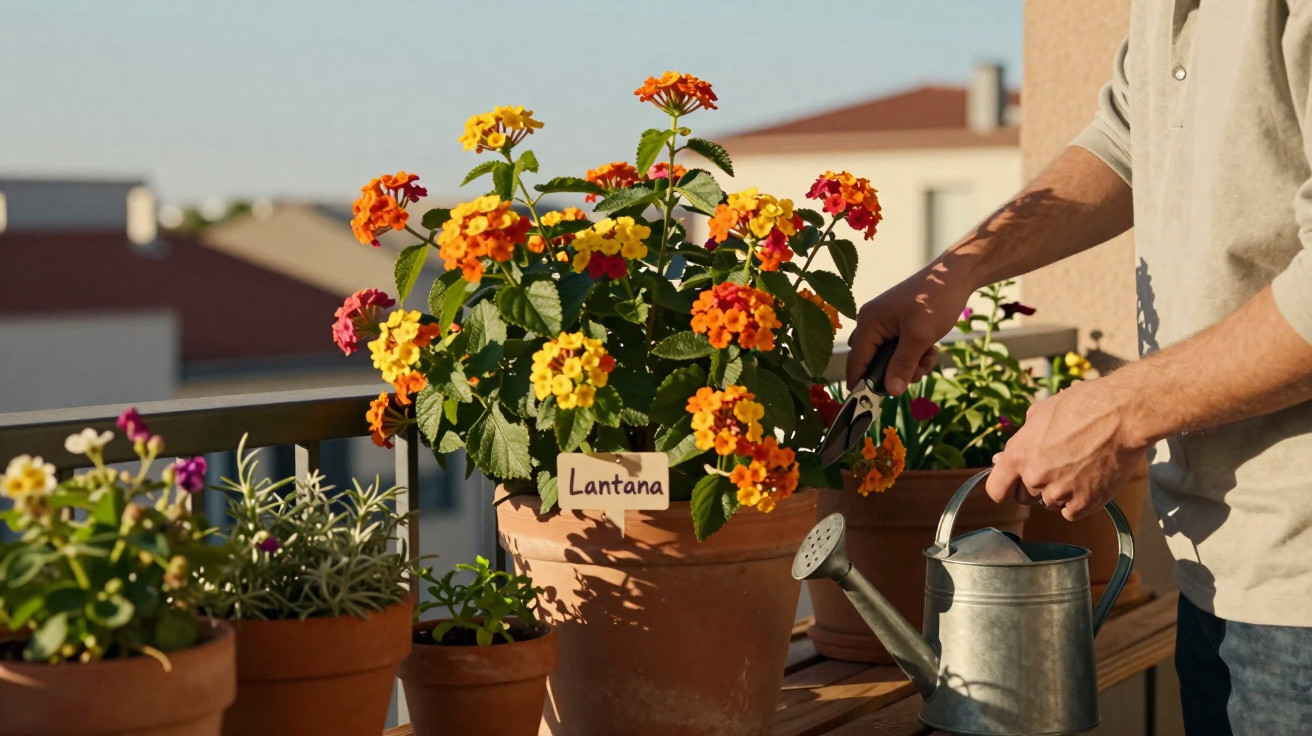
- Pruning: remove spent blooms and trim back lightly from time to time
Once established in a border, Lantana manages with relatively little water and copes with hot spells far better than many traditional summer bedding plants. In containers, it needs watering once or twice weekly during hot weeks, and potentially more often at the height of summer if the pot is small and stands in full sun.
Frost-sensitive, but ideal for containers and window boxes
Its frost tolerance extends only to around minus five to minus seven degrees. For this reason, Lantana is treated as a container plant in many areas and moved indoors in autumn. As soon as temperatures of around two to zero degrees are forecast, the pot should be taken to a bright, frost-free location.
Suitable places include:
- a bright frost-free stairwell
- a conservatory
- a cool, large window in a guest room or hallway
- a garage window, provided the space is not too dark
In mild wine-growing regions or sheltered coastal areas, Lantana can remain permanently in a border. Very free-draining soil and a thick winter layer of mulch or evergreen branches improve the chances of the shrub surviving for several years. Nevertheless, growing it in a pot remains the safer option.
A magnet for butterflies and other beneficial insects
Lantana flowers are rich in nectar. On warm days, butterflies, solitary bees and honey bees therefore gather around the plants. Anyone wanting to make their balcony more insect-friendly will find Lantana an attractive and useful companion.
“A large container of Lantana on the patio quickly becomes a meeting point for butterflies – a rare sight, especially in towns and cities.”
Small berries form in late summer and provide an additional food source for certain bird species. The plant therefore enhances a garden or balcony not only visually, but ecologically too.
Important warning: Lantana is toxic
For all its advantages, Lantana should be treated with a degree of caution. Its leaves, and especially its ripe berries, are regarded as toxic. Households with small children or pets should position the plant where nobody can nibble it unsupervised.
| Risk | Recommended measure |
|---|---|
| Small children in the household | Keep the plant out of reach, for example in raised hanging baskets or tall containers |
| Curious dogs or cats | Place only where animals cannot access it; if necessary, avoid the plant altogether |
| Frequent garden visitors | Make clear that fruits must not be tasted, and wear gloves when pruning |
Many gardeners wear gloves while cutting it back to avoid skin irritation. Prunings should go into general waste or be placed securely on the compost heap so that animals cannot accidentally eat them.
Creating the perfect display with Lantana in a window box
Lantana really comes into its own where conventional balcony plants begin to fade in late summer. A sunny south-facing balcony that becomes intensely hot at midsummer quickly pushes geraniums and fuchsias to their limits, whereas Lantana handles such conditions much more effectively.
One possible window-box combination is:
- an upright-growing Lantana in the centre as the focal point
- trailing Lantana varieties in a contrasting colour alongside it
- drought-tolerant partners such as lobelia or purslane flowers to complete the arrangement
The result is a window box that brings colour from early summer and remains appealing until the first frost. Consistently pinching out faded flowers encourages fresh buds to form continuously and prevents the plant from putting energy into berries too early.
Pruning and overwintering in practice
A substantial cutback before bringing the plant inside in autumn is worthwhile. Shorter shoots are easier to accommodate, while the plant branches more strongly the following spring and remains more compact. Keep Lantana on the dry side over winter, watering lightly only from time to time so that the root ball does not dry out completely.
In March or April, once the days begin to lengthen again, the plant starts growing vigorously. This is the time to provide fresh compost and, if needed, move it into a slightly larger pot. A further shaping cut prevents Lantana from becoming “leggy”, meaning that it produces long, weak shoots. As soon as frost is no longer a risk, the container can return outdoors into the sunshine.
Who is Lantana particularly suitable for?
Lantana is a good choice for garden and balcony owners who:
- want a long flowering period full of colour
- are willing to overwinter the plant somewhere frost-free
- have a very sunny, hot spot to make use of
- wish to attract butterflies and bees
It is less suitable for households where children or animals can reach pots without supervision. In such cases, alternative long-flowering plants include calibrachoa or hardy Cape daisies, which are non-toxic.
Anyone able to meet these requirements will gain a real showstopper in Lantana, one that greatly shortens the bare months on balconies and patios. As the plant is still not widely known everywhere, it regularly prompts questions from visitors and turns a previously unremarkable corner into a near year-round splash of colour.


Comments
No comments yet. Be the first to comment!
Leave a Comment