
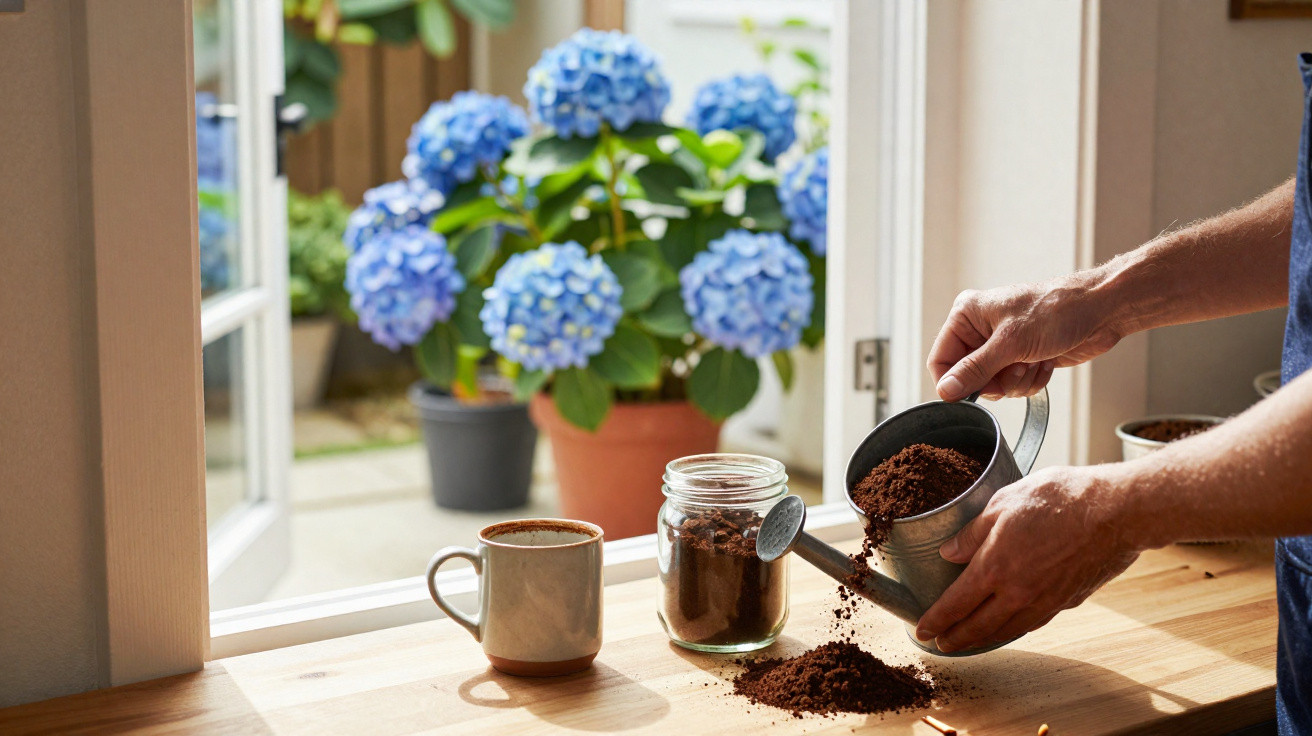
With a simple kitchen cupboard staple, it is possible to reverse the change.
Anyone who buys a brilliantly blue hydrangea from a garden centre rarely expects it to return in candy pink the following year. The colour shift is not caused by a different variety, but by a subtle chemical change in the soil, triggered by tap water, lime and unsuitable compost. Taking action in late winter or very early spring can steer the flower colour back towards an intense blue by summer.
Why hydrangeas change colour at all
Hydrangeas are often seen as little mood indicators in the garden. In particular, varieties of Hydrangea macrophylla and Hydrangea serrata are highly sensitive to the pH level of their growing medium. Blue or pink is determined not only by genetics, but also by the soil chemistry around their roots.
The process is straightforward: aluminium in the soil becomes soluble in acidic conditions. The plant absorbs this element and deposits it in the blooms, producing a blue pigment. In neutral or lime-rich soil, however, aluminium is effectively “invisible” to the roots, and flowers shift towards pink and red.
Blue-flowering hydrangeas need slightly acidic soil and available aluminium – otherwise, they gradually slip into pink.
A broad guide to pH levels around a hydrangea:
- pH 5.0–5.5: distinctly acidic – the ideal range for a strong blue
- pH 6.0–6.5: transition range – lilac, mauve or washed-out blue
- pH from 6.5–7.0: neutral to lime-rich – pink and red become dominant
If the soil remains too alkaline for an extended period, the hydrangea may show further signs of stress. Chlorosis is typical: leaves turn pale yellow between their veins while the veins themselves remain green. This points to trouble absorbing nutrients, particularly iron. It is a common sight in gardens with hard tap water and compacted soil.
It is important to note that not every hydrangea participates in this colour change. Mophead hydrangeas and mountain hydrangeas can be controlled effectively. Panicle hydrangeas, smooth hydrangeas and pure white varieties, by contrast, largely retain their original colour whatever happens in the soil.
The surprisingly simple kitchen helper for blue hydrangea flowers
Rather than buying costly specialist fertilisers, many gardening enthusiasts now use something already found in the cupboard: apple cider vinegar. Diluted in watering water, it can lower the pH around the roots slightly and move the soil towards acidity.
A practical guideline often used by amateur gardeners is:
- around one cup of apple cider vinegar to approximately ten litres of water
- stir thoroughly and apply only to the root zone, not to leaves or flowers
- repeat every one to two weeks in late winter and spring
The acetic acid has a mild effect and breaks down relatively quickly in the soil. This is precisely what makes the method appealing: rather than changing abruptly, the pH shifts gradually. Once the hydrangea has reached the desired shade of blue, the quantity of vinegar can be reduced or stopped altogether.
Those who stop the “blue treatment” once they like the shade can maintain their preferred colour fairly well – provided the rest of their care is right.
Garden experts point out that ordinary white household vinegar can also reduce pH. Apple cider vinegar is often more pleasant in smell for gardeners with sensitive noses and is regarded as slightly gentler. Whichever type is used, the dose is decisive. Excessive vinegar can damage roots and upset the balance of microorganisms in the soil.
Other home remedies: what genuinely works and what is mostly a myth
Garden tips about blue hydrangeas have circulated for years. Not all of them stand up to closer scrutiny. Some additions can offer genuine support, while others are at least questionable.
Useful helpers from the kitchen and garden
- Coffee grounds: Dried coffee or espresso grounds are mildly acidifying and provide nitrogen. Work them lightly into the soil around the plant rather than leaving a thick layer, as this can go mouldy.
- Leaf mould: Leaf mould made especially from oak or beech leaves is slightly acidic and improves both soil structure and water retention.
- Conifer needles and bark: Used as a mulch layer, they create a mildly acidic environment as they slowly decompose.
- Specialist rhododendron or ericaceous compost: These growing media are naturally acidic and are ideal for new planting or repotting.
More legend than solution
- Coins or nails in the soil: Rusting nails or coins provide barely any usable metal for the plant. They have virtually no effect on pH.
- Blue food colouring: Even if it makes the soil look blue, the plant will not incorporate this colouring into its flowers.
For deliberate yet controlled results, combine mild home remedies such as diluted vinegar and coffee grounds with an overall acidic soil base. This keeps the hydrangea healthy in the long term rather than merely “recolouring” it for a short time.
Step-by-step guide: how gardeners can make a hydrangea blue again
Timing is crucial if the blooms are to shine by summer. Many of the relevant processes begin long before the first buds can be seen.
- Test the pH in late winter: Use a basic testing kit from a garden centre, mixing a little soil from the root area as directed. If the reading is clearly above 6.0, action is needed.
- Improve soil structure: Loosen compacted ground and work in some acidic compost, bark humus or ericaceous compost. This improves water retention while gradually lowering the pH.
- Prepare a vinegar solution: Add one cup of apple cider vinegar to a watering can containing ten litres of water, then mix well.
- Water precisely: Moisten only the root area around the base of the hydrangea. Avoid the leaves to prevent scorch.
- Repeat regularly: Continue every one to two weeks until late spring. Once buds begin to show colour, it is better not to intervene heavily.
- Use rainwater: Where possible, collect rainwater and use it for watering on a long-term basis. Hard tap water continually pushes pH upwards.
The real decision on colour is made in spring, when the flower buds are developing. Intervening too late usually changes only the nuances.
Rainwater, hard water and the subtle effect of lime
Many gardens have a problem that is barely visible: lime-rich tap water. In hard-water areas, every watering adds small quantities of lime to the soil. Over the years, this noticeably raises the pH, especially in containers and raised beds.
Watering hydrangeas consistently with rainwater slows this process considerably. Even a simple water butt connected to a downpipe can be enough to supply container plants over the summer. In areas with particularly lime-rich water, it is worthwhile reserving collected rainwater for every plant that prefers acidic conditions, including rhododendrons, blueberries and camellias as well as hydrangeas.
Risks, limits and sensible combinations for blue hydrangeas
As tempting as this kitchen-helper trick may sound, a hydrangea cannot be turned endlessly “blue”. Every location has natural limits that can only be shifted to a certain extent.
- Too much acidity stresses the plant: A heavily reduced pH can harm roots and block the uptake of other nutrients.
- Pot-grown plants react more quickly: Interventions have a stronger effect in containers. Use less vinegar here and check pH regularly.
- Respect varietal differences: Some pink cultivated varieties have little genetic potential for a pure blue. Even in ideal soil, they are more likely to become a cool lilac shade.
A robust approach is therefore to build up the soil over the long term with acidic materials such as ericaceous compost, leaf mould and conifer mulch. Make rainwater the norm and tap water the exception. Diluted vinegar or coffee grounds should serve only as gentle adjustments, rather than a high-dose permanent solution.
Once gardeners understand how their hydrangea responds, they can manage it more precisely over time. Some even enjoy experimenting with the shades: a bed with slightly differing pH levels can produce blue, lilac and pink flower heads in a single summer – all from the same plant species, determined solely by subtle variations in the soil.
Comments
No comments yet. Be the first to comment!
Leave a Comment