
If you have a balcony or a small terrace, you will know the issue: colours burst into life in summer, then from October onwards there is a yawning gap. Typical seasonal flowering plants put on a show for a few months before disappearing without mercy. Yet there is one shrub that remains relatively overlooked in the UK, despite being remarkably good at filling exactly this gap in the year.
The little-known tropical plant that flowers for months
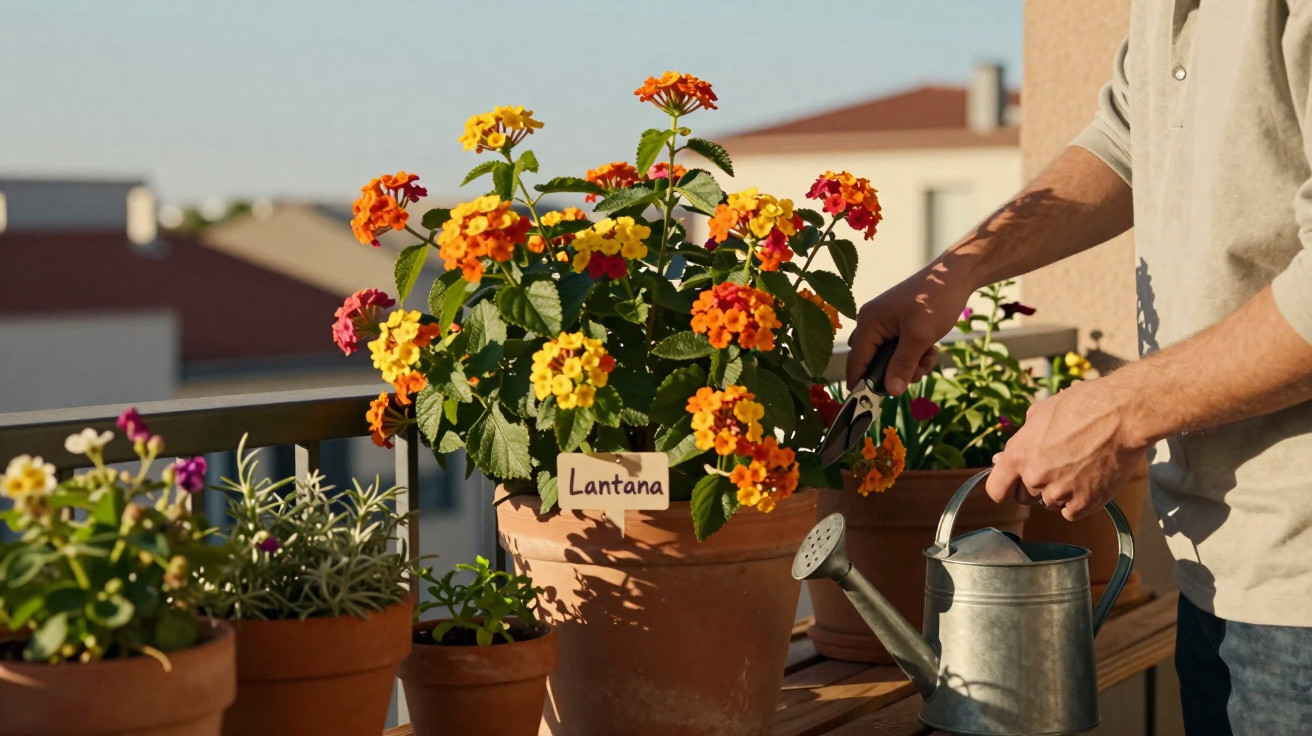
This plant is lantana, a low-growing, prolific flowering member of the verbena family. Native to tropical parts of the Americas and Africa, it has long since become an insider favourite for sunny gardens and balconies. In containers, it generally reaches between 30 and 60 centimetres in height; planted in the ground in milder areas, it can grow to 1 to 1.5 metres.
Its distinctive features include vivid green, slightly rough leaves and dense, rounded flower heads made up of dozens of tiny blooms. Available colours range from yellow and orange to pink, red and purple. Most interestingly, the flowers often change shade as they mature. As a result, one shrub may display several tones at the same time, looking almost like a miniature mixed flower bed.
“Lantana produces flowers continuously from spring well into autumn – with considerably less effort than many traditional balcony plants.”
Why lantana flowers for almost the whole year
In central European conditions, flowering usually begins in May. From then on, lantana keeps going in the truest sense: fresh flower heads emerge directly beside fading ones, with no significant break. In warm locations, this continues until October, and in mild years even into November.
In sheltered coastal areas or the south-west, the foliage may remain partly green. If the plant is kept frost-free in a very bright winter position, blooms can appear repeatedly even during the colder months. It can then seem to flower all year round – although a more realistic expectation is near-continuous flowering for many months at a time.
Getting the best possible flowering display from lantana
For the flowering performance not to falter, lantana needs one thing above all else: sunshine. A position in full sun, ideally with a light breeze, is perfect. Soil or compost should be loose and free-draining, so that water never sits around the root ball.
- Regularly pinch off spent flower heads
- Feed plants in pots with liquid fertiliser for flowering plants every two to three weeks
- Water plants in borders generously only during prolonged dry spells
- In high summer, water pots once or twice a week; water far less in winter
With this straightforward routine, lantana clearly belongs in the “low-maintenance” category. It will even tolerate being left for half a holiday without anyone watering it, provided the pot is not tiny and the compost does not dry out completely.
Ideal for balconies, terraces and sunny borders
Lantana can be used in many different ways. Upright varieties work particularly well in large containers beside a seating area or in a front garden. In mild parts of the country, it can also be used as a low flowering hedge where a compact border is wanted.
There are also trailing, mat-forming types that are ideal for window boxes and hanging baskets. They spill over the edge, creating real cascades of flowers while concealing unattractive concrete balcony railings.
Attractive planting partners for borders and containers
Lantana looks especially harmonious when paired with other sun-loving plants. Suitable companions include:
- Lavender for fragrance and a Mediterranean feel
- Ornamental sage for rich blue tones
- Compact grasses such as blue fescue for structure
- Verbena or bidens in yellow and white for an additional carpet of flowers
The important thing is that neighbouring plants have similar needs: plenty of sunshine, well-drained soil and no waterlogging. This creates a planting scheme that is both easy to care for and full of life.
Frost protection: helping lantana through winter
One issue has so far held back this plant’s wider popularity: it is hardy only to around minus five to minus seven degrees. Winter temperatures in many areas easily fall below this. For that reason, growing lantana in a pot is advisable, as it can be moved indoors or into a conservatory in good time before cold weather arrives.
As soon as night-time temperatures are consistently approaching zero degrees, lantana should be moved to a cool, bright location – such as a stairwell window, a bright garage with a window, or a frost-free conservatory. Keep the compost on the dry side and water only occasionally, ensuring that the root ball does not dry out entirely.
| Aspect | Recommendation |
|---|---|
| Summer position | Full sun, warm, sheltered from wind |
| Winter position | Bright, frost-free, fairly cool |
| Watering in summer | In pots 1–2 times per week, in borders only during dry weather |
| Watering in winter | Sparingly, keeping it only slightly moist |
| Feeding | Regularly during the growing season, not in winter |
A nectar bar for insects, but a risk for children’s hands
For anyone keen to create an insect-friendly garden, lantana is a genuine visitor magnet. Its nectar-rich flowers attract butterflies, bees and other pollinators. A sunny balcony can quickly become a small flight path, easily observed from a sun lounger or the kitchen table.
Less widely known is that the plant develops small berry-like fruits after flowering. They provide food for some bird species, but can be problematic for people and pets. The berries are considered poisonous, and other parts of the plant should not be tasted or handled carelessly either.
“Lantana should always be positioned so that small children and pets cannot reach its leaves or berries unnoticed.”
In family gardens, it is therefore better placed in raised containers or on top of walls, where children and dogs cannot easily reach it. Wearing gloves while pruning is recommended to avoid skin irritation.
Keeping its shape: pruning and managing growth
Lantana grows quickly, which is naturally an advantage when you want fast results in a pot. In very small gardens or narrow borders, however, this growth can crowd out other plants. Anyone wanting a compact shape should use secateurs regularly.
A hard prune in early spring encourages a dense, bushy habit and fresh flowering shoots. During summer, it is enough to shorten particularly long shoots slightly. This keeps the plant sturdy and prevents it from leaning forwards, which is especially important in window boxes.
Who benefits most from growing lantana
This plant is particularly useful for people with limited time. Typical situations include:
- People in full-time work who can water only at weekends
- Holiday homes where planting needs to be robust
- Small urban balconies that dry out quickly in summer
- Terraces in full-day sunshine where other flowering plants wilt
Anyone who has previously felt discouraged by such locations has a realistic chance with lantana of keeping window boxes and containers in flower for a long time, without needing to be out with the watering can every other day.
Practical tips for getting started
When buying lantana, it is worth checking its growth habit: upright varieties suit large pots, while trailing types are more effective in hanging baskets and window boxes. A pot that is too small will dry out very quickly in high summer, so it is better to choose one size larger.
If several plants are later combined in one window box, leave enough space between them so that growth does not become too crowded. A loose planting arrangement provides better air circulation and reduces disease pressure. Avoid standing water in saucers or decorative outer pots, as lantana is sensitive to it.
Lantana is also an interesting plant for amateur gardeners wishing to try simple shaping and training. With careful pruning, it is possible to create a small miniature standard, making an ideal focal point on an urban balcony or beside the front door.
Comments
No comments yet. Be the first to comment!
Leave a Comment