
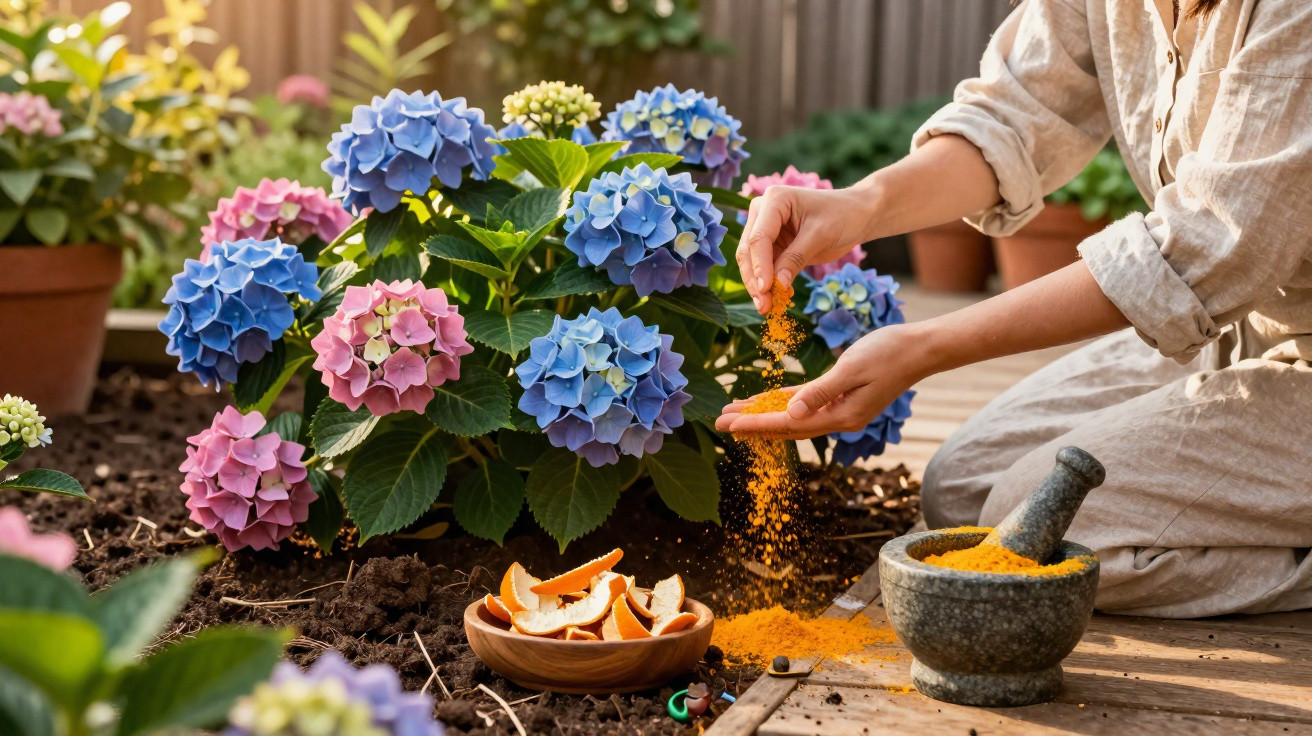
Anyone who grows hydrangeas in the garden or in containers will recognise the problem: yellowing leaves, drooping flowers and little growth – despite regular watering and feeding. Before buying expensive specialist fertiliser, it is often worth reaching into the food-waste bin. An everyday leftover from the fruit bowl can give these shrubs a visible boost when prepared properly.
Why many hydrangeas struggle despite good care
Hydrangeas are typical acid-loving plants. They prefer slightly acidic soil and thrive best at a pH of roughly 5 to 6.5. In many gardens, however, the value is considerably higher because tap water contains lime or the ground is naturally calcareous.
The consequences are immediately visible:
- leaves become pale or yellowish while their veins remain green
- flower heads stay smaller and appear in lower numbers
- growth is generally weak and sparse
- fertiliser brings hardly any noticeable improvement
The reason is that when the pH rises too far, the plant finds it harder to absorb many of the nutrients in the soil. Iron and other trace elements may be present, but they are effectively inaccessible to the roots. This is where a natural method can help: it gently shifts the soil towards acidity while also supplying a few minerals.
The surprising helper: citrus peel instead of specialist fertiliser
Something that normally goes straight into the bin can provide gentle soil care: the peel from oranges and other citrus fruits. It is an organic material that gradually acidifies the soil while adding small quantities of minerals.
“When prepared correctly, orange peel provides a mild, natural fertiliser that strengthens hydrangeas and encourages flower formation.”
The peel contains, among other things:
- potassium – supports flower production and cell stability
- magnesium – important for rich green foliage
- calcium – promotes sturdy shoots and healthy root development
- organic acids – help move the pH value slightly towards acidity
The quantities cannot be compared with those in conventional fertiliser; the benefit comes instead from the combination of mild acidification, organic matter and micronutrients. However, orange peel must be handled correctly if it is to benefit hydrangeas rather than cause more harm than good.
How to prepare orange peel properly
Putting peel straight into a pot or flower bed after peeling is not a good idea. Fresh, soft peel attracts fruit flies, can quickly go mouldy and decomposes very slowly. Before using it around hydrangeas, it must be allowed to dry out completely.
Three steps to turn waste into a garden aid
- Cut up the peel: After peeling, cut the remnants into broad strips or pieces. This helps them dry faster.
- Dry thoroughly:
- Spread the peel over a plate or baking tray and leave it for several days in a warm, well-ventilated spot, ideally in sunlight.
- Alternatively, dry it in the oven at a low temperature, leaving the door slightly ajar and checking it regularly.
- Grind or chop finely: Once the pieces are hard and brittle, place them in a blender or crush them with a pestle and mortar. The aim is to create as fine a texture as possible, ranging from coarse granules to powder.
The finer the material, the sooner soil organisms can break down the peel and the more evenly its nutrients reach the roots.
How gardeners should use orange peel powder on hydrangeas
Dried and crushed peel works like a mild homemade fertiliser. It is particularly suitable during the spring and summer growing season, when hydrangeas are producing new shoots and forming flowers.
In practical terms, use it as follows:
- apply roughly one small handful of powder or finely cut pieces per shrub about once a month
- scatter only a very thin layer around the root area; do not make a pile
- lightly cover the material with soil or compost
- water well afterwards so that the substances spread through the topsoil
“A thin film of orange peel is enough – applying too much material at once puts stress on both soil and plant.”
Those growing hydrangeas in containers should be especially careful with the dose: compost in a pot reacts more quickly because the volume is limited. A small pinch every four to six weeks is sufficient.
What actually changes in the soil
The crushed peel does not reach the roots directly. It first feeds the soil ecosystem: fungi, bacteria and soil animals break the material down. In the process, humus-forming components and organic acids are created, which can lower the pH slightly in the root zone.
For the hydrangea, this means:
- nutrients such as iron and manganese become more readily available again
- the green colour of the leaves becomes more stable and yellowing recedes
- flower heads grow stronger and appear in greater numbers
- the shrub looks healthier and more resilient overall
It is important to note that the effect is subtle and develops over time. In a garden with very calcareous soil, orange peel alone will not work miracles. In this case, it needs to be combined with other measures.
Combine it with other measures rather than expecting miracles
Hydrangeas respond very sensitively to their growing conditions. Anyone wanting to enjoy large, richly coloured flowers in the long term should rely on several measures at once.
Reliable partners for acidic soil
- compost made from oak, beech or horse chestnut leaves
- bark mulch or decorative bark from conifers
- pine or spruce needle litter applied in thin layers
- rainwater instead of lime-rich tap water, where possible
In highly calcareous areas, many gardeners also use specialist compost for acid-loving plants, at least around the immediate root area or in containers. Orange peel is an ideal addition here: it helps maintain the slightly acidic conditions and supplies a small nutrient boost.
Risks, limits and sensible alternatives
Useful as this method can be, it does have limits. Overdoing it can disrupt the soil ecosystem and, in extreme cases, achieve exactly the opposite result.
Gardeners should keep the following in mind:
- do not apply it more often than once a month
- do not spread thick layers or whole pieces of peel
- remove it immediately if there is a musty smell or mould develops
- reduce the amount if pests such as ants or slugs appear
Anyone who does not eat oranges or prefers to avoid citrus peel altogether can achieve similar effects with other kitchen leftovers, such as thin layers of coffee grounds. These are also mildly acidifying and add nutrients, but should be dried thoroughly and spread sparingly.
How the effect appears in everyday gardening
Many amateur gardeners report that the first changes become apparent after a few weeks: leaves look a deeper green, new shoots are sturdier and less spindly, and flower clusters are denser. The difference can be particularly clear in summer for plants that had previously only just been getting by.
A simple before-and-after comparison can be helpful: give one shrub regular orange-peel treatment while leaving another on its existing care routine. Observing both over a season will give you a feel for the results in your own garden, because soil, water and climate interact differently everywhere.
The bottom line is that it is worth looking in the food-waste bin. Rather than throwing away valuable organic matter, orange peel can travel directly from the fruit bowl to the roots of your favourite hydrangeas – where it provides more vigour, colour and flowering pleasure.
Comments
No comments yet. Be the first to comment!
Leave a Comment