
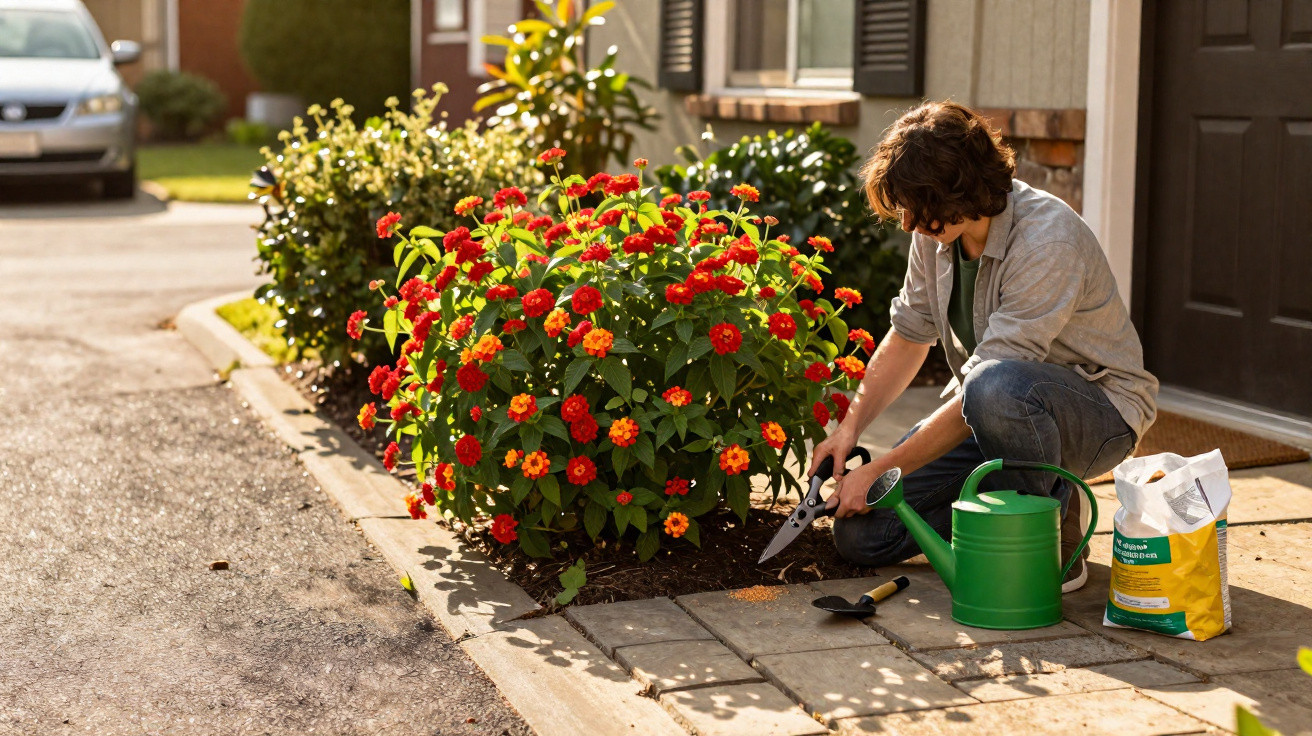
Many homeowners know the issue: the driveway looks tidy, yet somehow rather bleak. Few plants can cope with the combination of heat, vehicle traffic and road salt. This is precisely where a particular shrub excels – still something of an insider’s choice in Germany, it can look as though a blazing red carpet has been laid in front of the garage.
A striking red plant that shrugs off tarmac and heat
The plant in question is red lantana, specifically the cultivar Lantana camara ‘Hot Blooded’. Native to warmer parts of the world, this shrub belongs to the verbena family. It makes an immediate impression in the garden, with dark, aromatic foliage and an almost explosive display of flowers from May until October.
Its flowers provide a small firework display of colour. They first emerge golden yellow, then turn a vivid orange before reaching a deep, bright red. All three shades can often be seen on the same shrub at once. Planted beside a driveway, they create an unbroken, fiery ribbon – ideal where the front of the house is otherwise fairly understated.
“Anyone looking to plant up a hot, dry driveway will find red lantana one of the few genuinely effective problem-solvers.”
At roughly 60 centimetres tall and similarly wide, the plant remains compact. It does not obstruct car doors opening or impair visibility when reversing out, while still giving the appearance of a low hedge. These dimensions are almost ideal for driveways, access roads or the edges of parking areas.
Why this lantana is so useful for driveways
One major benefit of this cultivar is that it is considered sterile. In other words, it does not produce viable seed or self-seed throughout the garden. Anyone wanting a neat, clearly defined edge will therefore not have to keep pulling out young plants.
At the same time, the shrub supplies plenty of nectar for months. Bees, butterflies and other insects visit the blooms enthusiastically. Even in watered, heavily paved front gardens, lantana can therefore restore a little biodiversity without demanding much maintenance.
- tolerates high temperatures and heat reflected by tarmac or paving
- copes with prolonged dry spells
- handles splashes of road salt better than many other ornamental plants
- is generally avoided by deer – useful in properties on the edge of a town or village
For homeowners in particularly sunny positions, where lavender, roses or hydrangeas often struggle, red lantana is therefore a serious alternative.
Positioning red lantana where it performs best
This shrub thrives in hot conditions. Along driveways, garage approaches and paved paths, conditions are often extreme: reflected heat from below, limited soil moisture and occasional vehicle traffic. These are exactly the settings in which Lantana ‘Hot Blooded’ performs remarkably well, provided a few basic rules are met.
Plenty of sun and free-draining soil
The site should receive at least six hours of direct sunshine each day. In partial shade, flowering is noticeably reduced and the shrub grows less compactly. Good drainage is the main requirement for the soil, as lantana does not tolerate waterlogging well.
Ground alongside driveways is often compacted. It is worth taking extra time to prepare it before planting:
- dig a planting hole two to three times wider than the root ball
- loosen the soil thoroughly at the base rather than leaving it smooth and compacted
- improve heavy soil with gravel, grit or expanded clay
- position the root ball at soil level, not too deeply
- water thoroughly and mulch with fine gravel or grit
Mineral mulch complements tarmac or paving visually and stops the soil from drying out or becoming capped. It also keeps the roots well aerated.
How hardy is Lantana ‘Hot Blooded’ in German-speaking regions?
Lantana originally comes from considerably warmer climates. In mild areas, it can remain in a border as a perennial. Experience indicates that below approximately minus eight degrees the roots die, while the plant begins shedding its leaves as soon as temperatures reach freezing point.
In German-speaking regions, how it is used depends largely on the local area:
| Climate region | Recommended use |
|---|---|
| mild wine-growing or coastal areas | grow in the ground with winter protection; cut back in late winter |
| typical inland areas | use as a heavily flowering seasonal plant and plan to replace it in autumn |
| exposed upland areas | best grown in a container and kept somewhere bright and frost-free over winter |
Those planting near the limit of its hardiness can cover the base of the shrub with a thick layer of bark mulch or leaves in late autumn. This offers the root zone some protection from frosts without snow cover. In colder areas, it is often worth placing plants in decorative containers along the driveway and moving them to a bright, unheated room in autumn.
Seasonal care: keeping the driveway hedge in shape
The first summer after planting is the most demanding period. While the root system is still shallow, regular watering is essential. Hot days and heat reflected from the tarmac can dry the soil out quickly. Once established, however, the shrub can manage surprisingly long periods without water.
Watering, pruning and feeding
Useful maintenance rules of thumb are:
- Watering: water consistently during the first summer; afterwards, only during extended dry periods
- Feeding: work in a slow-release fertiliser or a little compost in spring
- Pruning: cut back firmly in late winter or very early spring to encourage fresh, free-flowering shoots
Regular pruning produces compact, cushion-shaped shrubs that line up neatly beside the driveway. Without cutting back, the stems become increasingly woody, flowering is concentrated towards the outside, and the plant looks less fresh.
Caution: a toxic plant with powerful effects
Attractive as red lantana may be, it has a downside: all parts of the plant are considered toxic. Swallowed berries can cause symptoms of poisoning in people and pets, and the leaves are not harmless either.
Anyone with young children, or with dogs and cats roaming freely in the front garden, should choose the planting position carefully. A site beside a driveway that children rarely use as a play area is often a workable compromise. Wearing gloves when pruning helps prevent skin irritation.
Ideal combinations and driveway design ideas
The strong red-orange-yellow progression of lantana is highly effective on its own, but it also combines well with other plants. Particularly interesting partners are those that cope equally well with heat:
- low ornamental grasses such as fountain grass or blue fescue
- silver-leaved species such as cotton lavender or dwarf groundsel
- drought-tolerant mat-forming perennials such as thyme or saxifrage
Anyone planning the colours of their driveway planting can use a blend of red, orange and yellow-flowering plants, while ensuring there is variety in leaf shape and height. Lantana then forms the glowing base, with taller perennials or grasses adding depth behind it.
What gardeners should know before planting
The term “bee-friendly” is often used in connection with lantana. From an insect perspective, this is true: its flowers offer abundant nectar. In some parts of the world, however, lantana is regarded as a problematic non-native plant because it spreads vigorously there. The sterile cultivar ‘Hot Blooded’ greatly reduces that risk, as it does not reproduce from seed.
Water is also a consideration in German-speaking regions. Front gardens with extensive paving and tarmac become intensely hot, while watering is viewed more critically as water prices rise. This is another area in which red lantana stands out: after its establishment period, it needs substantially less water than many traditional bedding plants and rewards that restraint with almost continuous flowering.
Anyone wishing to improve the appearance of their driveway without creating another high-maintenance task should keep this fiery red shrub in mind. Particularly in sunny, hot locations where many other plants give up, Lantana ‘Hot Blooded’ shows its full potential – turning plain tarmac into a bright welcome for everyone arriving home.


Comments
No comments yet. Be the first to comment!
Leave a Comment