
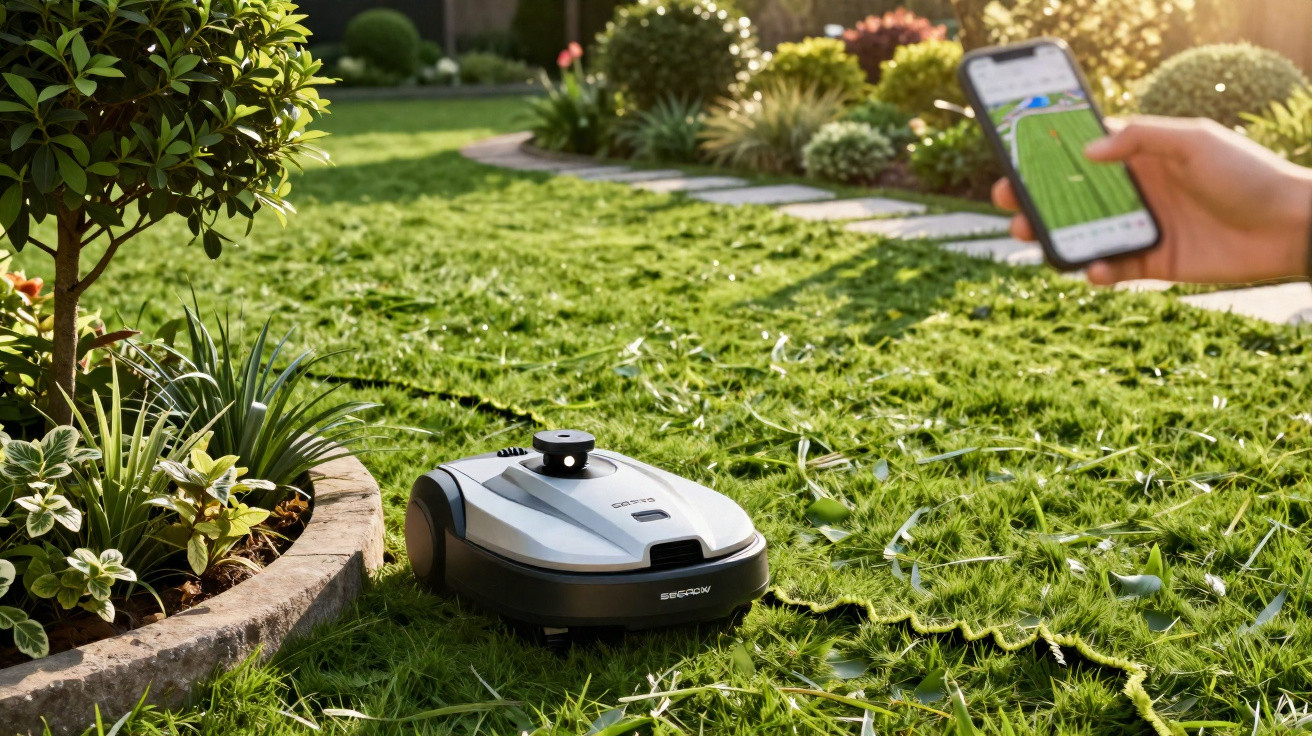
Narrow passages, dense flowerbeds, winding corners… The Segway Navimow i208 LiDAR claims it can handle the gardens that entry-level robotic mowers fear. We put it through its paces for two months on a challenging plot to find out whether its €1,199 price is justified.
Choosing a robotic mower in 2026 is something of a puzzle. In barely three years, the number of brands in the sector has grown as quickly as the number of models. At the same time, most products have abandoned antennas and boundary wires that need laying in favour of the promise of wire-free mowing.
The difficulty is that several navigation technologies now compete in this market: RTK, AI vision, LiDAR, wide-angle cameras, often at very similar prices. As a result, working out which system suits your needs can be complicated.
Take a practical example. In 2026, a wire-free robotic mower can be found for around €600, as illustrated by the Mova ViAX 250. The drawback is that, at this price, its navigation system does not include LiDAR and its maximum coverage is limited to 250 m².
By contrast, the Roborock RockNeo Q105 claims to cover areas of up to 500 m². It still has no LiDAR, but this time it comes with an antenna. Then there are manufacturers with extensive catalogues, such as Mova and, above all, Segway Navimow, which unveiled around twenty new models last spring.
Into this crowded market comes the Navimow i208 LiDAR. With its three sensors, this wire-free mower is aimed less at small lawns than at complicated gardens packed with narrow routes, flowerbeds and dense vegetation. It can cover up to 800 m² and launched at €1,199. If that sounds like your garden, this review is for you.
What we liked
Straightforward, speedy installation
For Segway, 2026 marks a turning point. None of the new robotic mowers presented by the brand in spring requires a wire to be buried around the lawn or an unsightly antenna planted in the middle of the garden.
Like the other models in its range, the i208 LiDAR only needs its charging station, placed in a corner with access to your home Wi-Fi, and most of the installation is already complete. Once it is connected, alongside Bluetooth pairing, the robot is ready to get to work.
There are two ways to set it up. The first, and most conventional, puts you in control. Using a virtual joystick on your smartphone, you steer the mower around the edges to map the garden boundaries. It takes a little dexterity, particularly on a plot full of angles.
The second option, increasingly common on recent LiDAR-equipped models, is automatic mapping. Here, the Navimow i208 LiDAR explores the lawn and creates its own map. In practice, this setting should only be considered for simple square or rectangular gardens with few obstacles - effectively the opposite of the terrain for which it appears designed.
Once the map has been created, you can view it in 3D and add no-go areas, boundaries and transit points. This is an important stage, as it largely determines how well the robot will navigate afterwards. For our first 250 m² zone, installation and mapping took just 45 minutes in total.
Ultra-precise navigation and a comprehensive app
This is where the Navimow i208 LiDAR really stands out. To navigate without an antenna, it relies on a three-sensor combination: a LiDAR scanner that reads its surroundings even in low light, a wide-angle camera to spot obstacles, and satellite positioning to establish its location.
Its performance matched the demanding course we gave it. Our test area included numerous planted beds, trees with large exposed roots, stone-edged borders, garden furniture and small winding corners. These were all potential traps that the Navimow i208 LiDAR avoided without issue.
Throughout two months of testing, we never had to free it by hand from an awkward situation. To push it harder, we even placed obstacles unpredictably in its path, and it navigated around them with no difficulty.
On the software side, the Navimow app is fairly comprehensive without becoming cluttered. Cutting height can be adjusted by zone from 20 to 70 mm, while the direction of the mowing stripes can be selected to avoid marking the lawn. Otherwise, very little is missing: you can schedule operating times, lock the buttons to protect children, and use a rain sensor to prevent it working during a storm.
Segway even offers the novelty of drawing a heart or a letter in the grass. If you have an artistic streak, or an original marriage proposal to make, why not?
Clean mowing and well-finished build quality
Turn it over like a turtle and the Navimow i208 LiDAR reveals a six-blade cutting deck that trims a strip around 22 cm wide. That is not the widest on the market, as some models reach 26 cm, but the results are highly convincing.
During a mowing session, the robot progresses in neatly parallel lines. It remains methodical from beginning to end. While other mowers can seem to wander randomly, rather like headless chickens, this one never appears lost. The cut is clean and, above all, very even.
Hardly any tufts or stray blades survive its passage. Almost, because another benefit of its excellent navigation is that small flowers scattered in its route are carefully avoided and left intact. There is not even any need to turn daisies into no-go zones.
What we liked less
Edges remain an enduring challenge
Just as robot vacuum cleaners are largely unable to remove dust from tiny corners, robotic mowers face a similar limitation: cutting right up to edges. This is currently one of the key battlegrounds for garden equipment, with every manufacturer trying to find an answer.
For example, Mova offers a manual mowing mode on the ViAX 250, allowing you to steer the robot yourself to finish specific spots. For its i208 LiDAR, Navimow instead relies on its EdgeSense technology, which is enabled by default.
In practical terms, during a standard mow of a zone, the robot always begins by following the perimeter before filling in the centre. It moves as close as possible, leaving only around 5 cm of uncut grass. Along a gravel path or a very flat patio, this works well, with the mower almost overlapping the boundary.
Against a wall or dense vegetation, however, there is no miracle. As its cutting deck does not extend sideways, it leaves roughly 10 to 15 cm of grass uncut. Those who are particularly meticulous will still need to finish these areas by hand with shears.
Wheels can slip, while charging is a little slow
The robot uses two driven wheels at the rear and two swivelling wheels at the front. This conventional arrangement works superbly on dry ground. It moves easily and can take tight turns. It will even climb slopes of up to 45%, or around 24 degrees, without complaint.
That said, we noticed that its wheels can slip in places as soon as the ground becomes loose or waterlogged after rain. It is nothing serious: while it can navigate a complex garden, do not expect it to act as an off-road machine on very steep, muddy areas.
Battery life is fairly impressive. Its 5.1 Ah battery enables it to cover between 215 and 240 m² per session. The aspect we found more frustrating was charging time.
It needs a good two hours before returning to work. Taken together and measured against its maximum 800 m² capacity, you should allow for around four mowing and charging cycles - a good twelve hours spread over one or two days.
A few other minor shortcomings
A handful of details stop the Navimow i208 LiDAR from achieving perfection. First, mowing customisation is rather limited for a robot at this price. You cannot choose the order in which it handles different zones, the number of times it passes along the edges, or the speed at which its blades rotate. In short, every mowing session is treated in the same way.
Then there is the 4G module. Its purpose is to let you retain control of the robot even when you are outside Wi-Fi range. If you go on holiday, for instance, you can start a mowing session or receive an alert if someone tries to take it. Its GPS chip can then be used to locate it. Unfortunately, this added convenience is free only for the first year. After that, expect to pay €30 per year to keep using it.
Finally, while the robot itself feels robust, the same cannot be said for its charging base. Its small orange accents may add a little flair, but it is made from very thin plastic - the kind more commonly found on cheaper models. If you also want a garage to shield the robot from rain, you will need to add another €149. These extras can quickly increase the overall bill.
Our verdict on the Segway Navimow i208 LiDAR
Robotic mower prices may be falling, but it is still best to know exactly what you need. For a flat square or rectangular lawn of no more than 500 m², affordable models below €1,000 may be sufficient. This applies to the Roborock RockNeo Q105 and Mova ViAX 250 that we tested recently.
However, once a garden becomes more complicated, with flowerbeds, vegetation, a patio, gravel paths or narrow passages, the situation changes. This is what we call a complex garden, and for such terrain, a mower with LiDAR navigation becomes essential.
That is exactly what the Navimow i208 LiDAR provides. Thanks to its trio of sensors, it delivers ultra-precise navigation and obstacle recognition. Installation is also quick, with no antenna to install, the cut is clean, and the app is fairly comprehensive.
It is not flawless, though. Edge cutting still has room for improvement, while its traction reaches its limits on steep slopes. These shortcomings are far from deal-breakers, but they are worth bearing in mind. Ultimately, for anyone with a complex garden of up to 800 m², full of obstacles and awkward corners, the i208 LiDAR is one of the best options available at present.
Segway Navimow i208 LiDAR
€1,199
8.6
| Category | Score |
|---|---|
| Installation | 9.5/10 |
| Navigation and obstacle detection | 9.5/10 |
| Mowing and edge-cutting quality | 8.5/10 |
| App and options | 8.0/10 |
| Battery life and charging | 7.5/10 |
What we like
- Quick and easy installation
- Ultra-precise navigation and obstacle detection
- A comprehensive app
- Dense, even mowing with no missed areas in the centre
- Excellent build quality
What we like less
- Edge cutting still needs improvement
- Wheels slip on very loose ground or steep slopes
- Limited mowing customisation
- 4G module chargeable after one year
- Charging base made from very thin plastic
Buy the Segway Navimow i208 LiDAR






Comments
No comments yet. Be the first to comment!
Leave a Comment