
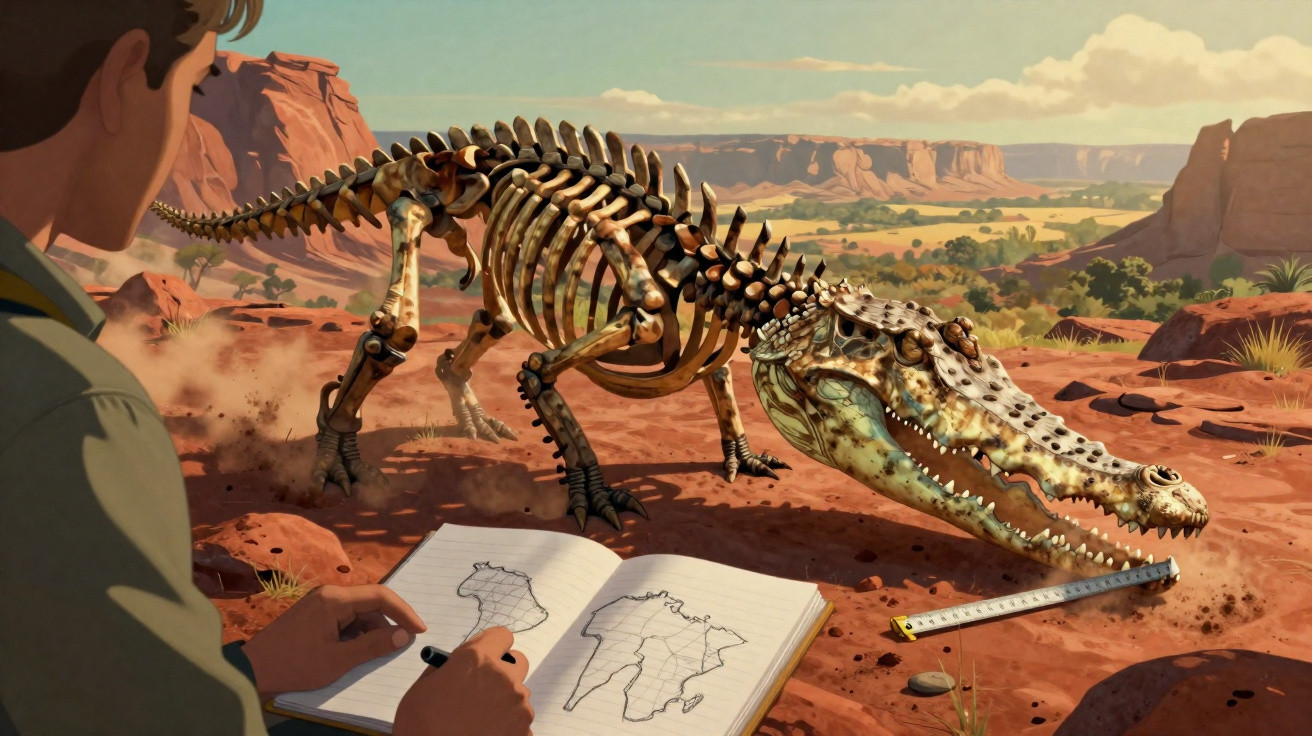
At first glance, it could easily be mistaken for a small predatory dinosaur. Yet a fossil found in Rio Grande do Sul has revealed something else: Tainrakuasuchus bellator, an armoured reptile from around 240 million years ago, belonged to the evolutionary branch that would later give rise to crocodiles.
What was this predator discovered in Brazil?
The fossil was unearthed in the municipality of Dona Francisca, Rio Grande do Sul, and includes parts of the jaw, vertebral column and pelvis. The species was described in a study published in the Journal of Systematic Palaeontology by a team led by palaeontologist Rodrigo Temp Müller of the Federal University of Santa Maria.
The animal was a pseudosuchian, a group of archosaurs related to the crocodilian lineage. More specifically, it was a poposauroid, a type of reptile that is comparatively rare in the South American fossil record. Although its appearance resembled that of some dinosaurs, it was not part of the dinosaur lineage.
Why did Tainrakuasuchus bellator look so much like a dinosaur?
Tainrakuasuchus bellator measured about 2.4 metres in length and had an estimated mass of roughly 60 kilograms. Its body combined an elongated neck, a narrow jaw, sharp teeth and a covering of bony plates across its back, known as osteoderms.
- It measured approximately 2.4 metres from head to tail.
- Researchers estimate that it weighed around 60 kilograms.
- It had sharp teeth and features consistent with an active predator.
- Its back was protected by bony plates similar to structures found in modern crocodilians.
This combination illustrates how animals from separate lineages can evolve similar appearances. The osteoderms are particularly noteworthy because they are also present in modern crocodiles, showing that this form of bodily protection already existed in ancient relatives of the group during the Triassic.
Was it one of the largest predators of its time?
Despite its intimidating appearance, the newly identified reptile was far from the very largest animals of its era. Müller explained that Tainrakuasuchus bellator was an active predator, but it shared its environment with hunters that could grow to around seven metres long.
The study helps demonstrate that the Triassic was not merely a prelude to the later age of dinosaurs. At that time, different archosaur groups occupied a range of niches and competed in terrestrial ecosystems, producing a diversity of forms far greater than the popular record often suggests.
Watch the video shared by the YouTube channel Top Noticias Cientificas about the species discovered in Brazil.
https://www.youtube.com/watch?v=ruPDS97KiwM
What does the fossil reveal about Brazil and Africa?
One of the discovery’s most intriguing features is its close evolutionary relationship with Mandasuchus tanyauchen, a pseudosuchian known from fossils found in Tanzania that lived around 245 million years ago. This similarity helps tell a story involving continents that are now separated by an ocean.
At that time, South America and Africa were still part of Pangaea. According to Müller, this connection allowed organisms to disperse across regions that are now widely separated. As a result, Brazilian and African fossil faunas share common elements, revealing an ancient ecological link between the two sides of the present-day Atlantic.
How does this animal change the story before the dinosaurs?
The description of Tainrakuasuchus bellator expands knowledge of Triassic poposauroids and pseudosuchians, whose history still contains many gaps because fossils are rare. Every new specimen helps palaeontologists reconstruct how these crocodile relatives diversified before dinosaurs became dominant.
The Brazilian fossil leaves an unforgettable image: a sharp-toothed hunter with an armoured back and an almost dinosaur-like appearance walking across Brazilian territory 240 million years ago. Learning about creatures such as this changes how we see that distant past and shows that dinosaurs were far from the only leading figures in their world.



Comments
No comments yet. Be the first to comment!
Leave a Comment