
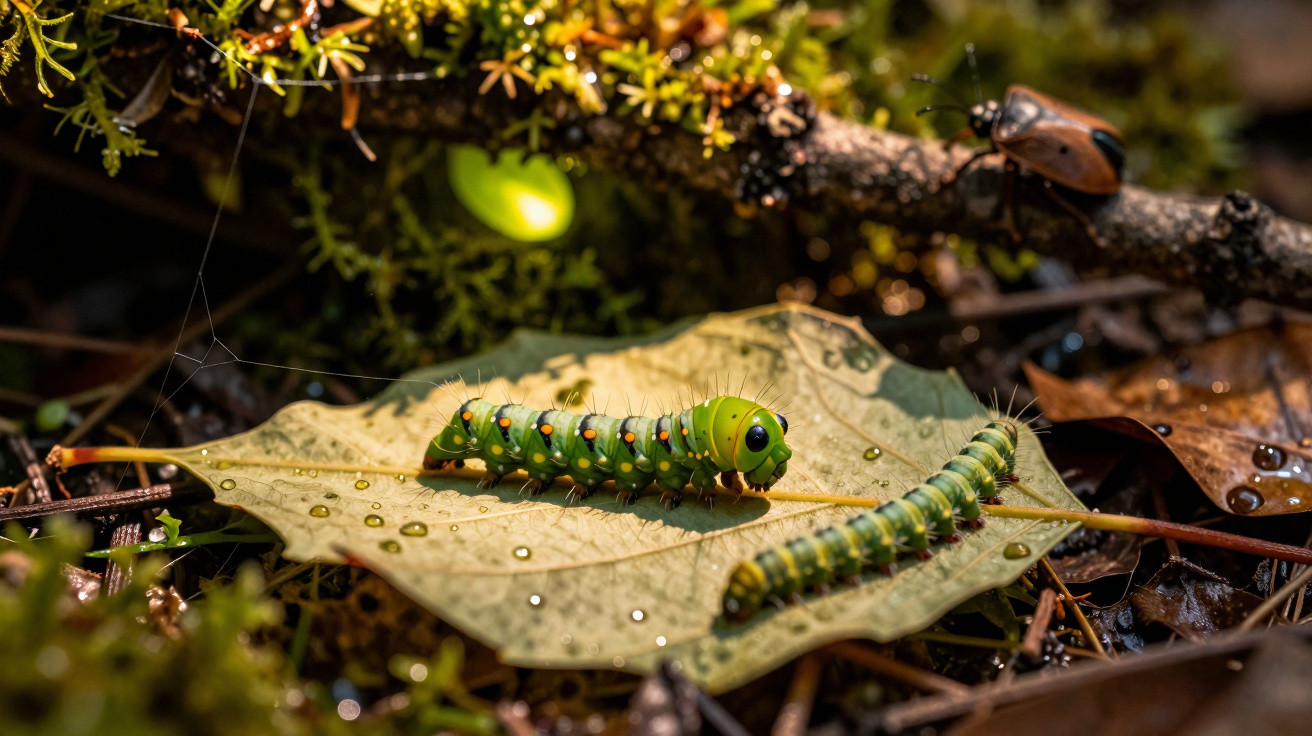
An insect may fit on the tip of a finger yet conceal a defence or hunting mechanism capable of startling anyone who watches closely. Among caterpillars, luminous larvae and true bugs, some species rely on disguise, traps, paralysing saliva and microscopic hairs to survive.
How can a caterpillar resemble a small snake?
The caterpillar of Hemeroplanes triptolemus is renowned for its visual bluff. If disturbed, it withdraws its real head and expands the front sections of its body, revealing eye-like markings and an outline resembling a snake’s head. The display is brief, but it may be enough to make a predator pause.
Despite its appearance, it has neither enormous eyes nor a concealed snake head. Scientific reviews describe this as a likely case of defensive mimicry or a startle display, while noting that predator responses to this particular species have not yet been tested conclusively.
Why does the glowworm use light to catch food?
In New Zealand, the larva of Arachnocampa luminosa makes its own light part of a trap. It lives in damp, dark places and emits a blue-green glow that draws in small flying insects. Silk threads coated in sticky droplets hang beneath its body.
When prey approaches the light and brushes against one of these threads, it becomes trapped. The larva then hauls in the line and eats its visitor. Its English name means something like a glowing worm, although the animal is actually the juvenile stage of a fungus gnat rather than a true worm.
What does the wheel bug’s gear-like crest conceal?
The adult Arilus cristatus, known as the wheel bug, has a serrated ridge on its thorax that resembles a small cogwheel. While this feature is striking, its hunting tool is in its mouth: a piercing rostrum that injects saliva to immobilise other insects and help liquefy the prey’s tissues.
This true bug is regarded as beneficial because it attacks a range of garden pests, but it should not be handled. The University of Florida warns that, if disturbed, it can bite people and cause severe pain. Its decorative appearance and effective defence neatly capture the contrast within this group.
- The snake caterpillar uses a threatening outline to gain a few valuable seconds.
- The glowworm combines bioluminescence with sticky threads to attract and trap prey.
- The wheel bug relies on a piercing rostrum and paralysing saliva to overpower other insects.
- Processionary caterpillars shed irritating hairs that can trigger a reaction even without direct contact.
Watch the video shared by the YouTube channel Animal Fact Files, featuring facts about the “wheelbug”, known in Brazil as the wheel bug.
How can an orderly line of caterpillars become an invisible hazard?
Processionary caterpillars take their name from the lines in which they travel, resembling a small procession. In species such as the oak processionary caterpillar, later developmental stages carry vast numbers of tiny irritating hairs. These can irritate the skin, eyes and, in some people, the airways.
Care involves more than simply avoiding contact with the caterpillar. The hairs can detach, be carried by the wind and remain in nests, vegetation and clothing. Forestry authorities therefore advise people not to handle processionary caterpillars or their nests, and to keep away from infested areas.
What do these four insects reveal about appearance?
These four examples show that small size does not mean a simple strategy. Some deceive a predator’s vision, others exploit attraction to light, while certain species depend on chemicals or structures so tiny that they do not even need to be noticed to work. Each mechanism developed in a different ecological setting.
The best response to an unfamiliar insect is to watch it without picking it up. An apparently delicate body may be doing far more than it seems, and understanding the gap between appearance and function can help prevent accidents while revealing the creativity of evolution.




Comments
No comments yet. Be the first to comment!
Leave a Comment