
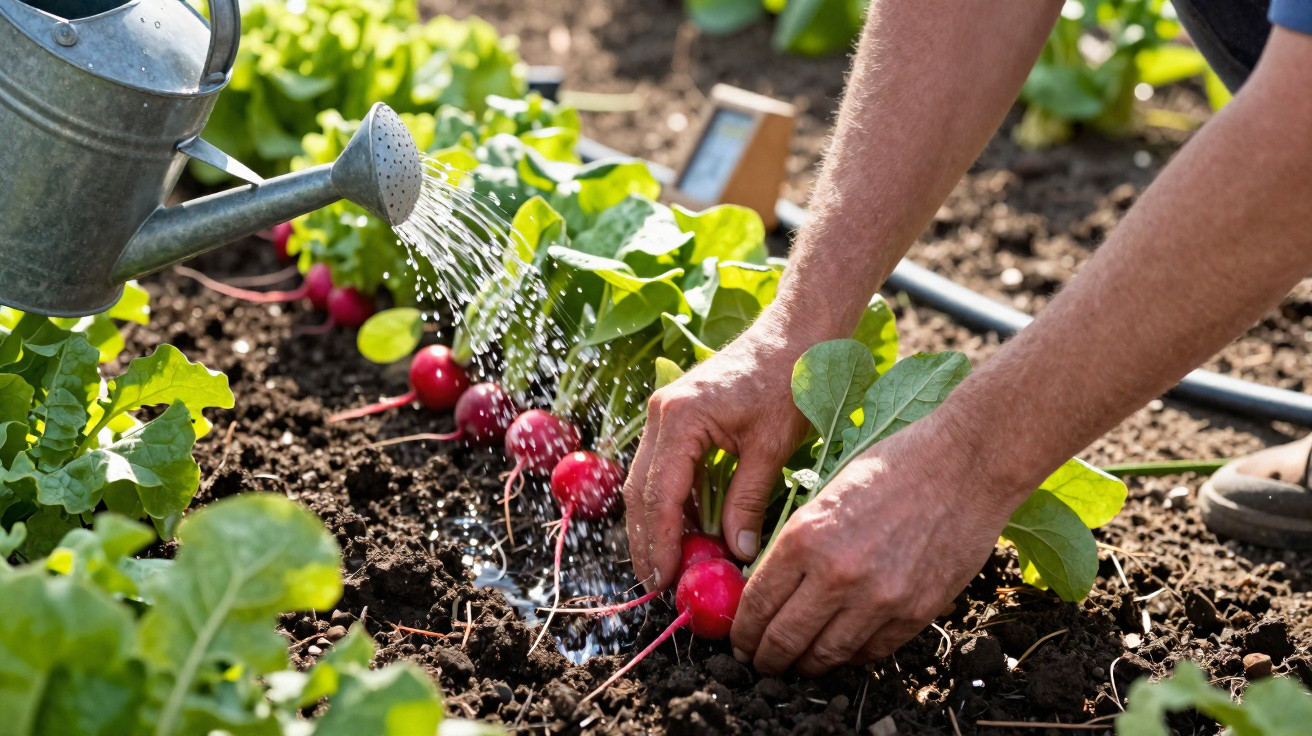
Radishes are often seen as the classic beginner’s vegetable: open the packet, sow quickly, harvest a few weeks later – job done. In reality, it is often not that straightforward. The roots may suddenly turn hot, become woolly inside or even split. These issues are usually not caused by “bad seed”, but by a very specific care mistake that can be avoided with one simple trick.
The key to radishes: consistently moist soil
Although radishes are hardy, they react surprisingly sensitively to fluctuations in soil conditions. Above all, watering determines whether the roots stay crisp or become unpleasant to eat.
“The most important trick for perfect radishes is to keep the bed evenly moist – without waterlogging and without drought stress.”
When the opposite happens, typical problems appear:
- Dry spells make radishes hot and cause the flesh to become tough and woody.
- Sharp changes between drought and wet conditions can make the roots split or crack.
- Constant wetness encourages rot and fungal diseases, while also creating a watery flavour.
The answer is soil that holds water well while still allowing excess moisture to drain away. Anyone gardening in light, sandy soil should work in plenty of compost. In heavy clay soil, sand, fine grit or well-rotted compost will improve its structure.
The ideal garden position for radishes
For the moisture trick to work, the bed also needs the right conditions. Radishes grow rapidly, but they are more particular than many people realise.
Site and soil: what matters
Radishes prefer:
- Sun or light partial shade – full sun in midsummer makes them more likely to bolt and dry out.
- Loose, crumbly soil – this allows even roots to form and makes harvesting easier.
- Humus-rich ground – compost retains water and provides nutrients in moderate amounts.
Heavily fertilised beds or beds containing fresh manure are unsuitable. Too much nitrogen promotes leaf growth, leaving the roots small or misshapen. An ordinarily maintained vegetable garden is entirely sufficient – radishes are among the less demanding crops.
Watering to a plan, rather than by instinct
A regular routine is especially worthwhile in a cold frame or during dry periods in spring:
- Thoroughly moisten the soil after sowing.
- Until germination, ensure that the top layer never dries out.
- Afterwards, water more often in smaller amounts rather than flooding the bed with a watering can only occasionally.
A straightforward check is to push a finger into the soil. If it feels dry at a depth of one to two centimetres, water it. If it remains slightly moist, wait a little longer.
Sowing radishes: spacing, depth and the right timing
Sowing method and timing are equally important for attractive roots. Neglecting these details can result in plenty of leaves but very few radishes.
How to sow radishes properly
A shallow drill is enough for a standard bed. It should not be too deep, otherwise the seedlings take unnecessarily long to emerge and may struggle.
| Parameter | Recommendation |
|---|---|
| Sowing depth | approx. 1 cm |
| Spacing between seeds | 3–5 cm |
| Row spacing | approx. 15 cm |
If seeds are sown too closely, thinning will be needed later. Leave around five to eight centimetres between individual plants. They need this room to develop round roots rather than crooked or flattened ones.
Early, late and heat-tolerant varieties
Radishes grow quickly, but not every variety suits every season. Varieties that cope with cool nights and short days are best for cold frames and very early outdoor sowings. They are less likely to produce flower stems as soon as temperatures fall.
In high summer, more heat-tolerant varieties are a sensible choice, as they do not bolt immediately. Anyone wishing to sow regularly should look for descriptions such as “for early crops” or “for summer growing” on seed packets.
Successional sowing: fresh radishes throughout the season
One common mistake is sowing a huge batch all at once. The result is piles of radishes in the kitchen for a few days, followed by an empty bed.
“Rather than making one large sowing, add small rows every two weeks – this keeps the bed productive and the harvest basket full.”
In practical terms, successional sowing means:
- Sow a first row in spring.
- Around two weeks later, make the next small row beside it.
- Repeat this pattern over several weeks.
This ensures that fresh, young roots keep coming through. Sowing only the amount a household can use within a few days reduces food waste and makes better use of the bed space.
The right harvest time: earlier is better than later
Radishes grow at great speed. Depending on the weather, they can be ready to harvest after just four to six weeks. Many amateur gardeners wait too long because they expect larger roots. That is exactly when the trouble starts.
Typical effects of harvesting too late include:
- The flesh becomes woolly and loses its crisp texture.
- The flavour changes from mildly peppery to unpleasantly hot.
- The roots partly become woody and are difficult to chew.
As a useful guide, harvest when the root is clearly visible above the soil surface and measures around two to three centimetres across. A few larger examples are fine, but small to medium-sized is the most worthwhile target size.
Combining radishes cleverly in the vegetable bed
Radishes are ideal as a fast catch crop. They make use of periods when other vegetables are still small or have not yet been planted in the bed.
Practical examples include:
- Sow them between rows of slow-growing vegetables such as cabbage or leeks – the radishes will be harvested before the other crops need the space.
- Add a few rows of radishes in gaps left after harvesting lamb’s lettuce or spinach.
- Use them as gap-fillers in a raised bed when you have not yet decided what will be planted there later.
As radishes remain in the ground for only a few weeks, they contribute little to soil fatigue and fit easily into any crop rotation.
Common radish problems and how to solve them quickly
Questions can still arise even with good care. Here is a brief overview of the usual stumbling blocks:
- Lots of leaves but no roots: This is often a sign of excessive nitrogen or sowing too densely. Use less fertiliser and increase the spacing.
- Radishes split: Usually the result of heavy watering after a dry spell. Adjust the watering routine and mulch more generously.
- Holes in the leaves: Flea beetles or slugs are typical culprits. Light hoeing and mulching help against flea beetles, while barriers and hand-picking help with slugs.
Following the principle of “consistent moisture, sufficient spacing, timely harvesting” prevents most of these problems before they develop.
Why the moisture trick also benefits the bed’s microclimate
A bed that does not dry out repeatedly has a positive effect on the whole garden microclimate. Mulch layers made from grass clippings or shredded leaves reduce evaporation, protect soil organisms and stop the surface from forming a crust. Rainwater infiltrates more effectively and remains available to plants for longer.
Collecting rainwater for watering also saves tap water and supplies plants with water that is usually softer. Radishes in particular, which react quickly to changing conditions, reward this relatively stable supply with even development and mild heat.
This turns what seems to be a beginner’s vegetable into a reliable indicator of your own gardening practice: when radishes are round, juicy and crisp, the rest of the bed is usually in good order too.
Comments
No comments yet. Be the first to comment!
Leave a Comment