
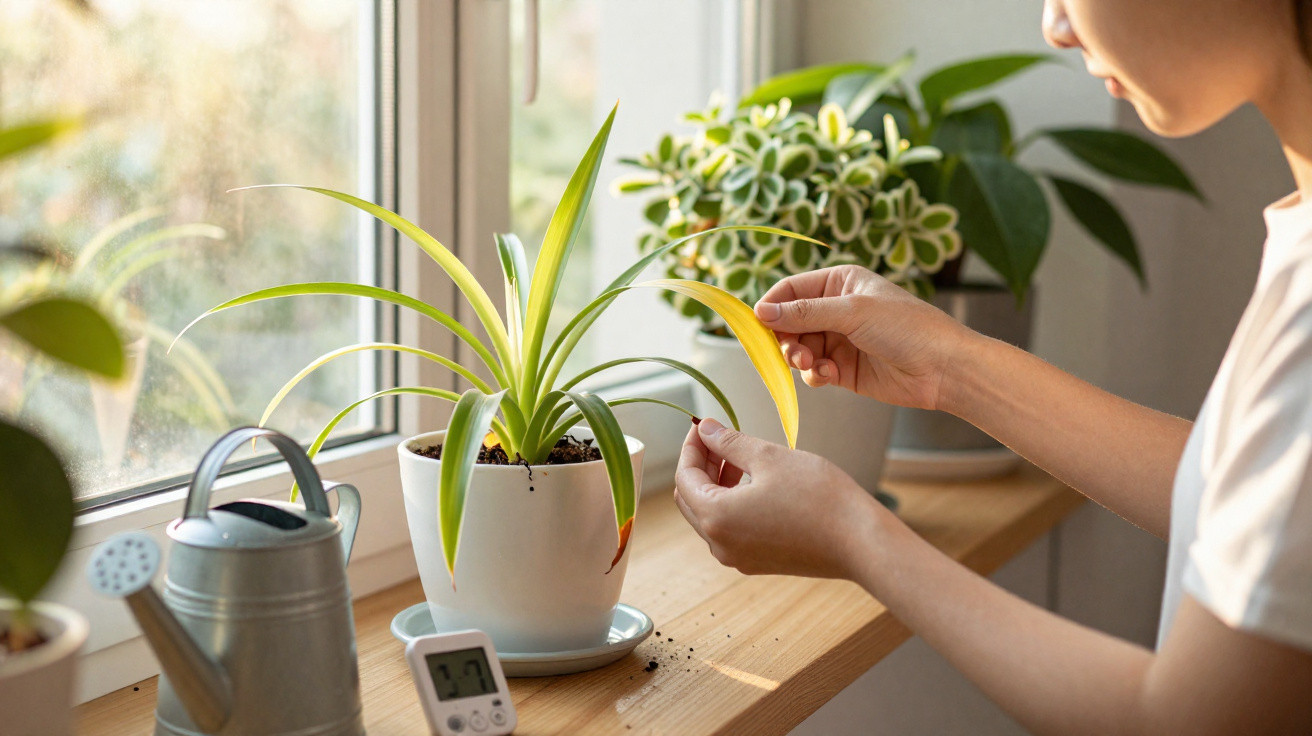
Many indoor gardeners only notice the problem once their spider plant no longer resembles a green fountain, but looks more like a tired fan. Its leaves droop oddly, fold in the middle or even snap. The light seems right and it is being watered, yet the plant still appears stressed. That is when it is time to investigate what is happening inside the pot.
What a genuinely healthy spider plant looks like
A thriving spider plant produces long, narrow leaves, usually deep green or green with a white stripe. Leaves emerge densely from the centre, curve gently outwards and then cascade down in a soft arch. This characteristic “fountain shape” is the clearest sign that the plant is receiving good care.
The leaf surface should feel smooth and springy. When you run a finger along a healthy leaf, you should not find a hard fold or an area that feels thin, soft or papery. Even particularly long leaves remain flexible and yield slightly rather than breaking straight away.
A truly creased leaf looks very different: it has a sharp angle, as though it has been neatly folded over. Its central vein no longer follows a smooth curve, but is actually broken at the bend. The affected area often turns yellowish, grey or brown afterwards, and may feel soft or, in severe cases, crumbly.
Healthy spider plants have long, flexible leaves with even colouring – every hard crease is a cry for help.
Bent, yellow and dry leaves: the likely causes
Before assuming there is a serious care issue, check the most straightforward explanation: physical damage. A door may brush the pot, a child may catch a foot on it, or a cat may land in the clump of foliage after jumping. Any of these can bend or break individual leaves without weakening the whole plant.
The more worrying pattern is when several new leaves emerge already misshapen, turn soft, flop over or tear at the base. In that case, the cause is almost always a care mistake, usually involving water, roots or humidity.
Too much water: when the roots are effectively drowning
Spider plants are considered tolerant, but they can only forgive waterlogged roots to a certain extent. Common signs of overwatering include:
- leaves that are bent and becoming yellowish or grey-green
- compost that feels heavy, cold and stays wet for a long time
- a slightly musty smell from the pot in some cases
- new leaves growing in thin and floppy
In this condition, damaged roots can no longer move water and nutrients efficiently. The vessels inside the leaves are affected, the tissue collapses, and the “fountain” ends up hanging like a wet cloth.
Rescue plan:
- Do not water again until the top 5 cm of compost is properly dry.
- Always empty the saucer beneath the pot; never leave it standing in water.
- If the plant remains soggy despite a watering break, carefully lift the root ball from the pot and inspect the roots.
If the roots are brown, soft and unpleasant-smelling, root rot is present. Decisive action is then essential: cut away rotten root sections with clean scissors, repot the plant in fresh, loose compost and water far more cautiously in future.
Too little water: when leaves snap like dry straw
The opposite extreme causes trouble too. Spider plants cope with brief dry spells, but prolonged lack of water gives the leaves these symptoms:
- they turn brown and ragged from the tips onwards
- they snap easily and feel hard and brittle
- the compost pulls away from the sides of the pot and develops cracks
The plant simply does not have enough water within its system. Cell walls lose their firmness, leaf tissue dries out and the leaves buckle as soon as pressure is applied. A quick one-off watering will rarely improve matters at this point, as the compost often no longer absorbs water properly.
Instead, water the pot slowly from below. Place it in a bowl of water until the compost has soaked it up, then allow it to drain thoroughly. Afterwards, water consistently but not every day, and always check whether the root area is genuinely thirsty again first.
Dry air and insufficient light: hidden stress factors
The watering can is not the only factor involved. Two other common causes are:
- Dry central-heating air: leaf tips turn brown, edges become ragged and fine creases occur more often. A small bowl of water or a saucer filled with damp pebbles beneath the pot can provide noticeable relief.
- Lack of light: the entire plant leans distinctly towards the window. Leaves become longer but thinner and weaker, making them more likely to crease. A bright position without intense midday sun, such as directly beside an east- or west-facing window, is much more suitable.
What to do with leaves that have already snapped
There is no point hoping that a genuinely broken leaf will “heal itself”. A sharply creased or fully snapped leaf will not straighten again. Its internal vessels have been destroyed, so the leaf remains a burden on the plant.
Once a leaf has been sharply creased, only a clean cut will help – the energy can then go into fresh growth.
Proceed as follows:
- Prepare clean, sharp scissors or a small pair of garden snips.
- Cut creased leaves as close to the base as possible.
- Leave the cut surfaces dry and do not water immediately afterwards.
A healthy spider plant quickly replaces leaves that have been lost. Regularly removing dead material also helps prevent rot and mould in the densely growing centre of the plant.
A permanently healthy spider plant: a routine to prevent fresh creases
To stop the problem of bent leaves from repeatedly returning, it helps to follow a simple care checklist. Keep a small notebook or a note on your phone to record watering dates, changes of position and repotting. This makes it much easier to spot links between your actions and the condition of the leaves.
| Problem | Typical signs | Action |
|---|---|---|
| Too much water | soft, yellowish leaves, wet root ball | increase the interval between watering, use a pot with drainage holes, loosen the compost |
| Too little water | brittle leaves, brown tips, compost pulling away from the edge | water thoroughly, then allow it to dry again |
| Rotten roots | musty smell, brown roots, limp plant | trim back roots, repot, improve drainage |
| Air too dry | brown edges, fine cracks | bowl of water, humidifier, move further from radiators |
| Too little light | plant leans towards the window, thin leaves | choose a brighter spot, avoid a dark corner of the room |
How to recognise care mistakes early
The sooner you respond, the fewer leaves will be lost. Check weekly for small warning signs:
- discolouration at leaf tips
- slight waves or wrinkles along leaf edges
- individual leaves that feel noticeably softer or harder than the rest
- changes in growth, such as a suddenly more lopsided shape or much wider gaps between leaves
These clues point to an imbalance in moisture or light well before entire leaves crease or break. Adjusting the amount of water, the position and the humidity at this stage will usually prevent serious damage altogether.
Why spider plants forgive so much – up to a point
Spider plants are among the hardier houseplants. They cope with tap water, tolerate fluctuating temperatures well and still grow reasonably well in moderate light. However, this resilience has a downside: many owners overlook the warning signs because the plant initially carries on bravely.
Leaves often begin to crease only after something has been wrong for quite some time. That is precisely why it pays to look closely rather than relying on the plant’s supposed “easy-care nature”. Anyone who follows a rough watering rhythm, checks the compost between waterings and avoids constantly moving the plant will still rarely face real problems with spider plants.
Interestingly, the same basic principles apply to other popular houseplants too, including spider plant relatives, peace lilies and smaller types of palm. In every case, leaves with creases, breaks or dry edges reveal a great deal about the water, air and light in the room. Once you understand this language, you can save yourself many dried-out pots on the windowsill.



Comments
No comments yet. Be the first to comment!
Leave a Comment