
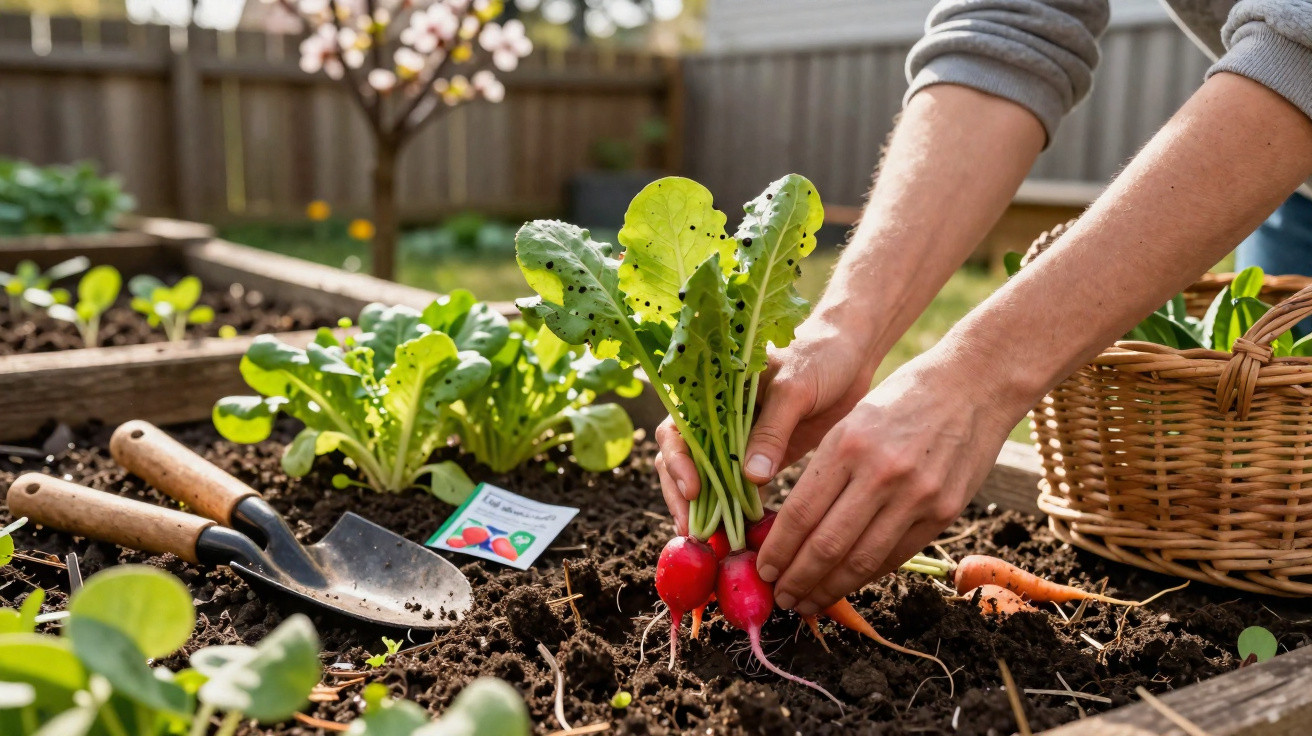
Starting a vegetable garden in March does not mean waiting until summer for the first harvest. Several hardy crops grow so quickly that they can be picked within a few weeks, even while nights remain chilly. Success depends on preparing the soil, choosing suitable varieties and following a few straightforward steps that many amateur gardeners overlook.
Why March marks the beginning of the vegetable garden season
The garden noticeably changes in March. Days grow longer, sunshine gradually becomes stronger, the ground thaws and can be worked again. This period has a major influence on how successfully the vegetable garden begins the growing season.
Before a single seed is sown, it is time for a spring tidy-up. Dead plant material, old stems, fallen leaves and sometimes remnants of cabbage or kale accumulate over winter. Leaving them in place creates ideal hiding places for pests and fungal diseases.
Once the area is cleared, attention turns to the most crucial factor: the soil. Gardening specialists and research bodies have long stressed how strongly good soil structure affects plant growth. Loose soil that is free from perennial weeds and enriched with mature compost acts almost like a boost for young plants. Roots can spread more easily, water is distributed more effectively and nutrients become available sooner.
Loose soil enriched with compost often determines in spring whether plants merely survive – or really take off.
A well-planned vegetable garden divides the available space into clear sections: one bed for leafy vegetables, for example, another for root crops and another for climbing plants. This makes it easier to monitor spacing and crop rotation, while preventing plants from restricting one another's potential.
Four vegetables that produce especially quick harvests in March
The focus is on four familiar crops that are particularly suitable for impatient or less experienced gardeners. Each tolerates cool conditions and grows considerably faster than many summer vegetables.
1. Radishes – the speed champion of the vegetable bed
Radishes are among the quickest vegetables to grow. In favourable conditions, the first delicate shoots appear after only a few days, while the roots are usually nicely rounded after around four weeks.
- Sowing: directly into the vegetable bed, possible from March
- Germination time: usually 4–8 days
- Harvest: around 25–35 days after sowing
As radishes require very little room, they are ideal for filling gaps in beds or edging paths. Many gardeners use them as a “catch crop”: they mature before slower-growing neighbours such as carrots or leeks take over the available space.
2. Lettuce – tender leaves in record time
Whether it is head lettuce, loose-leaf lettuce or cut-and-come-again lettuce, many varieties can be sown directly or planted as young plants in March. Loose-leaf types and so-called baby-leaf mixes are particularly fast. These leaves are harvested very young, but can be ready after only around three to four weeks.
Spacing is especially important for lettuce. Sowing too densely may create a quick display of green, but the plants soon compete with one another and remain small. Depending on the variety, allow 25 to 40 centimetres between plants for loose heads or sturdy rosettes.
The more air and light lettuce plants receive, the healthier they remain – and the more tender their leaves will be.
3. Peas – early starters with climbing ambitions
Peas thrive in mild temperatures and cope remarkably well with March conditions. Seeds can go into the ground as soon as the soil is no longer waterlogged or frozen. They need only a shallow sowing depth; two to three centimetres is sufficient.
As many varieties climb, a simple support is worthwhile: wire netting, taut strings or a wooden trellis. It helps the plants grow upwards and keeps the pods clean and dry later on. The first pods generally form after six to eight weeks. Choosing early varieties and a sheltered position can often save a little more time.
4. Spinach – a vitamin-rich crop with rapid growth
Spinach copes exceptionally well with cold weather and often grows faster in spring than it does in summer. Its seeds germinate reliably at low temperatures, provided the soil is not completely saturated.
- Sowing: directly into the vegetable bed from March
- Plant spacing: around 10 centimetres between plants
- First baby leaves: ready to pick after approximately 3 weeks
Harvesting only the outer leaves while leaving the plant's centre intact allows spinach to be picked repeatedly over several weeks. Nutrition specialists value spinach for its vitamins, minerals and secondary plant compounds. In seasonal spring cooking, it supplies fresh nutrients after a generally heavier winter diet.
How to sow and care for vegetables in March
For these four fast-growing vegetables to reach their full potential, the right timing must be matched by effective seed management.
Sowing drills should not be made too deep. Many amateur gardeners bury seeds too far down because they are unsure, delaying germination or even stopping it altogether. A useful rule is to sow a seed only about as deep as it is large. For radishes and lettuce, this is often barely more than half a centimetre, while peas and spinach need slightly more depth.
Consistent moisture is another key consideration. Soil should stay damp, but never sodden. In raised beds and light sandy soils especially, the surface can dry out on sunny March days more quickly than expected. A brief check in the morning or evening prevents germinating seeds from drying out.
Consistent moisture during germination ensures seedlings emerge evenly – making beds look as though they were “all of a piece”.
At the same time, it pays to watch for slugs and aphids. Young lettuce and spinach leaves are high on the menu for hungry slugs. Board traps, slug barriers or regular hand-picking after rainfall can already make a substantial difference.
Practical ways to harvest even sooner
Anyone keen to speed up the harvest further can help with a few simple measures. Clear horticultural fleece or a small polytunnel over the bed raises daytime temperatures and shields young plants from cold winds. Covering also reduces evaporation, keeping the soil moist for longer.
Staggering sowings is equally useful. Rather than sowing one large row of radishes at once, sow a short row every few days. This spreads the harvest across several weeks. The same approach works for loose-leaf lettuce and spinach.
| Vegetable | First sowing of the year | Approximate time to harvest |
|---|---|---|
| Radishes | from the beginning of March | 25–35 days |
| Loose-leaf lettuce | from March | 25–40 days |
| Spinach (baby leaves) | from March | 20–30 days |
| Early peas | from March, once the soil is open | 40–60 days to the first pods |
Why an early start in the vegetable garden pays off twice
Starting in March does more than provide quick rewards for the kitchen. Using the soil now improves it at the same time. Roots loosen the ground, while leaves protect the surface from drying out and heavy rainfall. Once the crops are harvested, the cleared space can be replanted immediately in late spring, perhaps with tomatoes, beans or courgettes.
There is another benefit: beginners in particular can quickly lose motivation in spring when nothing seems to happen for weeks. Radishes, loose-leaf lettuce and spinach offer early rewards instead. In a short time, they demonstrate that the work done with a spade and watering can is worthwhile. Many amateur gardeners say that these crops were what first gave them a real enthusiasm for growing vegetables.
Those with a little more experience can use mixed cropping strategically. Radishes work well between slow-growing crops such as carrots. Spinach can be planted alongside cabbage or later tomatoes, providing a harvest before its neighbours need more space. This makes the best possible use of the area while also reducing unused “bare patches” in the bed.
One further practical point for daily life: all four vegetables can be grown without difficulty in small gardens, raised beds or even larger balcony planters. For city dwellers with only a few square metres available, they offer a quick introduction to self-sufficiency – without major investment or a long wait.

Comments
No comments yet. Be the first to comment!
Leave a Comment