
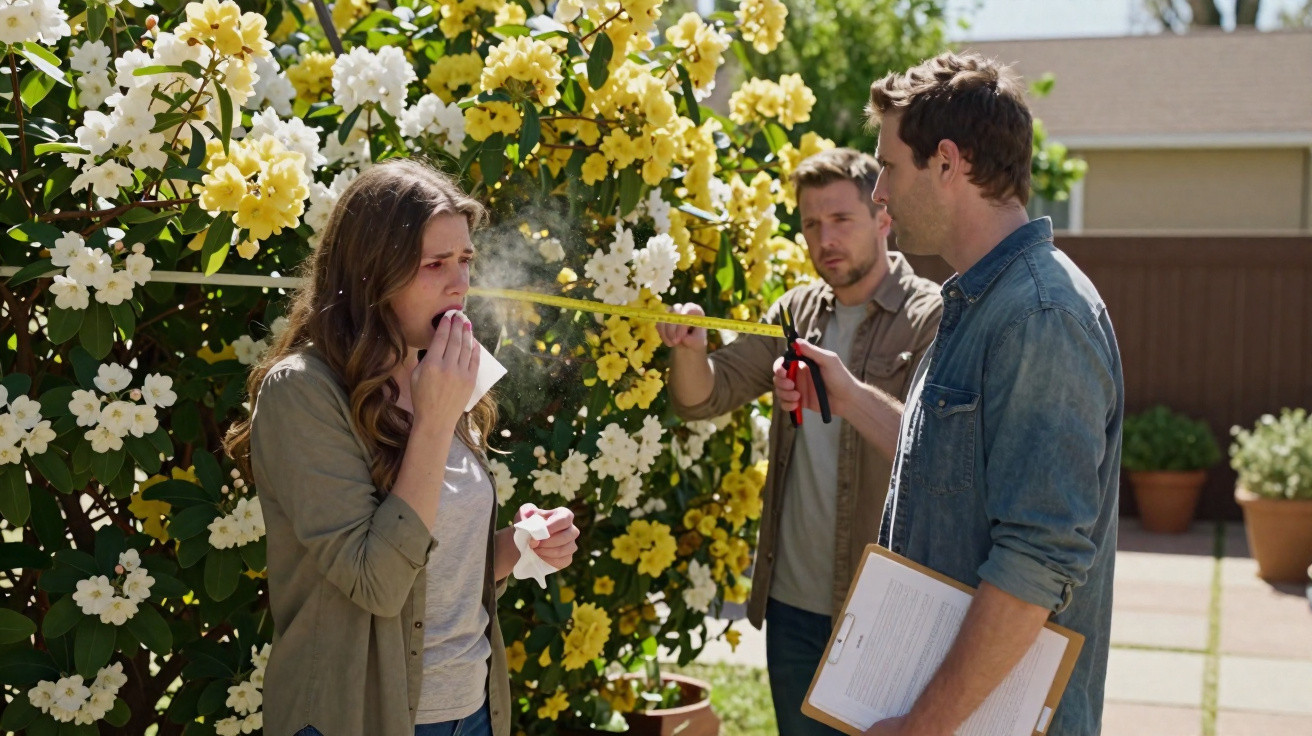
In many residential areas, it is not a noisy barbecue that sparks an argument, but something seemingly harmless: a hedge of thuja, cypress or laurel. For one household it provides privacy; for another, it causes sneezing. Once solicitors, expert reports and court proceedings are mentioned, many people ask themselves: do I really have to cut back my hedge – or even remove it completely?
When pollen becomes the cause of a dispute
Evergreen hedges are a familiar choice for many homeowners. They screen homes from view, reduce noise and create a tidy appearance. Yet certain species are regarded as genuine pollen producers. Millions of tiny particles drift through the air, settling not only in a neighbouring garden but also in bedrooms next door.
People prone to allergies often react severely: a runny nose, itchy eyes, breathing difficulties and even asthma attacks. For those affected, this is far more than a minor nuisance; it is a tangible health issue. That is precisely where neighbour law becomes relevant.
A hedge can be more than irritating: it may be classed as a “health-related nuisance”, with consequences for its owner.
The effect is intensified in densely built-up residential areas. Where a long, continuous hedge stands directly in front of windows, pollen can become concentrated within a small area. A neighbour may find this unreasonable and attempt to enforce their rights.
Boundary distances: what applies in practice
Most rules focus on two aspects: the height of the planting and its distance from the boundary. Many civil-law provisions, including those abroad, follow a similar pattern:
- Hedges or trees taller than 2 metres: usually at least 2 metres from the property boundary
- Plants up to 2 metres high: a distance of around 50 centimetres is often sufficient
- The centre of the trunk and the plant's highest point are generally decisive
There may also be local factors to consider, such as council by-laws, development plans or long-established neighbourhood customs. Anyone who plants purely by instinct can quickly find themselves on uncertain ground, even where allergies are not an issue.
If a hedge does not meet the required boundary distances, the neighbour can often demand that it be cut back or moved. Should the owner fail to respond, a formal procedure involving deadlines and, in extreme cases, enforcement measures may follow.
When health is involved: limits on property rights
A core principle of civil law is that ownership ends where the rights of others are unreasonably impaired. This includes physical wellbeing. Anyone whose planting creates a demonstrable health risk can no longer rely on the argument: “I can do whatever I want in my own garden.”
In legal terms, this is described as an “unlawful interference with neighbouring property”. The affected neighbour may then seek an injunction, removal and, in serious cases, even compensation. Factors that may matter include:
- How often and how severely the affected person experiences symptoms
- The plant species involved and their known allergenic effect
- The distance to the affected house and its windows
- Ways of reducing exposure, such as cutting back, pruning or replacing species
The more clearly the health complaints coincide with the hedge's flowering period, the greater the neighbour's prospects in court.
Courts frequently obtain expert evidence in disputes of this kind. Allergy specialists may then confirm whether a link between pollen from the hedge and the neighbour's attacks is plausible.
How a dispute over a hedge typically develops
Step 1: Discussion and an initial complaint
The process usually begins with a direct approach. The neighbour explains that the hedge is causing them problems and asks for it to be pruned or for individual plants to be replaced. Anyone who values a good relationship should take the conversation seriously rather than dismissing it.
Step 2: A written request
If discussion achieves nothing, a formal letter often follows. In it, the affected person refers to the applicable distances and their health situation. At this stage at the latest, it is worthwhile documenting your own planting and seeking legal advice.
Step 3: Mediation rather than going straight to court
Before a judge makes a decision, many legal systems provide for a form of conciliation, for example through a neutral mediation service. The aim is to reach a solution, such as:
- regular, more substantial pruning of the hedge
- partial replacement of highly allergenic species with more suitable plants
- moving the hedge further away from the neighbour's windows
A willingness to compromise at this point saves time, money and stress. Court proceedings can last for months and quickly become expensive.
What happens if the owner refuses outright?
If the garden owner ignores every request, deadline and attempt at mediation, the neighbour will usually have no option but to go to court. They can ask the court to order the hedge to be cut back, moved or removed entirely.
Judges have several options available:
- ordering substantial pruning to a specified height
- requiring the removal of some or all plants
- imposing a requirement to plant less allergenic species as replacements
- imposing a daily or weekly coercive payment if the owner fails to act by the deadline
- awarding compensation where health damage is recognised
In the end, a hedge can involve more than work: it can also lead to costly court and expert-report fees for both sides.
Courts will weigh up the circumstances: how serious are the symptoms? What alternatives are available to the owner? Is there a less intrusive option than complete removal? Judges often order pruning first, with full removal only if the problem recurs.
How to plant hedges without risking a dispute
Anyone starting a new planting scheme can avoid a great deal of conflict. A few practical tips are:
- check boundary distances with the council or relevant authority in advance
- avoid planting just one species along the entire length; use a mix instead
- avoid highly allergenic species if the neighbour is already known to have allergies
- prune hedges regularly so that they do not grow beyond every limit “overnight”
- speak openly with neighbours before the plants are put in
Gardeners often recommend deciduous shrubs or robust mixed hedges. These can be valuable for insects while producing considerably less airborne pollen at window height. This is not only more considerate towards neighbours, but also supports biodiversity.
When allergies already exist: the neighbour's rights and duties
The affected neighbour also has responsibilities. They must be able to substantiate their symptoms. A medical certificate or report from an allergy specialist can make a significant contribution. It should record:
- which pollen triggers the symptoms
- when the symptoms occur
- how severely everyday life is affected
If it later emerges that the symptoms are more likely to come from other sources, such as extensive tree cover in the surrounding area, a claim against the hedge quickly loses force. Here too, expert reports can help attribute the pollen exposure more precisely.
Why the dispute is often much bigger than the hedge
At the heart of many neighbour disputes, pollen is not the only issue. Old tensions, noise and parking problems can all boil over once health is added to the mix. The hedge then becomes a symbol of inconsideration or stubbornness.
Anyone who starts a conversation early and clearly signals, “I take your complaints seriously”, will often defuse the situation before legal provisions are quoted. Sometimes a joint site visit with a gardener is enough to find a solution that allows both parties to save face.
In the long term, a sensible combination of consideration, knowledge of legal requirements and plant choices that are not only attractive but also tolerable for the people nearby is worthwhile. After all, a hedge is meant to provide protection – not leave the neighbour standing at the door with tissues and a solicitor.




Comments
No comments yet. Be the first to comment!
Leave a Comment