
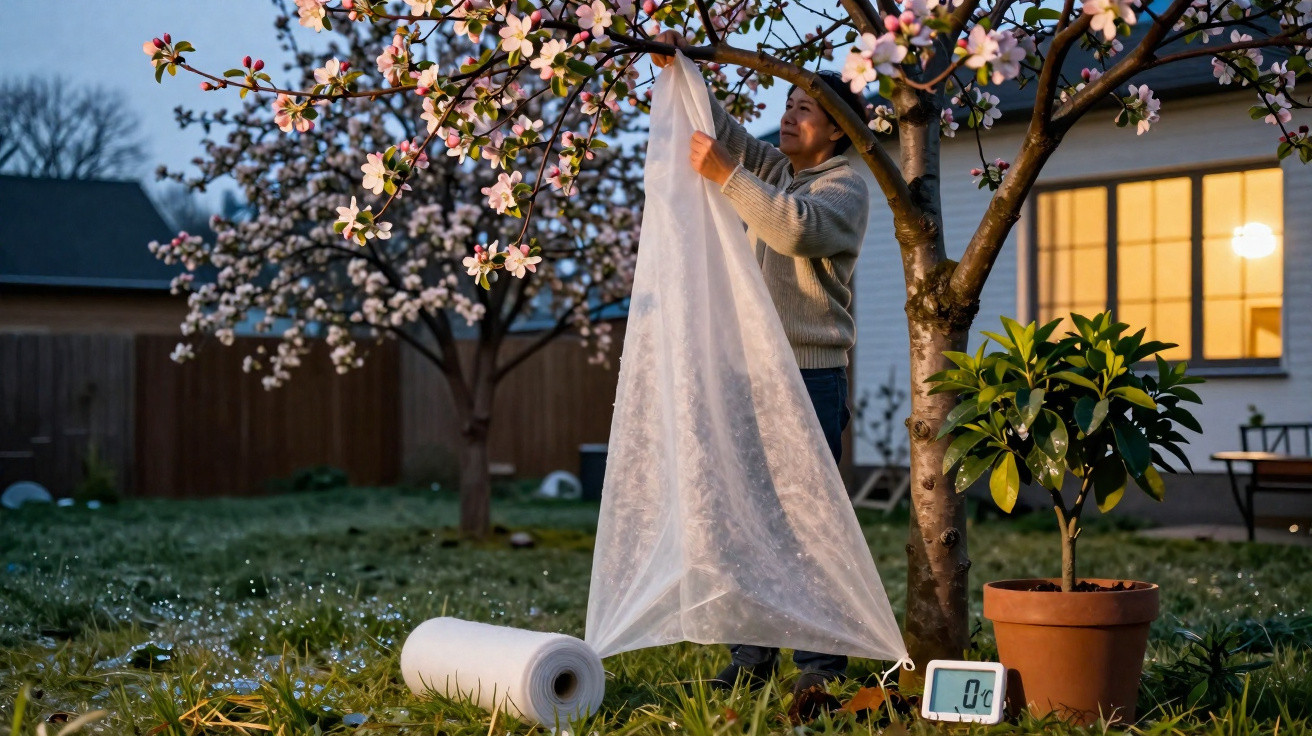
Many garden owners will recognise the situation: spring-like warmth during the day, bees buzzing and blossoms in full display – then, by the following morning, the flowers are brown and soggy. By the time the weather app warns of sub-zero temperatures, it is often already too late. A few well-timed measures can greatly reduce the risk.
Why fruit trees suddenly become so vulnerable in spring
During the depths of winter, a tree remains dormant. Its sap barely moves, the wood is hardened, and apple, pear and other fruit trees generally tolerate double-digit sub-zero temperatures without difficulty. That changes as soon as the buds begin to open.
When new growth begins, the plant becomes active. Sap fills the buds, the tissues hold more water, and this is precisely what leaves them susceptible to cold damage. If that water freezes, ice crystals rupture the delicate cells – a single frosty night can destroy the blossom completely.
“The further development has progressed, the more sensitive buds, flowers and young fruits become to cold.”
Typical critical temperature thresholds
- Buds as they break: damage often occurs at between –2 and –4 °C
- Open flowers: extremely sensitive; temperatures of just –1.5 to –3 °C may be enough
- Newly set fruit: affected from roughly –0.5 to –2 °C
Early-flowering species are particularly at risk. Apricots, peaches, almond trees and sweet cherries frequently burst into growth and bloom well before apples and pears. This places them directly in the period when late frosts remain common until May, especially around the traditionally named Ice Saints.
There is also a frequently overlooked factor: cold air “flows” downhill. In hollows, dips or behind walls where air cannot escape, the cold accumulates. A tree at the bottom of a garden may therefore suffer considerably more than the same type of tree just a few metres higher up on a slight slope.
What home gardeners can actually do on a frosty night
Unless you own a commercial orchard, there is no need for expensive machinery. Sensitive fruit trees can be protected remarkably well with straightforward materials – provided the cover is put in place in good time, on the evening before the forecast frost.
Frost fleece: the classic protection against late frost
A lightweight frost fleece or winter-protection fleece is the most effective option for home gardens. It is suitable for small-growing fruit trees, trained fruit trees and trees in containers.
To use frost fleece without damaging the blossom:
- Create supports: Push several poles into the ground around the canopy, or construct a simple frame.
- Lay the fleece loosely over the tree: It should not rest directly on the flowers, as pressure or moisture can harm them.
- Seal the edges: Weigh the fleece down lightly at ground level with stones or boards so that cold air cannot flow in freely.
- Open it the following morning: Once temperatures are above freezing again, remove the fleece during the day to allow light and air to reach the plant.
If the tree stands in front of a south-facing stone or brick house wall, the façade acts as a heat store. It absorbs solar energy during the day and releases it again overnight. This can raise the temperature immediately beside the wall by two to three degrees – enough to save the blossom.
Retaining warmth: supporting the soil and roots
Late frosts do not affect flowers alone; they also put strain on the tree’s base. Well-prepared soil helps to moderate temperature fluctuations.
- A substantial mulch layer: Straw, leaves or woody chipped material around the trunk keeps the soil more even in temperature and protects the graft union.
- A protective wrap: A simple covering of hessian or fleece around the graft area protects this sensitive point from frost cracks.
- Watering in late afternoon: Damp soil stores warmth during the day and releases it overnight. It may only add fractions of a degree – but that is often sufficient.
Fruit trees in pots: movable and easier to protect
Growing fruit in containers has one advantage: the trees can be moved when frost is expected. The ideal protection strategy is:
- Move the pot close to a sheltered house wall, preferably somewhere still and out of the wind.
- Wrap the sides of the pot with fleece, bubble wrap or hessian.
- Apply a thick mulch layer over the compost surface.
- Cover the canopy with a fleece hood or a loosely draped cloth.
This keeps the trunk more flexible, prevents the roots from freezing as quickly, and places the flowers in a slightly warmer pocket of air.
Long-term strategies: location, variety choice and pruning
Anyone planting a new fruit tree can reduce the danger of late frost from the outset. The most important factor is its location.
The right position often makes all the difference
A slightly elevated site or gentle slope, where cold air can drain away, is ideal. Trees planted in the middle of a hollow face a much higher frost risk. Growth habit also matters: standard trees with higher canopies often sit just above the coldest layer of air.
Trained fruit trees against warm walls are also highly effective. Apples, pears, peaches and apricots can be grown along wires and benefit from warmth stored in the wall. Their flowers develop slightly later and in a more sheltered position.
Late-flowering varieties and well-timed pruning
In areas where frosts regularly occur until May, selecting suitable varieties is worthwhile. Local tree nurseries know the hardier, later-flowering options that are better suited to the particular local microclimate.
Pruning time can influence bud burst as well. A later prune, for species that tolerate it, such as many apple varieties, may delay bud opening and therefore flowering slightly. This means the most vulnerable stages are less likely to coincide with the usual frost period.
What causes real damage – and what only looks harmless
Not every cold night automatically means a lost harvest. Looking closely at the flowers makes it possible to assess the damage fairly accurately. Healthy flower pistils inside the bloom appear pale and fresh. If they turn brown or black, the flower has died.
A few damaged flowers are not a disaster, as fruit trees usually produce more blossom than they could later support as fruit. It becomes more serious when nearly all flowers take on a uniform brown colour and no new buds follow.
| Sign | Meaning |
|---|---|
| Brown, glassy petals | Frost damage; the fruit set is usually lost |
| Only individual flowers affected | The tree will usually compensate with other flowers |
| Buds in shaded positions that appear intact | The prospects for a partial harvest are good |
Why professional methods are rarely worthwhile in a home garden
In fruit-growing regions, you may see blazing frost candles, operating wind machines or irrigated orchards where ice forms around the flowers. These methods work, but they are expensive, labour-intensive and require substantial equipment and water.
They have little place in a private garden. Open flames create a fire risk, fuel is costly, and continually monitoring the temperature is stressful. For home gardeners, the simpler combination of fleece, a favourable location and good variety selection generally offers a better balance between effort and benefit.
Practical additions for stress-free frost nights
A clear routine is useful: check the weather forecast every day, take frost warnings seriously and keep fleece ready to use. Anyone with several small trees can cover them using one shared lightweight frame, saving time.
A basic minimum thermometer in the garden is also worthwhile. It records how low the temperature has actually fallen over recent nights. Over the years, this helps identify which parts of the garden are particularly vulnerable and where new plantings will be better placed.
Late frost does not have to mean the end of hopes for home-grown fruit. With some planning, the right materials in the shed and a few jobs on the evening before a cold spell, many flowers can be saved – and the bowl may still be full of your own apples, cherries or apricots in summer.


Comments
No comments yet. Be the first to comment!
Leave a Comment