
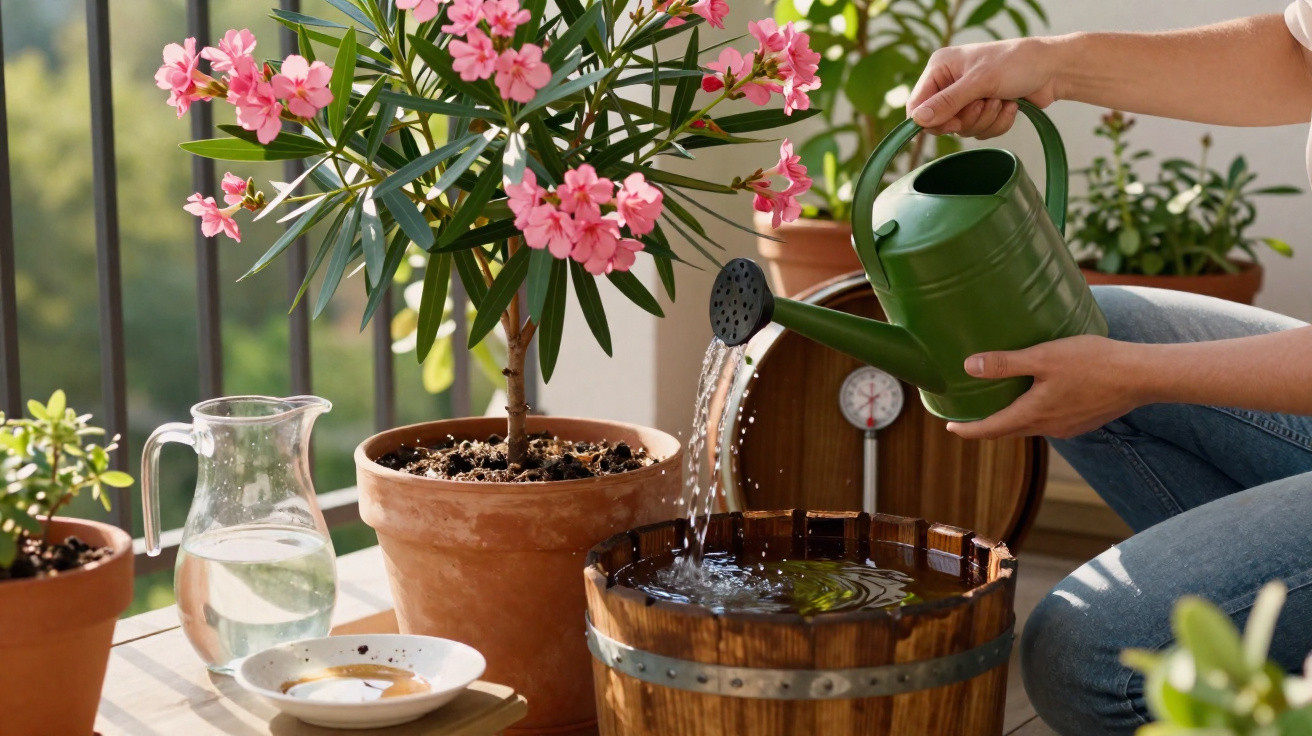
Oleander is considered a rewarding Mediterranean flowering favourite for balconies and terraces. Especially after winter, many owners take particular care with it – only to be surprised when the shrub suddenly droops, develops yellow leaves or even dies. The cause is often neither a pest nor a fertiliser issue, but an inconspicuous yet damaging habit involving the garden hose.
When Oleander suddenly dies after winter
In March or April, Oleander moves from its winter quarters back onto the balcony or terrace. Days are getting longer, sunlight is becoming stronger and the pot is warming up – everything points to a fresh start. Then comes the first thorough watering, usually straight from the tap.
A few days later, the mood changes: leaves hang limply, fresh shoots look weak and flowers fail to appear. Many people interpret this as thirst and reach for the watering can even more often. That is precisely what pushes the shrub into a full-blown crisis.
The main mistake is often not the amount of water, but the temperature of the water and the limescale content of tap water.
In a container, the root system is considerably more sensitive than it is in open ground. The pot quickly heats up during the day, and the roots adapt to warmer conditions – which is exactly when the shock occurs.
Why cold tap water becomes a trap in April
During spring, tap water is well below 10 degrees Celsius in many areas. It may feel pleasantly fresh to people, but it gives the warmed roots of Oleander a cold shock.
When ice-cold water is poured into an already warmed pot, this is what happens:
- Fine root hairs contract and can function only to a limited extent.
- The plant absorbs hardly any water, even though the pot is soaking wet.
- So-called “physiological drought” develops – the Oleander effectively dies of thirst while sitting in water.
- Excess water displaces oxygen, causing the roots to start rotting.
The plant then looks as if it has dried out: limp foliage and an overall tired appearance. Anyone who adds even more water at this point makes the damage worse. Rather than being thirsty, the Oleander has wet, chilled roots with no air around them.
The second problem: excessively hard, lime-rich water
Water temperature is not the only relevant factor; water quality matters too. In many regions, tap water contains a great deal of limescale and has a relatively high pH value. Over time, this can become problematic for Oleander in a pot.
If the watering water is consistently too hard, it often leads to what is known as iron chlorosis. Despite nutrients being present, the plant can no longer absorb iron. This can be recognised by a characteristic pattern:
- The leaves turn yellow.
- The leaf veins remain distinctly green.
- The plant looks generally weakened and grows less well.
- Flowers fail to develop or drop prematurely.
Yellow leaves with green veins almost always indicate disrupted iron uptake caused by excessive limescale in the watering water.
This nutrient deficiency appears more quickly in a container than in garden soil, especially because the volume is limited. The pot gradually accumulates salts, the pH rises and the roots become unbalanced.
The ideal water supply for Oleander in a pot
The good news is that a few adjustments can bring Oleander safely and reliably through spring. What matters is not only how much water is given, but also what is used and when it is applied.
The best option: rainwater
Collected rainwater is almost ideal for Oleander in containers:
- It is soft and low in limescale.
- Its pH is generally slightly acidic.
- It warms quickly to ambient temperature in a water butt or container.
Anyone able to use a water butt should preferably water their Oleander from it during spring. This reduces limescale exposure while preventing temperature shocks.
Preparing tap water correctly
If rainwater is unavailable, tap water can be improved with a few simple steps:
- Fill a watering can or bucket the day before.
- Leave it standing at room temperature for at least 24 hours.
- Optionally, add around one tablespoon of white vinegar or lemon juice to 5 litres of water to slightly buffer the limescale content.
- Before watering, briefly check at the wrist that the water feels neither ice-cold nor warm.
Ideally, water should be between 15 and 20 degrees Celsius when watering – roughly the ambient temperature.
This prevents abrupt temperature changes around the roots and also reduces the effects of limescale.
Watering Oleander properly: technique and timing
Alongside water quality, the watering method itself is highly important. With Oleander in a pot, it is worth taking a close look at the usual routine.
Aim directly at the root zone
Always direct the water at the edge of the pot or straight onto the compost – never onto leaves and shoots. Wet leaves encourage fungal diseases and do little to benefit the root ball.
Useful basic rules include:
- Water slowly so that the compost has time to absorb it.
- Avoid standing water in the saucer, and pour away excess water after a short time.
- Allow the top layer of compost to dry slightly between waterings.
The “finger test” offers a simple check: push a finger about 2 to 3 centimetres into the compost. If it still feels clearly moist at that depth, the next watering can wait.
Spring, summer and heat: adapting water levels
| Season | Watering routine | Special points |
|---|---|---|
| Early spring | Cautious, with breaks | Temper the water; roots are still sensitive; avoid waterlogging |
| Late spring | Regular, moderate | Allow slight drying; monitor leaf colour |
| Summer | Often daily in hot weather | Use plenty of water, but do not leave it permanently standing in the saucer |
At the height of summer, Oleander in a container genuinely needs large amounts of water, particularly on hot and windy days. The key requirement is a well-draining pot with drainage holes so that surplus water can run away.
Reading warning signs correctly and taking action
When Oleander is already suffering, its symptoms can reveal what is happening inside the pot.
Yellow leaves with green veins
This pattern very often points to iron deficiency caused by overly lime-rich watering water. The solution is to switch immediately to softer water. In severe cases, a specialist chelated iron fertiliser can help – but it will only work if the water does not remain too hard.
Limp leaves, a waterlogged pot and a musty smell
This usually indicates a combination of overwatering and watering with water that is too cold. The roots are sitting in a swamp, receive too little oxygen and begin to rot.
- Empty the saucer and place the pot where it is protected from rain.
- Pause watering until the compost has dried slightly.
- If necessary, carefully lift the root ball from the pot and remove rotten roots.
As soon as the pot smells like a damp cellar or rotten soil, the root zone has a serious problem and needs air rather than more water.
In particularly serious cases, repotting into fresh, free-draining compost may be the final rescue attempt. It is also worthwhile adding a thick drainage layer of expanded clay or coarse gravel at the bottom of the pot.
Why Oleander in a pot reacts so sensitively
Oleander is naturally adapted to warm Mediterranean conditions. Temperatures, light and water availability fluctuate there too, but the soil dries more quickly and warms more evenly. In a pot on a balcony, the situation is artificial and often more extreme.
The root ball becomes very warm in sunshine, then cools down rapidly again overnight. Cold tap water intensifies these fluctuations, while overly dense or compacted old potting compost worsens the lack of oxygen. However, the right watering strategy can keep this artificial system well under control.
Anyone who already enjoys growing container plants will benefit from rainwater-ready equipment: a water butt, a simple lid to keep mosquitoes away and perhaps a second container for bringing water to temperature. Combined with loose compost, a dependable drainage layer and an eye for leaf signals, this care rewards Oleander with abundant flowers – rather than letting it quietly drown in its plant pot during spring.
Comments
No comments yet. Be the first to comment!
Leave a Comment