
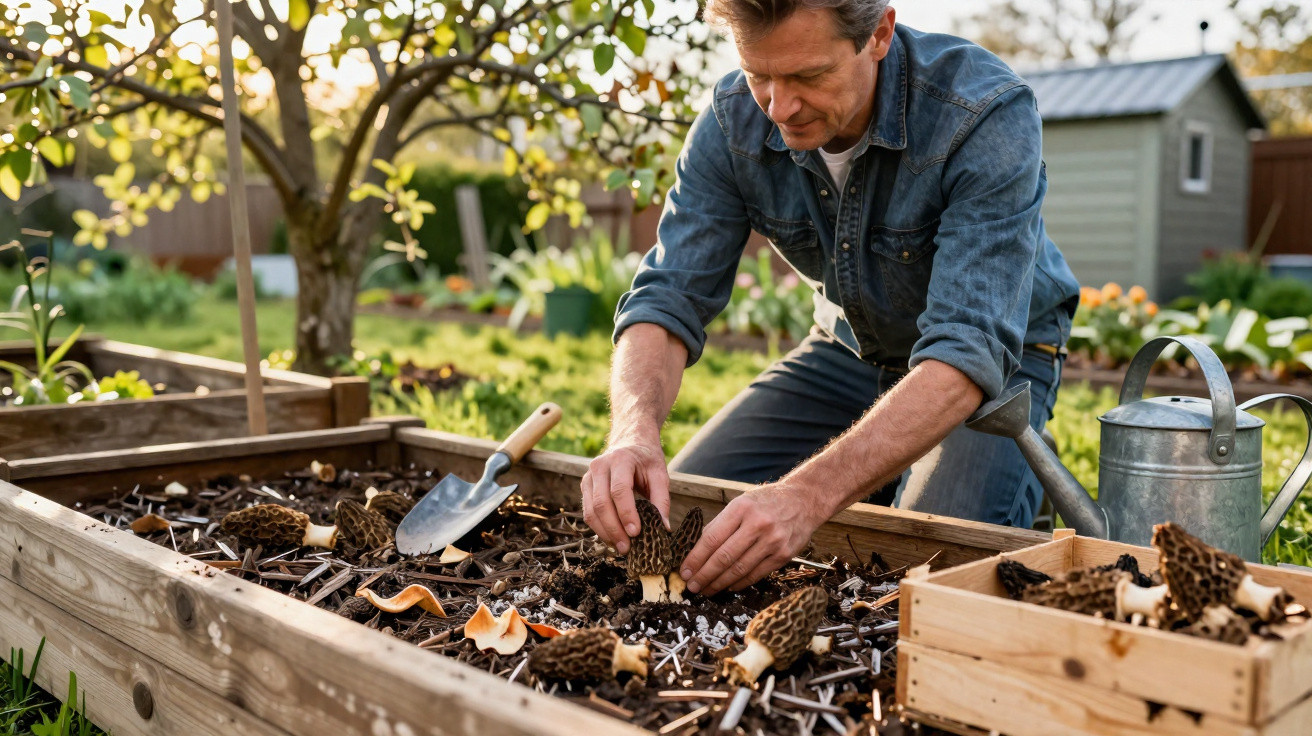
An often-overlooked piece of kitchen waste could transform your own garden.
Morels are regarded as the holy grail of mushrooms: expensive, scarce and notoriously unreliable to find. After one or two discouraging attempts, many amateur gardeners give up in frustration. Yet recent practical approaches from mycology suggest that growing them in a home garden is possible – provided the site, soil and one particular everyday waste product work together.
Why morels are considered “impossible” to grow – and what is really behind it
In the wild, morels seem to appear from nowhere. One spring may yield baskets full of mushrooms, while the following year brings nothing at all. For decades, this inconsistency has fuelled the belief that morels cannot be cultivated.
Look more closely, however, and morels respond quite logically to their surroundings. They need:
- calcareous soil with good drainage;
- light, consistent moisture rather than waterlogging;
- a partially shaded position, ideally beneath deciduous trees;
- a clear winter trigger: cold conditions followed by warming.
When these conditions are in place, the likelihood improves considerably. The interesting question is how such a “morel habitat” can be recreated in the garden with simple materials.
The turning point comes when gardeners make deliberate use of an everyday waste product: apple pomace from the kitchen combined with wood ash.
The ideal garden site: partially shaded, calcareous and well aerated
The foundation for growing morels is a spot that resembles their natural habitat. An old orchard or an area beneath a deciduous tree, such as an apple, ash or hazel tree, is ideal. Fallen leaves are already present there, and the soil stays fresh for longer without becoming truly wet.
Set up the area as follows:
- Pick a partially shaded spot that will not dry out in summer.
- Loosen the soil gently without digging deeply.
- Work in a little well-rotted compost to provide organic matter.
Morels favour slightly calcareous soil. In many areas, the pH is already roughly suitable. Where the ground is more acidic, the real “secret tip” helps: wood ash – not applied heavily, but used in a measured way.
Wood ash and apple pomace: turning waste into a luxury mushroom bed
This method centres on a mixture of apple pomace, or apple leftovers more generally, and cold wood ash, which creates conditions that encourage morels to fruit. These materials would otherwise usually end up in the bin or on the compost heap.
Apple pomace is produced when pressing apple juice or processing large quantities of apples. It contains sugars and pectin, which are ideal energy sources for the underground fungal network known as mycelium. Wood ash from untreated fireplace or stove wood raises the pH and supplies minerals including potassium and calcium.
The ash creates an artificial “burn site”, similar to the ground after a forest fire or campfire. Such areas are well-known morel hotspots.
Step-by-step guide to your morel bed
Autumn, broadly between October and November, is the best time to establish the bed. This prepares it for the following season:
- Lay down a base: Spread a layer of apple pomace. Alternatively, use chopped apple scraps, mixed pomace from a cider mill or, if necessary, finely chopped overripe apples. Mix in some fallen leaves.
- Apply the ash layer: Evenly distribute 2–3 centimetres of cold wood ash from untreated timber over the area. Painted or treated wood must not be used.
- Introduce the morels:
- Either use a ready-made mycelium kit from a specialist retailer;
- or soak over-mature morels in water, crumble them into it and use this “spore water” to water the bed.
- Add a light mulch: Cover the whole area with a thin layer of leaves or fine bark mulch to prevent the soil from drying out.
From this point, winter does the work for you. Frost, moisture and changing temperatures help the mycelium establish itself and build up reserves.
What happens in the soil: from sclerotium to morel
Within this mixture, the mycelium develops small, dense survival structures known as sclerotia. Think of them as tiny stores of nutrients: the fungus accumulates resources so that it can produce fruiting bodies – the visible morels – rapidly in spring.
The wood ash creates a more alkaline environment in which morels are more comfortable than many competing fungi. Meanwhile, the sugars and pectin in apple pomace provide readily available energy for building these reserves.
Anyone who doses the wood ash and apple pomace mixture correctly gives morels an advantage over other fungal species in garden soil.
Moisture, cold shock and patience: creating the harvest moment
Without water, every ambition of growing morels remains just a dream. The soil must stay evenly moist through winter and early spring, but it must not become waterlogged. A fine spray from a watering can or rose attachment is ideal.
One intriguing technique from professional guides is used in early March, as winter gradually recedes: many growers imitate melting snow cover. They give the morel bed one thorough watering with very cold water. This “temperature shock” tells the mycelium that spring has arrived and that it is time to fruit.
If everything goes well, the first fruiting bodies may appear between March and May, depending on the region. There is never any certainty, as morels remain temperamental. In many gardens, the first specimens do not emerge until the second year, once the fungal network has established itself securely.
Harvesting and care in later years
Once the characteristic honeycomb-like morel caps push through the mulch, cut them off just above ground level. Do not pull them out, as this would disturb the underground network.
To keep the bed productive over the long term, add a little more material each year:
- a thin autumn layer of fresh apple pomace or apple scraps;
- a very light covering of cold wood ash;
- then another “curtain” of leaves.
In this way, kitchen and stove waste can be used several times over, while gradually creating a resilient “morel zone” in the garden.
Risks, common mistakes and tips for beginners
As with any mushroom cultivation, there are potential pitfalls. Frequent problems include:
- Too much ash: A thick crust of ash harms soil life and prevents moisture from penetrating. The 2–3 centimetres should not be exceeded.
- The wrong wood: Ash from painted, coated or glued timber can introduce harmful substances. Use only pure stove or fireplace ash.
- Persistent waterlogging: Wet hollows where water collects are unsuitable. Morels need moisture, but also air-permeable soil.
- Impatience: Those who give up after one year often miss the real breakthrough in the second or third spring.
Knowledge of mushrooms is also essential. If in doubt, have any finds checked by an expert before they go into the frying pan. Poisonous lookalikes exist, particularly among spring mushrooms.
Who can benefit from growing morels – and what to combine them with
This approach is especially appealing to homeowners with an old orchard or traditional meadow orchard. In autumn, plentiful apple remnants are produced there anyway and can be used directly on site. Anyone with a fireplace will also have suitable wood ash available.
The principle can also be tested in smaller gardens, for instance in a border beneath an apple tree or beside a partially shaded hedge. It is interesting to combine it with other woodland plants such as wild garlic, sweet woodruff or ferns, which have similar site requirements. This creates a kind of “spring woodland corner” that is visually appealing and offers plenty in culinary terms.
Anyone exploring mycology soon encounters specialist terms such as mycelium, sclerotium and pH value. Mycelium refers to the fungus’s actual tissue in the soil – comparable to a plant’s roots. The visible morel is merely the fruiting body. The pH value indicates whether soil reacts more acidically or alkalinely; wood ash shifts it towards the alkaline range, which suits morels.
There is still an element of chance in the end. But rather than passively hoping for luck in the woods, wood ash and apple pomace shift the odds considerably in your favour in your own garden – turning simple waste into an experiment that may, at best, end with a frying pan full of aromatic morels.
Comments
No comments yet. Be the first to comment!
Leave a Comment