
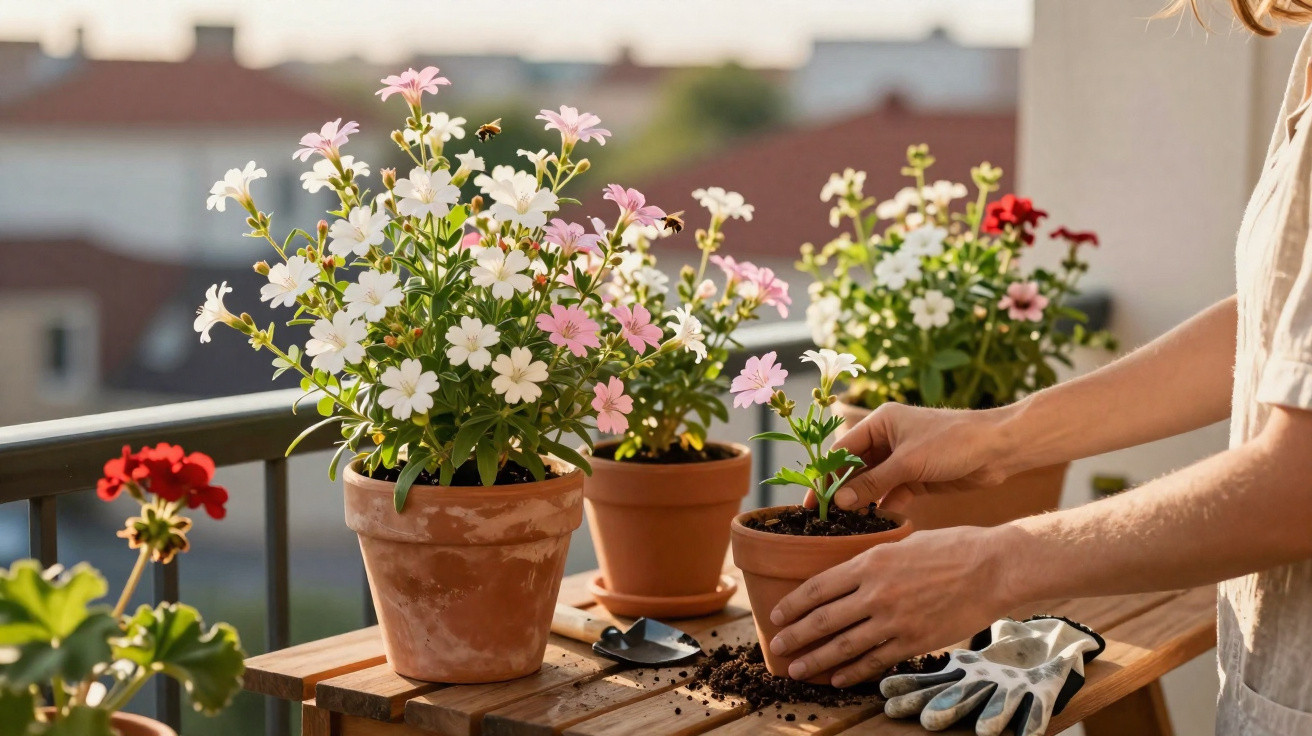
Many amateur gardeners are fond of their traditional balcony geraniums, yet become frustrated by daily watering, dried-out planters in the height of summer and flowering that stops abruptly with the first frost. However, there has long been a perennial that resolves all these issues while also providing food for insects. Plant it in April and it can flower well into late autumn.
Why geraniums are becoming a problem in a changing climate
Geraniums – more accurately called pelargoniums – are among the best-selling balcony plants in Germany. They offer intense colour, grow quickly and look flawless in photographs. In everyday life, however, they often prove rather demanding.
- At the height of summer, they usually need watering almost every day.
- Faded flower heads require continual removal.
- The first hard frosts are enough to end their season.
- During hot spells, leaves and flowers can scorch easily.
As heatwaves become more frequent, dry periods lengthen and watering restrictions are introduced, geraniums are reaching their limits in many locations. Anyone who cannot keep a constant eye on their window boxes may quickly find scorched, patchy planting by July. This is a genuine nuisance for very busy people, commuters and owners of holiday homes.
Gaura: the long-flowering alternative from the southern United States
The sought-after plant that solves these problems is Gaura lindheimeri, often sold simply as gaura or prairie gaura. Botanically, it belongs to the evening primrose family and originates from Texas and Louisiana. In its natural habitat, it has adapted to cope with heat, wind and poor soils.
“Gaura puts on a delicate floral display for up to six months – while requiring far less watering than traditional balcony geraniums.”
Gaura is known for its dainty, butterfly-like flowers in white or shades of pink. Carried on long, flexible stems, they dance in even the slightest breeze. With its airy, almost transparent appearance, the plant works particularly well in borders, gravel gardens and contemporary front gardens.
Gaura flowering period: from early summer to November
Those who plant gaura in April or May can generally expect the first flowers from late May or June. In many areas, it will continue flowering into November, depending on how early and severe the first frosts are. This perennial tolerates temperatures down to around –15 °C, making it suitable for large parts of the German-speaking region.
A comparison makes the difference clear: where geraniums may need around ten litres of water per week for each planter in July, a well-established clump of gaura requires almost no extra watering after its first year – provided it is growing in the right position.
How Gaura copes: a taproot rather than constant thirst
The key to this perennial’s resilience lies underground: gaura develops a powerful taproot that reaches deep into the soil. This allows the plant to draw on water reserves and nutrients from lower layers once the surface soil has long become dusty and dry.
For it to make full use of this ability, the plant needs the right conditions:
- Full sun: The more light it receives, the better it flowers.
- Free-draining soil: Waterlogging can quickly damage the roots.
- No overfeeding: Soil that is too rich encourages plentiful foliage but fewer flowers.
Gaura thrives in lean, loose soil. Where garden soil is heavy clay, work coarse sand or grit into the planting hole. This creates a drainage effect that encourages the root to grow downwards instead of sitting in wet ground.
Plant Gaura in April: step-by-step instructions for borders and containers
April is an ideal time to plant gaura in the garden or in larger containers. The soil has already warmed slightly, while there is still sufficient time for the taproot to establish before high summer arrives.
Planting Gaura in a border
- Choose the position: Pick a sunny, open and airy spot, avoiding areas that stay wet.
- Prepare the soil: Loosen the earth, remove stones and incorporate sand or gravel if the soil is heavy.
- Water the plant: Place the root ball in water for ten to 15 minutes, until no more air bubbles rise to the surface.
- Dig the planting hole: Make it roughly twice the size of the root ball.
- Plant and firm in: Position the gaura so that the root collar remains level with the soil, then gently firm the soil around it.
- Water in: Give it a thorough watering so the soil settles well around the roots.
Leave 40 to 50 centimetres between plants. This gives the clumps room to fill out over time without toppling into one another.
Container planting: a balcony replacement for geraniums
On balconies and terraces, gaura can replace or accompany traditional geranium planters. One factor matters above all: depth is more important than width alone. The taproot needs adequate room.
- Choose a container at least 30–35 centimetres deep.
- Add a substantial drainage layer of expanded clay or gravel.
- Mix sand or fine grit into the compost so excess water can drain away freely.
- Select the sunniest possible position; a south- or west-facing balcony is ideal.
In a container, gaura needs slightly more attention initially than it does in a border, especially during its first summer. Even so, it can be watered at much longer intervals than geraniums. Only reach for the watering can once the top layer of compost has dried out.
Easy care throughout the year: what Gaura actually needs
Once it has rooted in properly, this plant is remarkably undemanding. Its most important maintenance tasks come in the second half of the year and in late winter.
“Cutting it back to around ten centimetres in late winter is enough for gaura to produce fresh, compact growth again.”
Gardeners should wait until February or March before cutting back the dried stems. The dead shoots offer the base some protection from cold and wet conditions during winter. Gaura needs fertiliser only very sparingly, if at all. Too many nutrients make the growth soft and more likely to flop.
If preferred, individual spent stems can be removed during the season to keep the plant looking tidy. This is not essential for continued flowering, though: gaura constantly produces new buds.
Limits of the plant: where Gaura will struggle
Despite its toughness, there are growing conditions in which gaura performs poorly. Permanently wet soils, shady sites and areas with very harsh, prolonged winters well below –15 °C are particularly problematic. In these places, it is better grown in a container with winter protection, or replaced with other drought-tolerant perennials.
| Condition | Suitable for Gaura? |
|---|---|
| Full sun | Ideal |
| Light partial shade | Still possible, but with fewer flowers |
| Permanently wet, heavy soil | Unsuitable; root rot is likely |
| Winter below –15 °C without protection | Risky; container growing is preferable |
Benefits for insects and the garden’s appearance
One point that is often overlooked is that gaura supplies wild bees and butterflies with food over many months. Particularly in smaller gardens and on balconies, where only short-lived seasonal flowers are often planted, it can provide an important “basic food source”.
Visually, it suits modern, naturalistic planting schemes extremely well. Combined with ornamental grasses, lavender, catmint or sage, it creates a light, almost Mediterranean effect that does not look thirsty even at the height of summer. Anyone familiar only with compact, brightly coloured bedding plants will find that gaura brings a very different, more flowing feel to the garden.
Practical advice for beginners and planting combinations
Anyone growing gaura for the first time should begin with two or three plants in a border or a large container. This makes it possible to observe how its growth habit and flowering behaviour develop in their own conditions. The perennial is particularly effective when planted in small groups, allowing its clouds of flowers to overlap.
Mixed plantings with other low-water plants are especially appealing. Typical companions include:
- Lavender or cotton lavender for fragrance and structure
- Ornamental grasses such as fountain grass for movement
- Catmint, sage or coneflower for strong splashes of colour
- Smaller sedum varieties at the front to create a dry edging
People who are away frequently or garden without an irrigation system can use combinations like these to create whole areas that need virtually no watering. Front gardens benefit in particular: instead of scorched lawns or short-lived seasonal bedding, the result is a long-lasting, insect-friendly display.
One final point on longevity: gaura is among the shorter-lived perennials and often remains productive in the same spot for only a few years. In return, it self-seeds readily. Those who look out for small seedlings in late summer and deliberately leave them in place or transplant them can almost automatically secure new plants for the following seasons – without buying more from the garden centre.
Comments
No comments yet. Be the first to comment!
Leave a Comment