
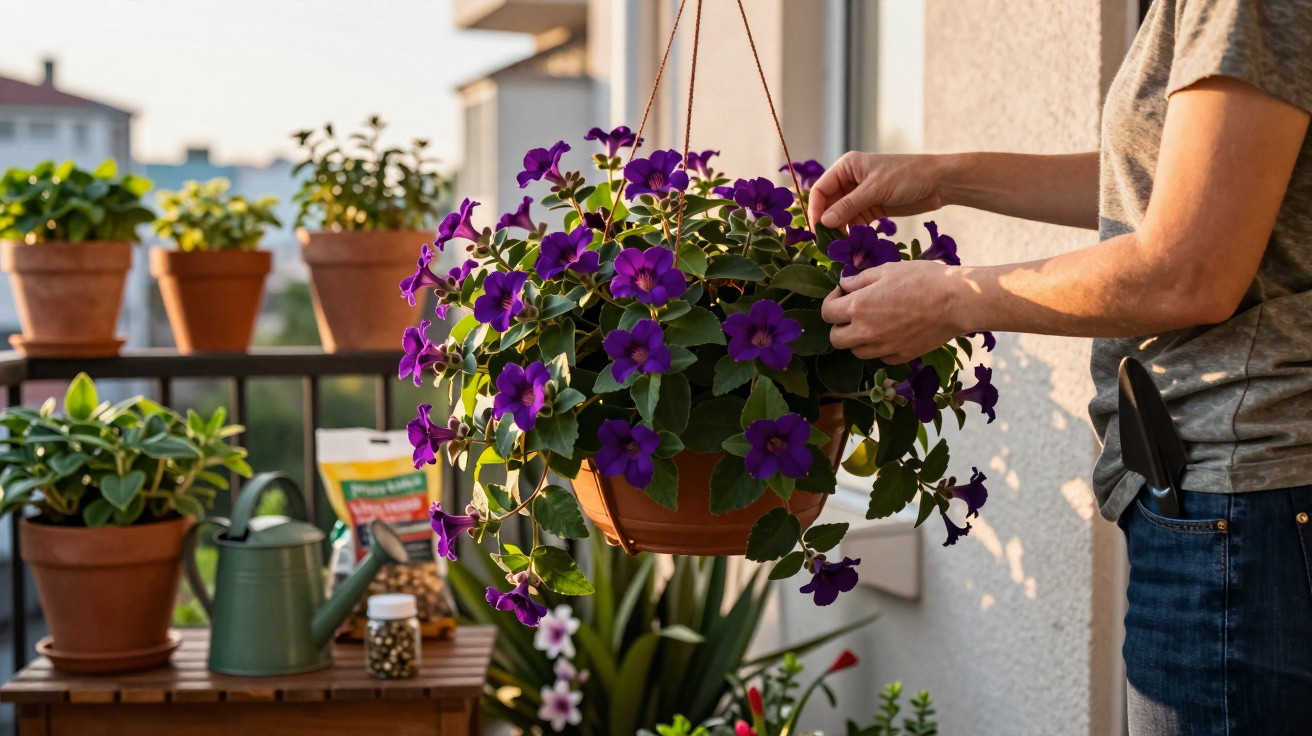
Many amateur gardeners choose fuchsias or petunias every year. They are undeniably attractive, but short-lived, thirsty and often past their best by the end of high summer. A still-uncommon perennial from South Africa proves there is another option: Plectranthus ‘Magic Mona Purple’, often sold as ‘Mona Lavender’, can turn an unremarkable shaded balcony into an autumn showpiece.
The little-known star plant for shaded hanging baskets
Botanically, Plectranthus ‘Magic Mona Purple’ belongs to the spur-flower group, although it grows far more compactly than many related plants. It develops into an upright, bushy plant with good branching and, according to growers, reaches around 60 to 70 centimetres tall and up to 75 centimetres wide.
Unlike familiar trailing plants such as geraniums or surfinias, it barely spills over the edge. Instead, it forms a dense, rounded bush. This makes it particularly suitable for hanging baskets and larger pots that need to look full quickly.
“Plectranthus ‘Magic Mona Purple’ is a compact, easy-care perennial that gives shaded corners a spectacular burst of bloom in autumn.”
Its foliage is dark green with striking purple undersides. This alone makes the container decorative, creating an almost two-tone effect even before flowering begins. Anyone familiar with balcony boxes that contain nothing but green leaves from August onwards will appreciate the difference this can make.
Why it becomes the queen of balcony plants in autumn
This plant’s greatest strength is its flowering period. As petunias and similar plants begin to tire in late summer, Plectranthus ‘Magic Mona Purple’ truly comes into its own. In autumn, it produces long, upright flower spikes in rich violet, resembling small lavender candles.
The flowers attract bees and other insects, and are considered especially nectar-rich. Anyone who has previously seen few pollinators on a shaded urban balcony may be surprised by how much activity suddenly appears.
- Flowering period: Mainly in autumn
- Flower colour: Violet, candle-shaped flower spikes
- Use: Late-flowering plant for balconies, hanging baskets and containers
- Additional benefit: A food source for pollinators during the final stretch of the season
The right position – a shade lover that needs warmth
The plant originates from frost-free parts of South Africa. In very mild climates (USDA zones 10–11), it can remain outdoors permanently and regrows each year. In the UK, however, it is better suited to life as a container plant that moves indoors for winter.
How much light can Plectranthus ‘Magic Mona Purple’ tolerate?
It prefers bright conditions without intense sunshine. Suitable locations include:
- Partial shade to bright shade
- An east- or north-facing balcony
- Positions beneath a canopy or tree cover
Strong midday sun, especially on hot summer days, puts the plant under stress. Its leaves may scorch and flowering can suffer. Those with only a south-facing balcony should choose a sheltered spot behind a taller plant or beneath a shade sail.
Temperatures and overwintering
It becomes vulnerable as soon as temperatures approach freezing. In most areas, gardeners can successfully keep the plant outside from May to October, bringing it indoors before the first frosts.
| Season | Location advice |
|---|---|
| Spring | Move outdoors from mid- to late May, once frost is no longer expected |
| Summer | Keep on a shaded to partly shaded patio or balcony, with consistent moisture |
| Autumn | Main flowering period outdoors; move closer to the house on cool nights |
| Winter | Keep indoors in a bright, cool room and on the dry side |
Many gardeners give the plant this “double life”: a lush hanging basket in summer and an attractive houseplant by a bright window in winter.
Planting in a pot or hanging basket: getting started successfully
Choosing the right container matters. Since the plant does not tolerate waterlogging, the pot or basket must have generously sized drainage holes. A medium to large hanging basket with a sturdy support works particularly well.
Growing medium and planting
For vigorous growth, use a loose but nutrient-rich growing medium. A reliable mix consists of:
- Good-quality multipurpose compost
- A small amount of well-rotted compost
- A mineral addition such as clay pebbles, perlite or coarse sand
Plant it at the same depth as it was growing in its nursery pot. Firm the compost gently after planting, then water thoroughly so that the soil settles around the roots without becoming compacted.
Everyday care: little effort, great impact
Compared with many traditional balcony plants, it requires relatively little maintenance. Following a few basic rules will keep it looking good for many months.
Watering and feeding
The root ball should remain evenly and lightly moist. The plant dislikes drying out completely just as much as it dislikes standing constantly in wet compost.
- Check with a finger: water when the top layer of compost feels dry.
- Remove excess water from saucers and decorative outer pots.
- From April to September, apply liquid fertiliser for flowering plants every two to three weeks.
Plectranthus ‘Magic Mona Purple’ is regarded as “moderately hungry”: it responds well to nutrients but does not need excessive feeding.
Pruning and shape
A light trim helps the plant retain a pleasingly dense form:
- In spring, lightly shorten the shoot tips to encourage branching.
- Remove spent flower spikes so that new ones can follow.
- Give it another light trim after the main flowering period to maintain a compact cushion-like shape.
“Just a few cuts each year are enough to turn a simple pot into a lush, rounded flowering bush.”
Propagation and saving money: cuttings made easy
Anyone who does not want to buy new plants every year can take advantage of one of its best qualities: it is exceptionally easy to propagate from cuttings.
This is how many amateur gardeners do it:
- In late spring or early summer, cut non-woody shoots measuring 8–10 centimetres.
- Remove the lowest leaves so that no foliage rots in the water or growing medium.
- Place the cuttings in a glass of water or directly into lightly moist propagation compost.
- Position them somewhere bright but out of direct sun, keeping them moderately moist.
- Roots will have formed after a few weeks, after which they can be potted up.
This makes it easy to raise several new plants during the season for a balcony, patio or as gifts.
Plants that combine well with it
As Plectranthus ‘Magic Mona Purple’ enjoys partial shade, it pairs perfectly with other shade-loving plants. Interesting combinations include:
- White- or pink-flowering fuchsias, which bloom earlier
- Evergreen ivy varieties that trail over the edge
- Delicate grasses to provide structure in the background
- Hostas in larger containers placed alongside it
In a hanging basket, it works well as the central “heartpiece”, surrounded by more loosely trailing species. Its two-tone foliage also creates a strong accent in arrangements made entirely from green plants.
What beginners should also know about this perennial
Many people with limited experience of container plants worry about complicated care routines. Plectranthus ‘Magic Mona Purple’ takes away much of that pressure because it is relatively forgiving of mistakes.
A root ball that dries out briefly is usually not a problem, provided it is watered again in time. A few hours of excessive sun may damage the leaves, but the plant will recover in most cases once it is moved to a better position.
As with all ornamental plants, households with pets should ensure that cats and dogs do not continually chew the leaves. It is purely an ornamental plant for people and is not intended for consumption.
It is also an appealing choice for anyone planning their balcony for the long term: rather than throwing everything away in September, the pot can be brought indoors, cared for over winter and returned outside the following year as a much stronger, already established plant. Over time, it can develop into a real plant with character, becoming a little more impressive every autumn.



Comments
No comments yet. Be the first to comment!
Leave a Comment