
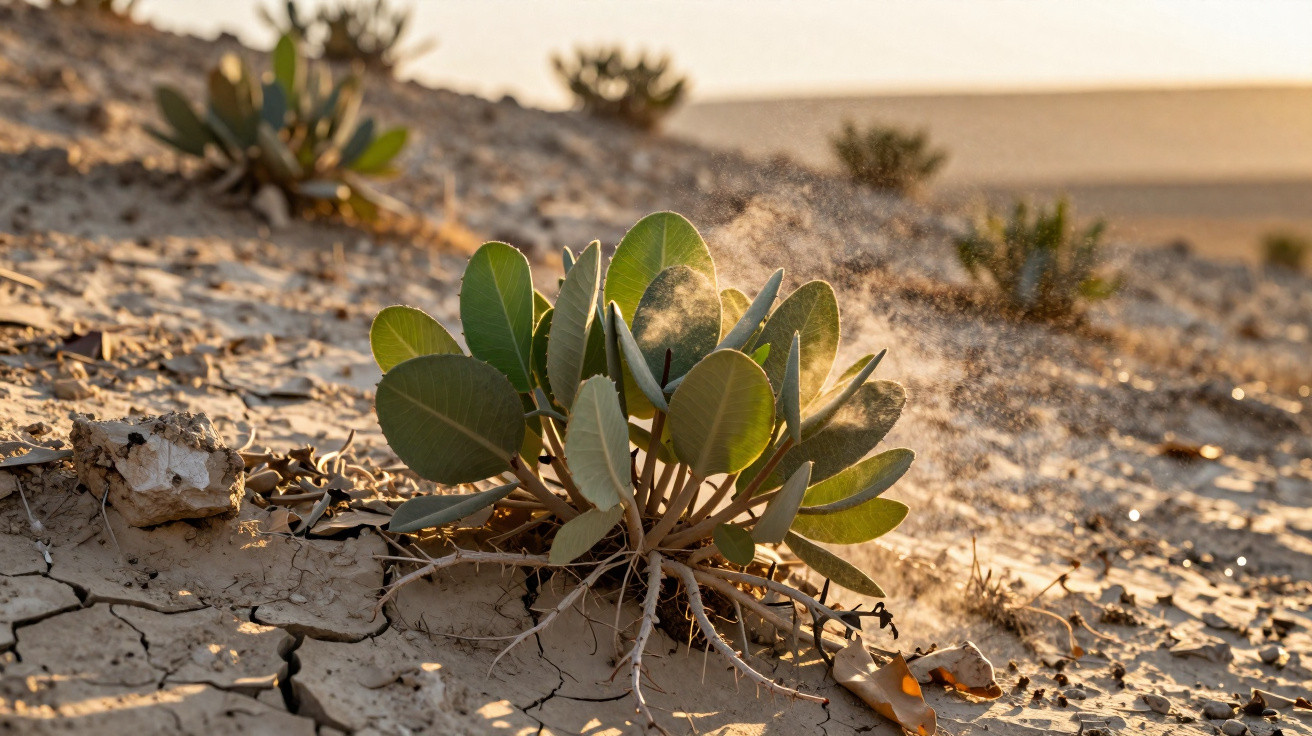
Plants can absorb nutrients from atmospheric dust directly through their leaves, rather than obtaining them solely through their roots, a new study has found.
The research shows that a short-lived dust event can provide nourishment directly, reshaping the understanding of plant nutrition in dry landscapes with poor nutrient availability.
Dust delivers micronutrients
In a Mediterranean shrubland, plants exposed to dust accumulated substantially more iron and other micronutrients than untreated shrubs growing nearby.
At the Judean Hills site in Israel, Anton Lokshin of Ben-Gurion University of the Negev connected this nutrient boost to minerals that were released and absorbed on leaf surfaces.
The rise was largely confined to the shoots, with little change seen in the roots, strengthening the evidence that the dust entered via foliage instead of the soil.
That distinction raises an important question: did the nutrients actually pass into living tissue, or did they simply remain attached to the leaf surface?
Chemical fingerprints of dust
To distinguish genuine uptake from leftover residue, the researchers followed rare earth elements, trace metals that retain chemical signatures linked to their source.
In dust-treated plants, these patterns shifted away from those of the local soil and towards the signature of the dust that had been applied.
The leaves also displayed the dust's chemical fingerprint, whereas plants receiving dust only through their roots changed very little.
This chemical evidence made straightforward surface contamination an unlikely explanation and supported the conclusion that nutrients crossed the leaf barrier.
The conversion of a dusty layer into nourishment depended on leaf-surface chemistry, rather than on the particles alone. Each of the three shrub species had mildly acidic leaves and released organic acids, small compounds that can dissolve resistant minerals.
In laboratory simulations, this fine film of moisture freed iron, manganese, zinc, magnesium, nickel and copper much more quickly than water by itself.
By contrast, the alkaline surrounding soil made many of these same nutrients more difficult to release below ground.
Roots lagged behind
Applying dust close to the roots had a far weaker effect, even when the same material was placed immediately beside the plants.
The soil spread out the particles, bound nutrients to minerals and exposed them to microbes before a shrub could take up much of their content.
Leaves bypassed this constraint because every grain encountered plant tissue first, dissolving within a thin acidic film.
This difference helps show why a dust storm can have an effect within a day, rather than only across the long timescales of soil formation.
Where airborne minerals matter most
When extended beyond the field location, the findings identified areas where airborne minerals could form an important component of plant nutrition.
The researchers calculated that dust-borne iron may provide up to 17 percent of the soil-derived supply in the western United States.
In the eastern Amazon, Saharan dust already travels across the Atlantic, while leaf uptake accounted for up to 12 percent of the soil-derived phosphorus supply.
These hotspots occurred where substantial dust deposition coincided with soils that hold limited nutrients particularly tightly.
An increase in dusty days
Yearly averages also concealed the most pronounced variation, as dust tends to arrive in short bursts instead of as a constant flow.
For Mediterranean dust days, the authors determined that daily iron and phosphorus supplied through leaves can equal or surpass the supply from soil.
Copper rose to roughly half the daily soil input, while manganese increased by a smaller yet still noticeable proportion.
“This suggests a shift from the traditionally soil-centric view of nutrient acquisition toward a vegetation-mediated pathway,” said Lokshin.
Limitations in plant growth
The additional nutrients did not rapidly produce bigger plants during the study's three-month field season.
Initial plant sizes varied, weather conditions changed, and phosphorus may move quickly through tissues rather than accumulating at the point where it enters.
Large amounts of dust can also suppress photosynthesis by shading foliage or partially obstructing stomata, the tiny pores responsible for gas exchange.
The results establish that the pathway exists, although it did not lead to marked short-term growth in this experiment.
Dust in nutrient-poor places
Phosphorus is especially significant in ecosystems that are already nutrient-limited, with parts of the Amazon providing a clear illustration.
The region's old tropical soils can contain so little phosphorus that forest productivity is directly limited.
This shortage explains why even a relatively small airborne addition could be important when leaves are able to capture it.
In nutrient-poor areas, the canopy becomes part of the nutrient supply system instead of depending on soil alone.
Future research directions
Every year, dust transports vast quantities of mineral material across land and oceans worldwide.
Should future warming, land degradation or desert expansion change these movements, leaves could either gain or lose a previously overlooked nutrient source.
Most current vegetation models direct atmospheric nutrients straight into soils, overlooking the canopy pathway revealed by the team.
Including this pathway could produce better predictions of plant growth, nutrient stress and carbon storage across dusty regions.
This study presents leaves as active surfaces that capture dust, dissolve it and transfer some of it into plant nutrition.
The next stage is to establish which species, climates and dust events make this concealed pathway most powerful, or make it detrimental.






Comments
No comments yet. Be the first to comment!
Leave a Comment