
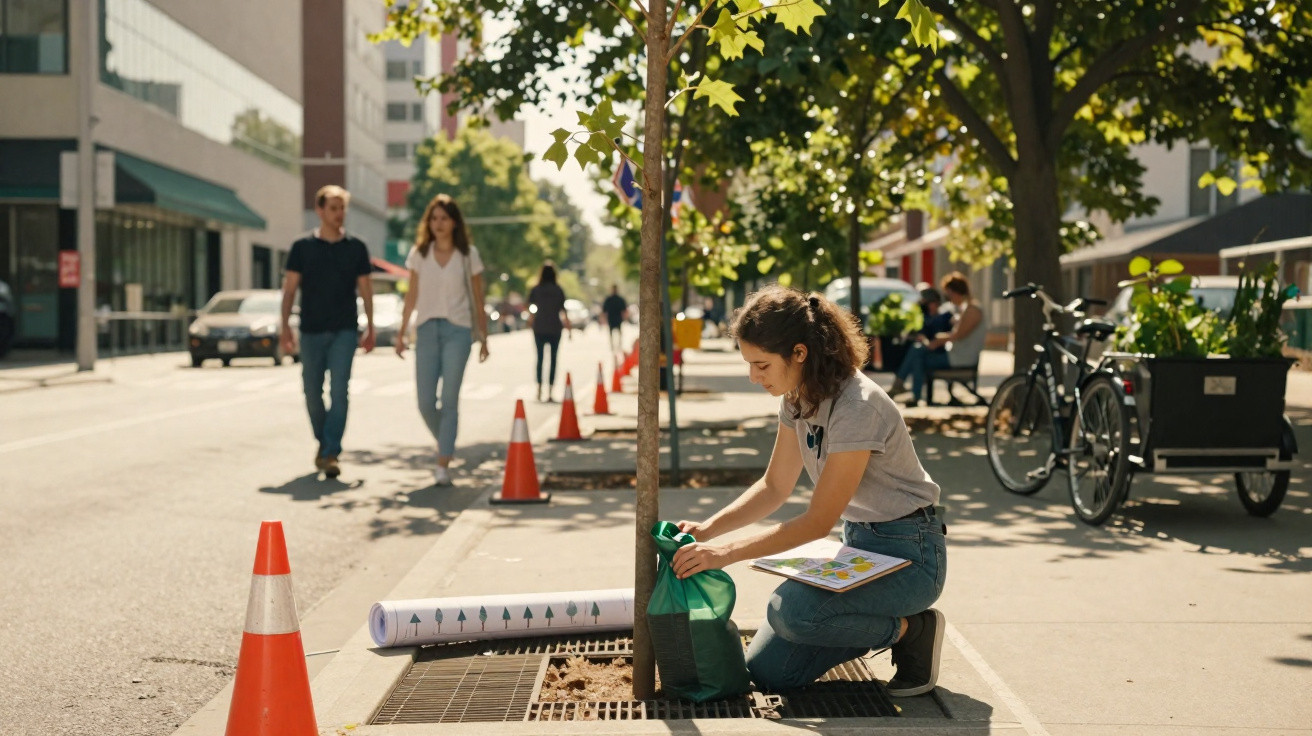
On a blisteringly hot afternoon, standing beneath a large mature tree makes one point that urban planners are only beginning to recognise: shade is not merely ornamental. It performs an essential function.
Trees lower temperatures along the street, intercept rainwater before it overwhelms roads, and filter pollutants from the air people breathe.
A new paper, produced by more than 60 scientists from dozens of countries, argues that most cities remain reluctant to regard trees as the vital infrastructure they plainly represent.
The research team is headed by Manuel Esperon-Rodriguez of Western Sydney University and Bangor University, while Mark G. Tjoelker of Western Sydney University is the senior author.
Mature trees need decades to grow
A young tree can be planted in 20 minutes, but developing a proper canopy that provides meaningful neighbourhood cooling requires decades.
When a mature tree is felled, therefore, a city loses far more than one tree. It gives up 30 or 40 years of built-up shade, habitat and carbon storage, none of which can be replaced quickly.
Yet trees continue to lose these disputes. Developers remove them because doing so is cheaper and quicker, while sanctions for unlawful felling are frequently too mild to deter anyone.
Municipal budgets often pay for the publicity of a planting ceremony, rather than the years of watering, pruning and pest control needed to ensure a tree survives.
The researchers call for stronger enforcement, meaningful tax incentives for landowners who retain mature trees, and legally mandated minimum canopy requirements instead of voluntary commitments.
They also propose redesigning major infrastructure schemes – projects that commonly clear everything in their route – so that they create canopy rather than destroy it.
Shade is not shared equally between neighbourhoods
In almost every location examined by researchers, affluent neighbourhoods are generally far leafier than poorer areas.
At the same time, lower-income communities typically endure the greatest heat and the most polluted air.
Put simply, trees are often concentrated in precisely the places where they are least necessary.
Addressing this inequality requires more than a citywide average that obscures the most disadvantaged streets.
Greening neighbourhoods without forcing residents out
The authors advocate setting goals for each individual neighbourhood.
They also say that local residents, including Indigenous communities, should help determine what is planted and where, rather than having greening decisions imposed by a planning office.
There is another concern: extensive tree planting without a considered strategy can cause green gentrification, increasing rents and displacing the very people intended to gain from the new trees.
According to the researchers, the only genuine solution is to connect tree policy directly with housing policy, rather than leaving them as separate departments that do not communicate.
Urban forests barely feature in climate policy
Considering the scale of the benefits trees provide, their near absence from the major climate and biodiversity agreements that direct funding and political momentum is striking.
The authors want urban forests to be explicitly included in national climate plans, biodiversity strategies and the pledges nations make through frameworks such as the Paris Agreement.
Funding remains the central obstacle. The estimated worldwide cost of nature-based climate solutions, including urban forests, exceeds $500 billion annually.
Much existing finance pays only for the ceremonial moment when a tree is planted, then ends there. This leaves the decades of maintenance that decide whether the tree lives without funding and often overlooked.
The study identifies emerging mechanisms, including green bonds, biodiversity credits and monitoring initiatives such as Tree Cities of the World, as potential ways to narrow that shortfall instead of treating tree funding as a one-off cost.
Many cities do not maintain tree records
Perhaps the most unexpected conclusion is not political but practical. Many cities simply lack reliable records of the trees they own.
They do not monitor which newly planted saplings survive their first few summers, which species are under pressure, or how unevenly canopy cover is distributed across the city.
Without such data, cities are largely guessing about whether their tree policies achieve anything.
The scientists recommend more affordable and precise methods – including satellite imagery and AI-assisted monitoring – to address this information gap, particularly in less wealthy cities.
City trees need greater diversity
The team highlights a less obvious threat as well: using the same small number of species street after street. Although it may appear orderly, this approach is vulnerable.
A single pest or disease arriving at the right moment could eliminate an entire city canopy in one outbreak.
Instead, the researchers say cities should broaden the range of trees they plant. Non-native species may have a role where they are suited to a hotter, drier future.
However, cities should still give priority to native trees and take account of the ecological and cultural setting of every location.
An urgent issue
Urban trees are not an optional extra to be financed only once the “real” priorities have been met.
They already serve as public health policy, climate protection and neighbourhood equity, whether or not they are funded or viewed in those terms.
The authors do not present this as a far-off concern. Cities are continuing to expand, while heatwaves are becoming more severe.
Consequently, choices made today – over which trees remain standing and which neighbourhoods retain their shade – will quietly determine how liveable those cities are for decades after today’s decision-makers have gone.

Comments
No comments yet. Be the first to comment!
Leave a Comment