
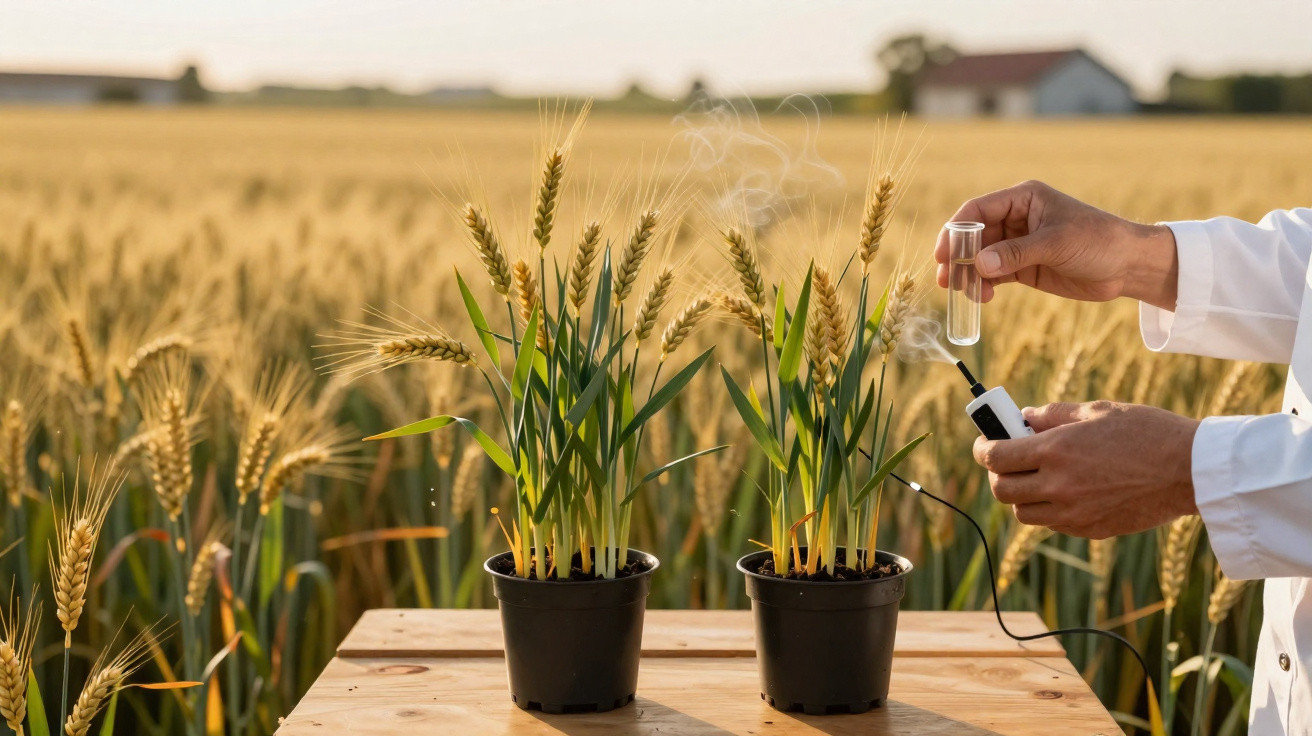
A field can appear peaceful at first: leaves flutter in the breeze, stems lean towards the sun and roots spread unseen below ground. Yet an invisible exchange is taking place in the air.
As part of their ordinary lives, plants emit minute chemical compounds. Other plants nearby can detect certain compounds and react to them.
Scientists have long understood that plants can issue warning signals when insects attack.
However, new research from the Swedish University of Agricultural Sciences points to a broader role: healthy plants may use airborne signals to assess the way neighbouring plants are growing.
In other words, they may get ready for competition before it actually starts.
Plants communicate beyond danger
Plant communication is commonly viewed as an emergency response. When one plant is attacked, it releases chemicals that prompt nearby plants to prepare their defences.
That process does occur, but the new study examined a different type of signal.
Healthy, undamaged plants also give off volatile organic compounds, known as VOCs. These chemicals travel through the air.
They are a routine part of plant biology rather than being produced only in response to threats.
Everyday plant signals
The researchers set out to establish whether these routine chemical emissions influence neighbouring plants.
“Healthy non-damaged plants are constantly releasing their own chemical ‘fingerprint’ into the air, and their neighbors actively read these signals to adjust not only their defenses, but their entire growth strategy,” said Dr. Velemir Ninkovic, lead author of the study.
“This is like a continuous conversation between neighbors, and the finding that these background VOCs can reshape growth and gene activity opens up a new dimension in how we understand plant communication.”
A straightforward barley experiment
The team investigated three barley cultivars: Fairytale, Luhkas and Salome.
They provided a useful comparison because their growth rates differ. Fairytale is slow growing, Salome grows quickly, and Luhkas falls between the two.
Plants were positioned in transparent chambers, allowing air and the chemical signals it carried to pass from one plant to another.
However, the plants could neither make contact nor share soil. Their roots were unable to interact.
This arrangement allowed the scientists to isolate a clear question: how does a plant respond when it is exposed solely to another plant’s airborne chemicals?
Neighbouring scents altered plant growth
The findings were notable. Slow-growing Fairytale plants grew more and gained biomass after receiving VOCs from fast-growing Salome plants.
Conversely, fast-growing Salome plants grew less when exposed to VOCs from slow-growing Fairytale.
Luhkas, the intermediate grower, produced less pronounced effects. Plants exposed to signals from a cultivar with a comparable growth rate showed little change.
This indicates that the responses were not random. Instead, plants appeared to react to the type of neighbour beside them.
Growth comes with trade-offs
Plants have a finite supply of energy. They may direct it towards becoming larger or towards defending themselves against insects, disease and stress.
They cannot invest all of their resources in every function at the same time. Fast-growing plants generally put more into size and rapid development.
Slow-growing plants generally devote more to defence.
Plants may anticipate competition
According to this study, plants may use scent to assess the type of neighbour they are facing.
Where a neighbour appears likely to grow rapidly and compete for light or nutrients, a plant may also accelerate its own growth.
Where a neighbour appears slower and more focused on defence, the plant may instead direct more energy towards protection.
“VOC receiver plants adjusted their growth to match the competitive pressure signaled by their neighbor’s scent: they grew more when exposed to a fast-growing neighbor and less when exposed to a slow-growing one,” said Dr. Ninkovic.
“This effect was seen consistently across all parts of the plant leaves, stems, and roots rather than the plant simply reshuffling resources between its parts.”
Genes followed the same pattern
The researchers also examined gene activity.
This was significant because it showed that the differences in growth were not merely superficial. The plants were being altered internally.
When Fairytale received signals from fast-growing Salome, numerous genes associated with stress and defence became less active. This suggested that the plant was shifting energy towards growth.
When Salome received signals from slow-growing Fairytale, more than 2,000 genes became more active. Many of these were connected with DNA replication, protein activity and defence-related processes.
The plants were therefore doing more than growing differently: chemical information from their neighbours was altering their internal biology.
Each barley cultivar has a distinct scent
The team next analysed the chemical blend emitted by each barley cultivar.
They identified 115 volatile compounds. Each cultivar produced its own chemical profile, much like a scent signature.
A computer model identified the cultivar responsible for each chemical sample with 93.1 percent accuracy, showing that the differences were distinct and substantial.
Fairytale emitted greater amounts of benzyl nitrile, a compound associated with insect-repellent effects. Salome contained higher levels of 1 octen 3 ol. Nonanal occurred more frequently in Fairytale and Luhkas than in Salome.
Such chemical variation may enable nearby plants to recognise whether a neighbour is more focused on growth or on defence.
Competition may begin early
It is usually simple to imagine plant competition. Roots vie for water, leaves compete for sunlight, and taller plants cast shade over shorter ones.
Yet the study indicates that competition could begin before any of these interactions take place.
A plant may detect a fast-growing neighbour through the air and start adjusting its growth pattern before direct competition begins. Chemical clues may help it prepare for future pressure.
This presents plant life as far more active than previously assumed.
Plants have no brains and do not think in the way animals do. Nevertheless, they can detect information, react to it and alter the way they allocate resources.
How barley VOCs could affect farming
The findings could have implications for agriculture.
Farmers frequently plant a single crop variety throughout a field. Increasingly, though, researchers are exploring cultivar mixtures as a way to improve resilience and cut pesticide use.
So far, cultivar selection has largely concentrated on visible characteristics, including growth rate, disease resistance and root depth.
The study indicates that chemical compatibility may be another important consideration.
If crop varieties influence one another through airborne signals, an appropriate mixture might enhance growth, defence or pest resistance. An unsuitable combination could lower performance.
Further research is required before farmers can apply the approach widely, but it offers an intriguing direction for crop science.
Chemicals that transmit messages
VOCs may be among the principal means by which this information is transferred.
Rather than simply being waste products, these chemicals can convey meaningful signals. They may influence growth, defence and gene activity.
“Plants release a rich blend of volatile compounds as a normal part of their biology, and it would make evolutionary sense for neighbors to have developed the ability to pick up on each other’s chemical signals over millions of years of co-existence,” said Dr. Ninkovic.
“We believe this type of constitutive VOC interaction may likely be widespread across the plant kingdom, though the specific compounds involved and the strength of the response will probably vary greatly between species.”


Comments
No comments yet. Be the first to comment!
Leave a Comment